


Building Better Commodity Portfolios – Part 3 Diversification Beyond Markets (Diversification Is More Than Counting Commodities)
Dual Edge Research publishes two powerful newsletters that work great individually — and even better together. The Bull Strangle Newsletter focuses on stocks and options, combining stock ownership with premium-selling strategies to generate consistent income and market-beating returns. The Smart Spreads Newsletter specializes in seasonal commodity futures spreads, offering a diversified approach with low correlation to equities. Together, they deliver a complete investment perspective — one focused on income, the other on diversification — all under one simple subscription.
Introduction
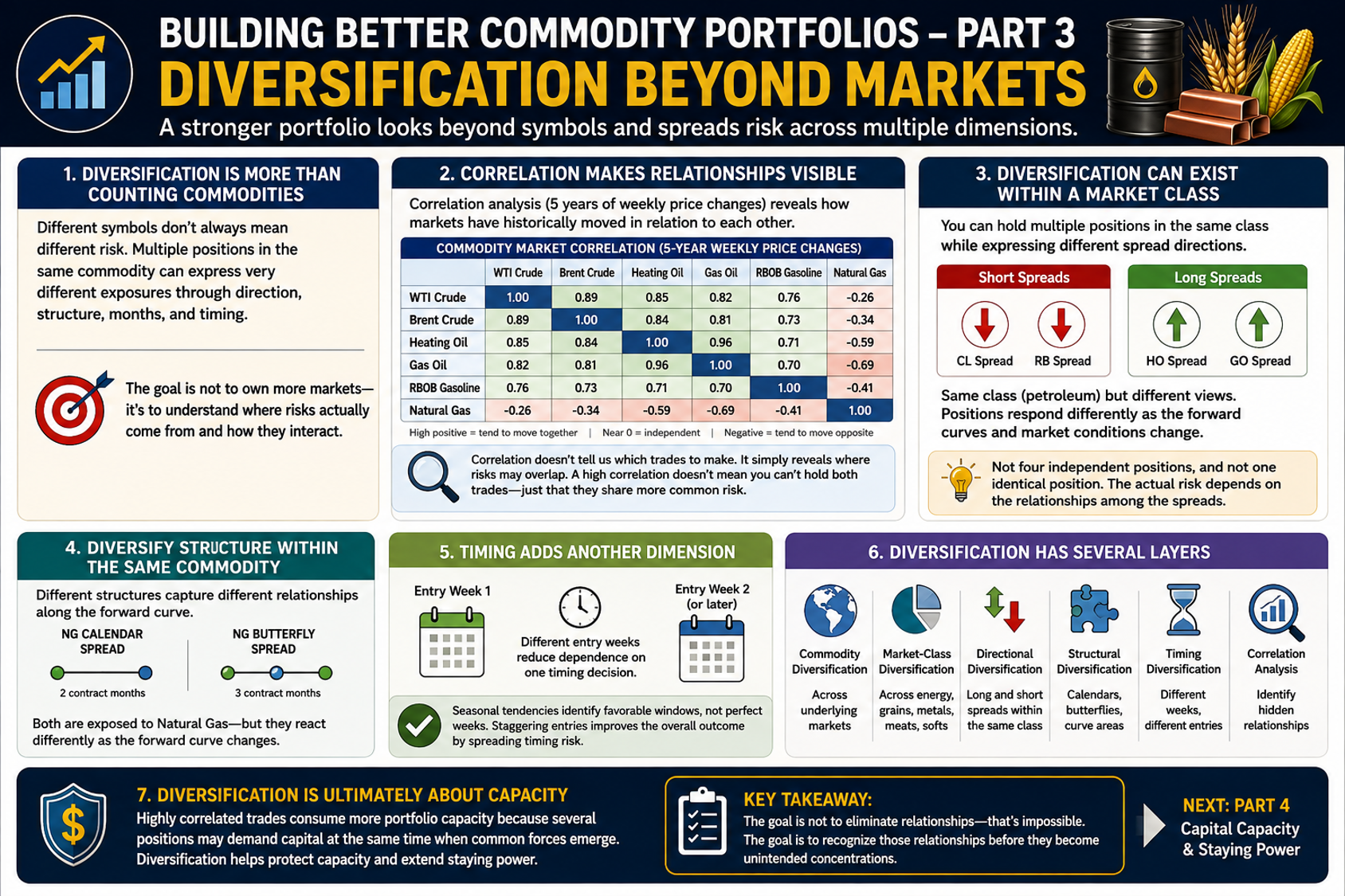
Diversification sounds simple: avoid concentrating too much capital in a single market and spread positions across different commodities. That is a useful starting point, but commodity spread portfolios require a deeper approach. A portfolio containing crude oil, Brent crude, heating oil, gasoline, and gas oil technically contains five different markets. Yet those markets are influenced by many of the same forces and frequently move together. Five different symbols do not necessarily represent five independent sources of risk.
The opposite can also be true. Multiple positions within the same commodity class—or even the same underlying commodity—can sometimes express meaningfully different exposures through direction, spread structure, contract months, and entry timing. The objective is therefore not simply to own more markets. It is to understand where the portfolio's risks actually come from and how those risks interact.
Correlation Makes the Relationships Visible
One way to move beyond market labels is through correlation analysis. In Trading Commodity Spreads, I analyzed weekly price changes over five years across major commodity markets. The purpose was not to create a mathematical optimization model, but to make relationships among markets more visible. Correlation provides an objective measure of whether markets have historically tended to move together, independently, or in opposite directions.
The energy markets provide an excellent example. The analysis showed an 89% correlation between WTI Crude Oil and Brent Crude, while Heating Oil and Gas Oil had a 96% correlation. These relationships make intuitive sense. Petroleum products share crude-oil inputs and are affected by many of the same supply, refining, inventory, and global demand forces. Natural Gas was very different. Its correlations with the petroleum markets ranged from -26% to -69% in the analysis, reflecting a market driven much more heavily by weather, storage, and regional supply conditions.
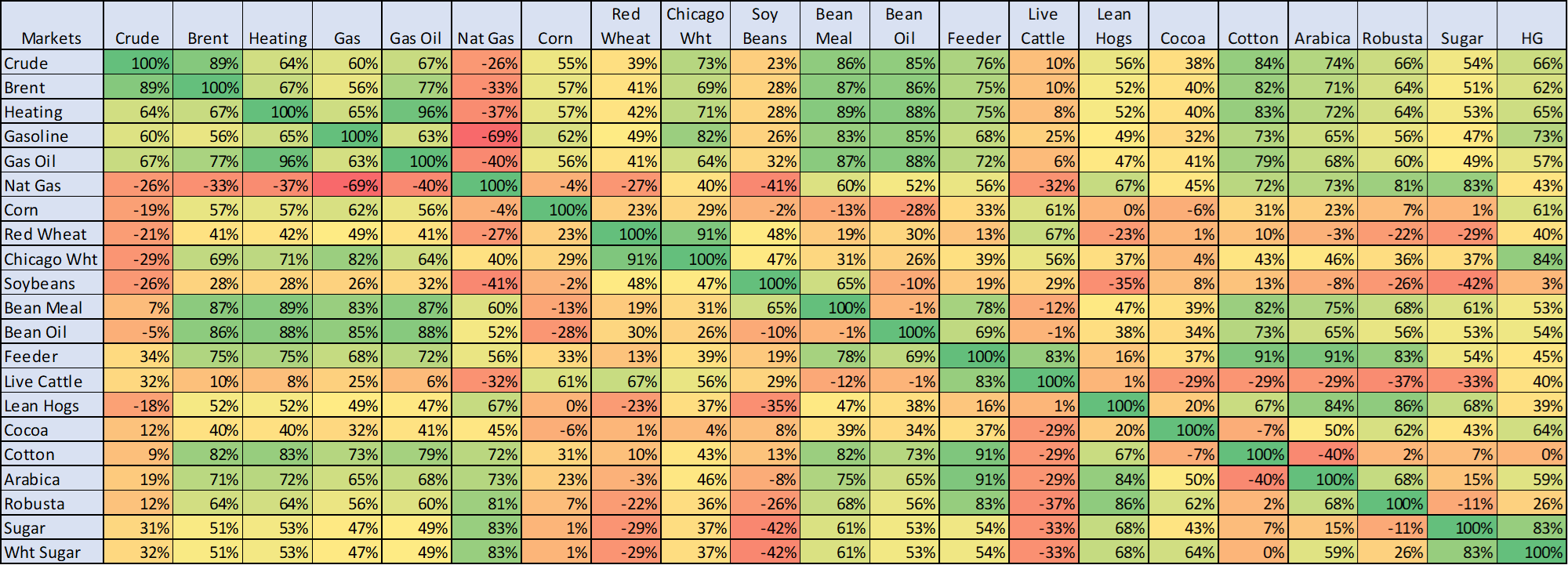
The table adds an important layer to portfolio construction. Holding WTI and Brent should not necessarily receive the same diversification credit as holding two historically unrelated markets. Likewise, Heating Oil and Gas Oil should not be automatically treated as independent exposures simply because they trade under different symbols. Correlation does not tell us which trades to make, and a high correlation does not mean two trades should never be held together. It simply helps reveal where risks may overlap.
Diversification Can Exist Within a Market Class
Correlation also demonstrates why diversification should not be reduced to rigid sector limits. I might hold several positions within the petroleum complex, for example, while expressing different spread directions. A portfolio could be short CL and RB spreads while simultaneously long HO and GO spreads. From a simple market-class perspective, that portfolio is heavily concentrated in petroleum. But the positions are not all expressing the same spread view.
That distinction matters. A fundamental development affecting petroleum markets could influence all four positions, so the portfolio clearly retains significant common exposure. At the same time, opposing spread directions may cause individual positions to respond differently to changes in the forward curves. The correct conclusion is therefore neither "four energy trades equal four independent positions" nor "four energy trades equal one identical position." The actual risk lies somewhere between those extremes and depends upon the relationships among the spreads themselves.
This is an important limitation of using correlations among the underlying commodity markets. The correlation table provides valuable information about common market drivers, but Smart Spreads trades relationships between contract months rather than outright commodity prices. Two highly correlated underlying markets can still produce different calendar-spread behavior. Correlation should therefore be viewed as another portfolio tool rather than a rigid trading rule.
Diversifying Structure Within the Same Commodity
Diversification can go another step deeper. Multiple trades in the same commodity do not necessarily have to use the same spread structure. Natural Gas provides a good example. I frequently may hold an NG calendar spread and an NG butterfly spread at the same time. Both positions remain exposed to Natural Gas, so calling them completely independent would clearly be misleading. However, they are not identical trades.
A calendar spread measures the relationship between two contract months, while a butterfly uses three contract months and captures a different relationship along the forward curve. The positions can therefore respond differently as the shape of that curve changes. This provides structural diversification within the same underlying market. It does not eliminate Natural Gas risk, but it avoids concentrating all exposure in a single structure.
Timing Adds Another Dimension
There is another important difference in how I typically build these related positions: I generally do not add them during the same week. If I establish one NG calendar spread this week, and NG butterfly spread weeks later, the overall Natural Gas allocation will be diversified not only by contract structure but also by entry timing.
This reduces dependence on a single entry point. Seasonal analysis can identify historically favorable windows, but it cannot tell us that one particular day or week will provide the best entry. Markets can move temporarily against a position immediately after entry even when the broader seasonal tendency ultimately develops as expected. Establishing related exposure at different times means the entire allocation is not dependent on the market conditions that existed during a single entry week.
Diversification Has Several Layers
These examples demonstrate why I think diversification in a commodity spread portfolio should be viewed across several dimensions. Commodity diversification distributes exposure among underlying markets. Market-class diversification spreads risk among groups such as energy, grains, metals, meats, and soft commodities. Directional diversification recognizes that long and short spread positions can express different views within the same class. Structural diversification distributes exposure among different calendar spreads, butterflies, or portions of the forward curve. Timing diversification avoids establishing all related exposure during the same period. Finally, correlation analysis provides an objective way to identify markets that may share more underlying risk than their different names suggest.
None of these measures should be used independently. A portfolio with positions in ten different commodities can still contain substantial common risk. Conversely, several positions within a single commodity class may be more diversified than a simple sector count would suggest. The goal is not to eliminate relationships among positions. That would be virtually impossible. The goal is to recognize those relationships before they become unintended concentrations.
Diversification Is Ultimately About Capacity
This brings diversification back to the larger portfolio framework. Highly correlated trades consume more portfolio capacity than unrelated trades because several positions may demand capital simultaneously when common market forces emerge. Correlation and diversification therefore matter not simply because a portfolio looks better balanced, but because they influence how much risk the portfolio can comfortably carry.
That leads directly to Part 4. Even after selecting attractive trades, sizing them appropriately, and diversifying exposure across markets, structures, directions, and time, there is still a limit to how much can safely coexist. In the next part, we will examine capital capacity and staying power—why the amount of capital a portfolio can deploy can be very different from the amount it should deploy, and why leaving capital unused can be one of the most important risk-management decisions a spread trader makes.
Additional Details
The Bull Strangle Newsletter focuses on stocks and options, combining stock ownership with disciplined option-selling techniques designed to generate consistent income while managing risk.
The Smart Spreads Newsletter focuses on seasonal commodity spreads, a historically proven approach that seeks opportunities across agricultural, energy, metal, and financial futures markets.
Each strategy is designed to stand on its own, but together they provide a diversified approach that can perform across a wide range of market environments. For traders looking to deepen their education, The Bull Strangle Strategy and Trading Commodity Spreads, both available on Amazon.
Visit BullStrangle.com to subscribe for just $1 for the first month.
For a video overview of the Bull Strangle Newsletter
For a video overview of the Smart Spreads Newsletter
Darren Carlat
Dual Edge Research
(214) 636-3133
DualEdgeResearch@gmail.com
Disclaimer
This information is for informational purposes only and should not be considered as investment advice. Past performance is not indicative of future results, and all investments carry inherent risk. Consult with a financial advisor before making any investment decisions.