


Coupang (CPNG) Stock Still Looks Cheap After A 53% Fall
Coupang’s stock has had a rough run over the past year, yet the current share price screens as cheap on both an intrinsic value check and on market multiples. That mix of a long slide and a high conviction undervaluation signal is what matters for anyone trying to work out what the stock is really worth today.
- The share price has fallen about 53.3% over the past year, which means the market has already priced in a lot of pessimism.
- Coupang’s ability to grow cash flow from its e-commerce and related services may support the valuation case, while any setback in margins or cash generation would quickly weaken it.
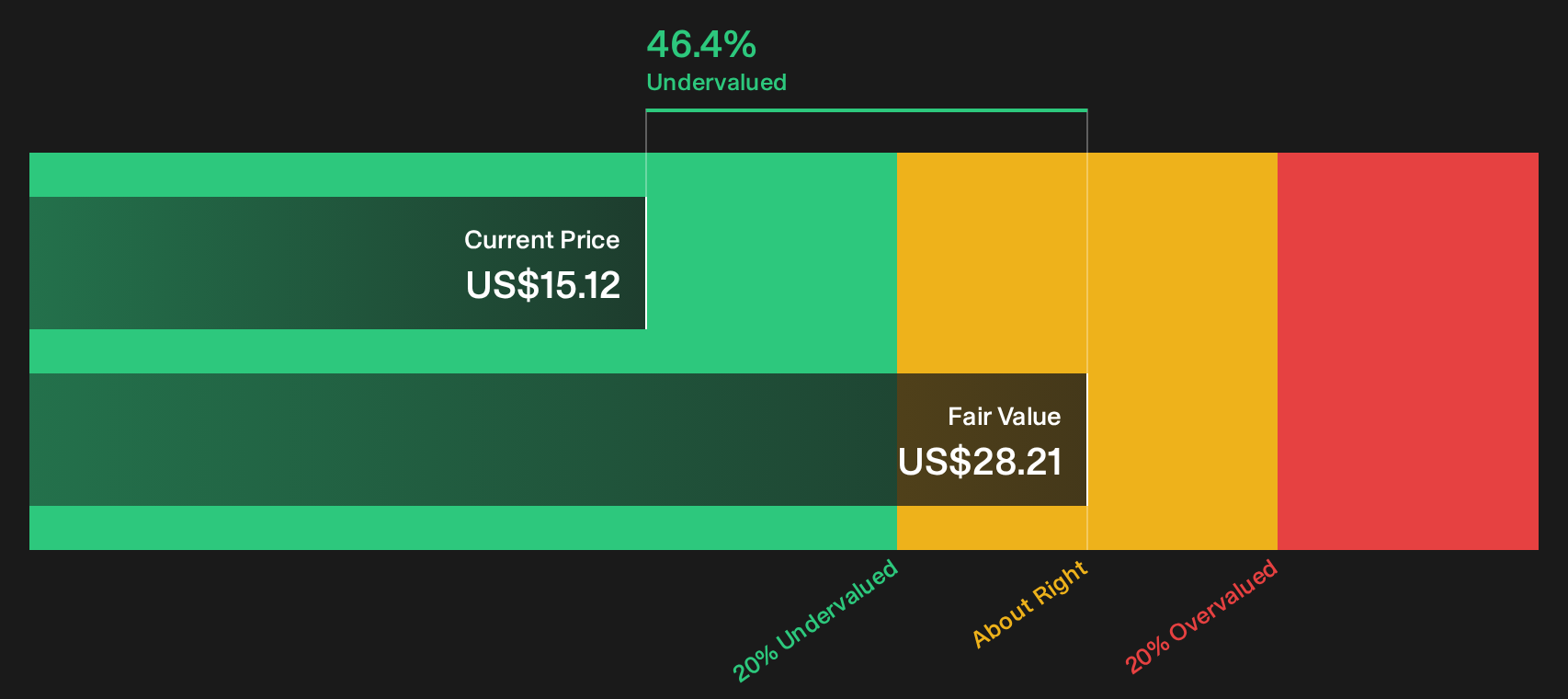
- The broader checks lean cheap, with Coupang scoring strongly on value screens and an intrinsic value estimate from a Discounted Cash Flow (DCF) suggesting the shares trade at about a 46.4% discount to that fair value, as outlined in the valuation score of 5.
The issue now is whether Coupang’s current price reflects a genuine bargain on long term cash flows or simply a fair response to the risks in the business model.
Scan for other deep value setups like Coupang’s by checking 31 high quality undervalued stocks, which has been pre-filtered for quality and balance sheet strength.
Is Coupang a Bargain on Cash Flow?
The Discounted Cash Flow model values Coupang by projecting future free cash generation and discounting it back to today. On the latest twelve month numbers, Coupang produced about $241.7 million of free cash flow, so this is not a story built on hypothetical profitability alone.
Analysts feeding into this framework expect free cash flow to grow from this base. The 2 Stage Free Cash Flow to Equity setup reflects that with a rising stream of projected cash flows before a steadier phase. On those assumptions, the model points to an intrinsic value of about $28 per share, which implies a 46.4% gap between that estimate and the current price. If Coupang can keep turning projected cash generation into actual cash in the amounts implied, the current market valuation looks disconnected from what the Discounted Cash Flow model suggests.
On this cash flow view, Coupang screens as undervalued relative to the intrinsic value implied by the Discounted Cash Flow model.
Our Discounted Cash Flow (DCF) analysis suggests Coupang is undervalued by 46.4%. Track this in your watchlist or portfolio, or discover 31 more high quality undervalued stocks.
Is Coupang Still Cheap on Sales?
P/S fits Coupang because revenue is the main yardstick investors use for fast scaling retailers that are still building consistent earnings.
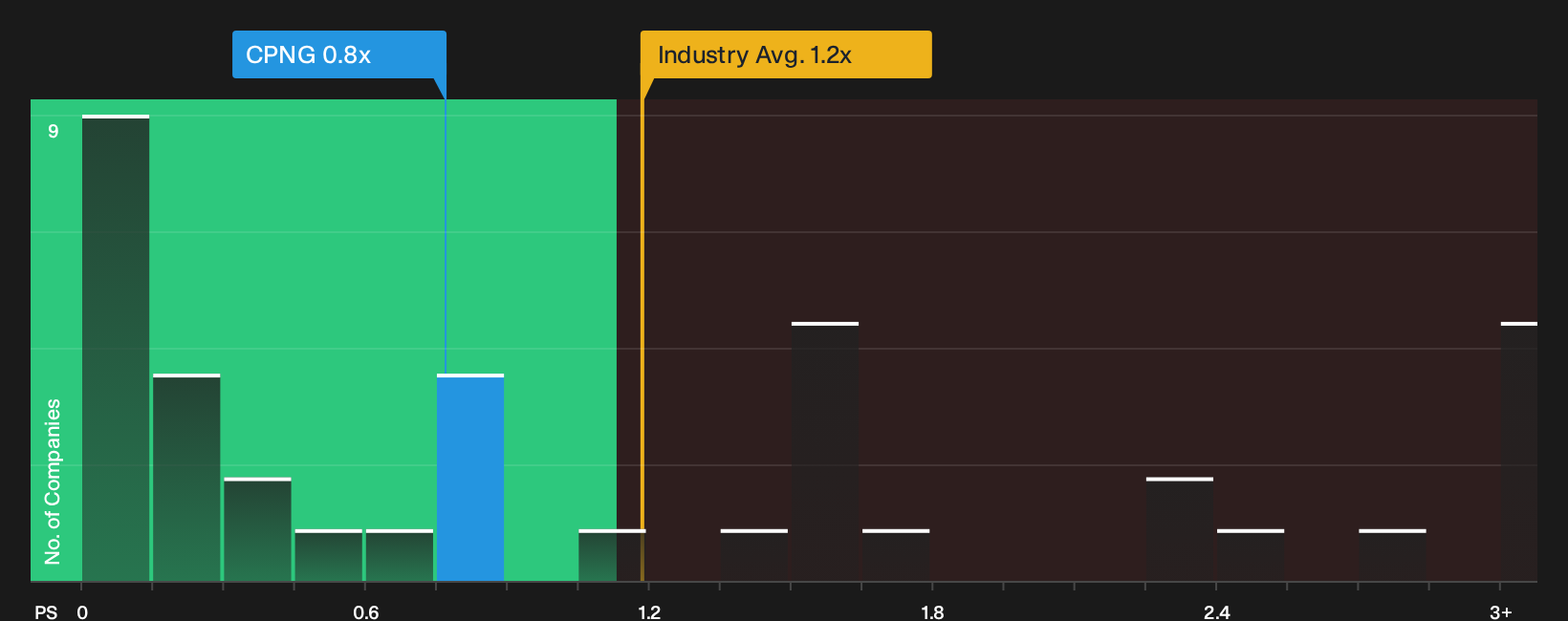
Coupang trades on a P/S ratio of about 0.8x, which is below both the Multiline Retail industry average of roughly 1.2x and the broader peer group near 2.0x. The fair P/S ratio implied by the model is about 1.2x, which is closer to those benchmarks and higher than where the shares change hands today.
That gap means the stock is priced as if its sales stream deserves a discount to what the model suggests for a business with Coupang’s profile. If the market eventually prices the shares closer to the implied fair P/S level rather than the current sub 1x multiple, the valuation gap on this metric would narrow.
On this sales multiple, Coupang looks undervalued relative to both its industry and the model’s fair P/S benchmark.
See what the numbers say about this price — find out in our valuation breakdown.
The Coupang Narrative: What Would Justify Today's Price?
Coupang’s valuation story only makes sense once the future is spelled out. Simply Wall St Narratives, which sit on Coupang’s Community page, turn that puzzle into a set of explicit paths for growth, margins and earnings that would need to hold for the stock to be worth materially more or materially less than today’s price. Where a single ratio or model gives one neat figure, these narratives describe the future that number depends on so you can track whether reality matches it.
Community views on Coupang are miles apart, with one side leaning into efficiency upside and the other fixated on rising structural costs and regulation.
Bull case: 36% undervalued
"Ongoing investments in automation, AI, and logistics technology are already driving major improvements in operational efficiency and gross margins, and management sees significant further upside as these technologies are scaled..."
Read the full Bull Case to see why Coupang could be undervalued
Bear case: roughly fairly valued
"Coupang's long-term profitability is threatened by rising labor costs and the demographic challenges in South Korea, such as a shrinking workforce, which will significantly elevate operating expenses and strain last-mile logistics, leading to compressed net margins regardless of near-term gains in automation or process improvements..."
Read the full Bear Case to see why Coupang could be overvalued
Do you think there's more to the story for Coupang? Head over to our Community to see what others are saying!
The Bottom Line
Coupang screens as undervalued on both the Discounted Cash Flow (DCF) intrinsic value estimate and the P/S comparison against peers, so the current discount is not just a single model quirk. The valuation gap only closes if the business keeps converting its scale into durable cash generation while sustaining a revenue profile that earns at least a peer-level multiple. Everything turns on that execution question. If profitability and cash flow delivery stall or structural costs bite harder than expected, the present markdown may prove closer to fair than to an enduring bargain.
This article by Simply Wall St is general in nature. We provide commentary based on historical data and analyst forecasts only using an unbiased methodology and our articles are not intended to be financial advice. It does not constitute a recommendation to buy or sell any stock, and does not take account of your objectives, or your financial situation. We aim to bring you long-term focused analysis driven by fundamental data. Note that our analysis may not factor in the latest price-sensitive company announcements or qualitative material. Simply Wall St has no position in any stocks mentioned.
Have feedback on this article? Concerned about the content? Get in touch with us directly. Alternatively, email editorial-team@simplywallst.com