


Is Artisan Partners Asset Management (APAM) Stock A Bargain Or Fully Priced?
Artisan Partners Asset Management stock has fallen over recent months, yet several valuation checks suggest the shares may be pricing in more caution than the business fundamentals imply. After a three year gain of 30.7%, the recent pullback leaves investors weighing a cheaper entry point against the usual uncertainties around future fee income and fund flows.
- Over the past 3 years, Artisan Partners Asset Management has returned 30.7%, which points to meaningfully positive longer term performance despite weaker recent returns.
- The fee based asset management model can support earnings if client assets remain resilient. However, any sustained outflows or pressure on performance fees may weigh heavily on future cash generation.
- The broader valuation checks lean cheap, with the stock screening as undervalued on most measures, and a high value score of 5 that aligns with an Excess Returns intrinsic value estimate suggesting a sizeable discount to fair value.
For investors, the debate is whether Artisan Partners Asset Management’s recent share price weakness already reflects the key business risks or if the intrinsic value gap still leaves too little compensation for them.
Capture the recent pullback in Artisan Partners Asset Management, and then widen your hunting ground with 31 high quality undervalued stocks, which shares a similar value tilt.Is Artisan Partners Asset Management a Bargain on Excess Returns?
The Excess Returns model estimates what Artisan Partners Asset Management can earn above its cost of equity on each dollar of shareholder capital. It then prices those surplus profits over time into a per share value.
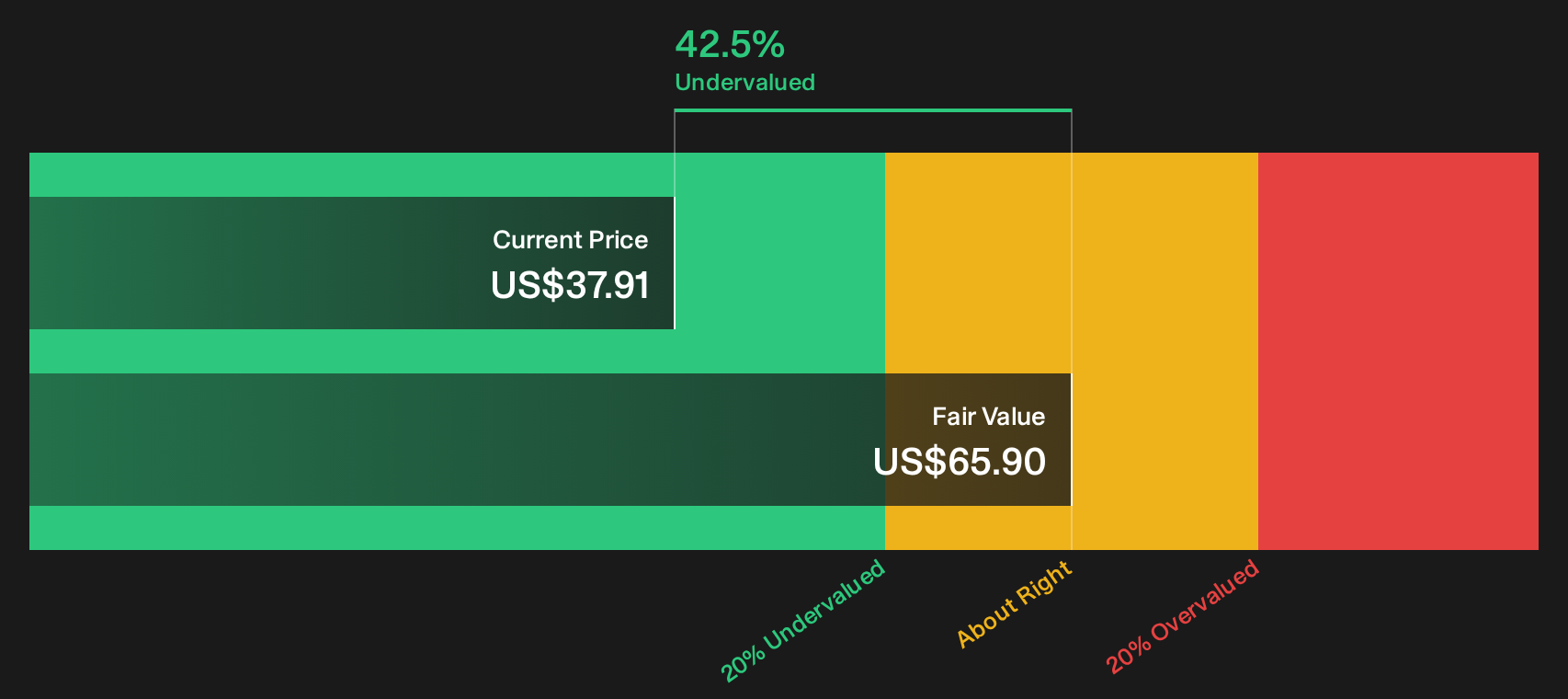
For Artisan Partners Asset Management, the key input is a high average return on equity of 57.48% on a stable book value base of $5.31 to $5.92 per share. That supports a stable EPS estimate of $3.05 per share, while the cost of equity is put at $0.43 per share. The gap between these numbers produces an excess return of $2.63 per share, which the model capitalises into an intrinsic value of about $65.90 per share.
Set against the current market price, that Excess Returns output suggests the stock is about 42.5% undervalued. In other words, the market appears to be assigning a much lower value to the firm’s ability to earn above its equity cost than this framework indicates.
On these Excess Returns assumptions, Artisan Partners Asset Management appears undervalued relative to its estimated intrinsic worth.
Our Excess Returns analysis suggests Artisan Partners Asset Management is undervalued by 42.5%. Track this in your watchlist or portfolio, or discover 31 more high quality undervalued stocks.
Is Artisan Partners Asset Management Still Cheap on Earnings?
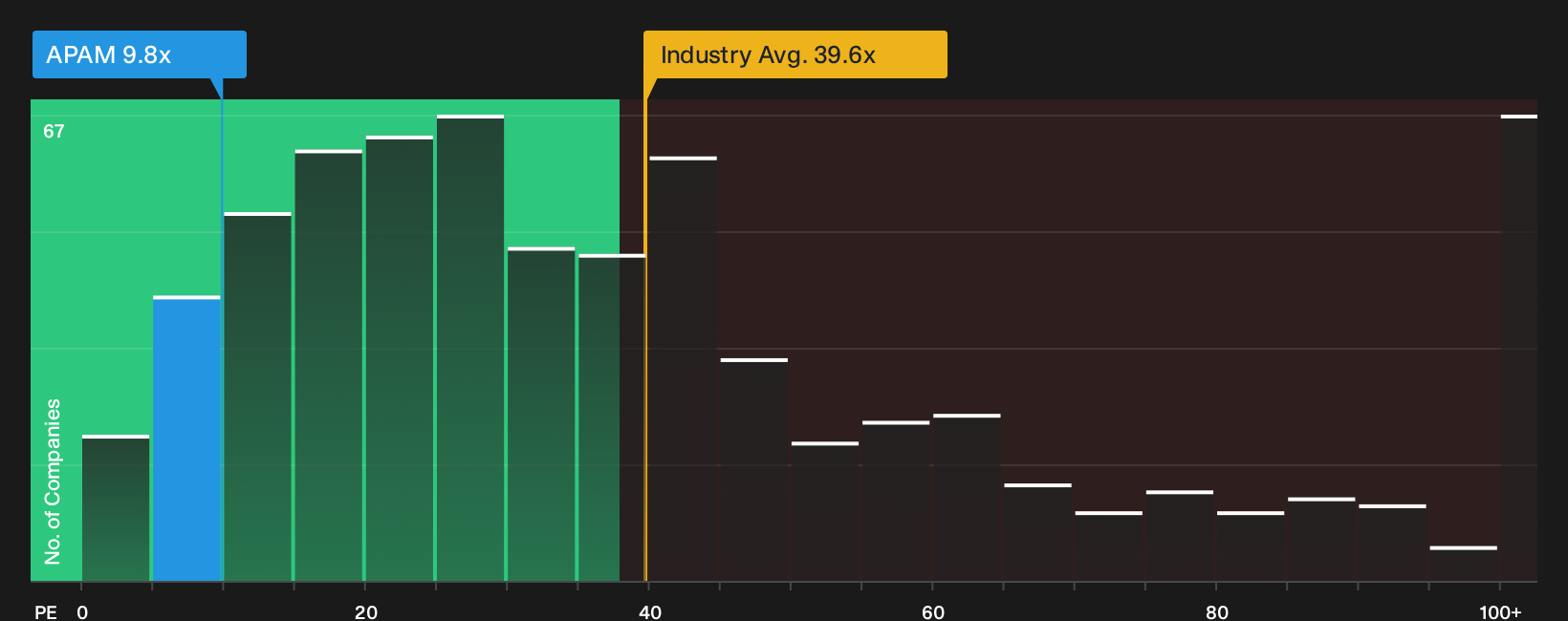
For Artisan Partners Asset Management, a P/E check fits neatly because the business is built around relatively consistent fee based earnings. The current P/E of about 9.8x sits well below both the broader Capital Markets industry average of roughly 39.6x and a peer group closer to 17.2x.
The fair P/E ratio implied by the model is 11.0x, which is above where the stock trades today. That gap indicates the market is assigning a lower earnings multiple to Artisan Partners Asset Management than the framework would expect based on its profile and risks. For investors comparing entry points, the current P/E represents a discount to that fair ratio.
On this P/E yardstick, Artisan Partners Asset Management appears undervalued relative to what the model treats as a reasonable multiple for its earnings.
See what the numbers say about this price — find out in our valuation breakdown.
The Artisan Partners Asset Management Narrative: What Would Justify Today's Price?
Narratives on Artisan Partners Asset Management pick up where the valuation checks leave off by spelling out what future growth, margins and earnings would need to look like for the current share price to move meaningfully higher or lower. Rather than just offering a single output from a ratio or model, they unpack the specific business path that number rests on so you can monitor whether Artisan Partners Asset Management's actual progress tracks that story over time on Simply Wall St's Community page.
Community views on Artisan Partners Asset Management split around how much its expansion and capital allocation really support the current valuation.
Bull case: roughly fairly valued
"By having a strong liquidity position and maintaining a disciplined approach towards expenses, including variable expenses adjusting with revenues, Artisan Partners is well-positioned to sustain profitability and protect or improve net margins..."
Read the full Bull Case to see why Artisan Partners Asset Management could be undervalued
Bear case: 8% overvalued
"Although the build out of credit and alternatives is gaining traction, continued equity outflows of $15.6b and client reallocations away from active strategies could limit the benefit of multi asset diversification, which may cap future revenue growth and fee mix improvement..."
Read the full Bear Case to see why Artisan Partners Asset Management could be overvalued
Do you think there's more to the story for Artisan Partners Asset Management? Head over to our Community to see what others are saying!
The Bottom Line
Artisan Partners Asset Management screens as undervalued on both the Excess Returns intrinsic value estimate and the P/E comparison, which points to a coherent message rather than mixed signals. The key question is whether the business can keep earning returns on equity in line with the assumptions that underpin that intrinsic value while fee based earnings hold up. If those economics prove durable, the current discount may reflect market caution more than fundamentals. If client outflows or pressure on fees persist, the gap to intrinsic value could simply be the market pricing in that risk rather than offering a clear bargain.
This article by Simply Wall St is general in nature. We provide commentary based on historical data and analyst forecasts only using an unbiased methodology and our articles are not intended to be financial advice. It does not constitute a recommendation to buy or sell any stock, and does not take account of your objectives, or your financial situation. We aim to bring you long-term focused analysis driven by fundamental data. Note that our analysis may not factor in the latest price-sensitive company announcements or qualitative material. Simply Wall St has no position in any stocks mentioned.
Have feedback on this article? Concerned about the content? Get in touch with us directly. Alternatively, email editorial-team@simplywallst.com