


United Overseas Bank (SGX:U11) Stock May Trade At A Discount To Fair Value But Not On Earnings
United Overseas Bank has delivered a gain of 107.5% over the past 5 years, yet current valuation checks suggest the stock may still trade below a conservative estimate of its intrinsic value. The Excess Returns model points to a meaningful gap between market price and intrinsic value, and the market multiple view broadly lines up with that signal.
- A 107.5% return over 5 years means long term holders have already seen strong compounding, so any perceived discount now matters more to new buyers than to existing investors.
- Upcoming participation in Swift’s ledger initiative can support expectations for fee and payments related income, while any execution issues or slower take up of these services may limit how much value investors ultimately assign to that opportunity.
- The broader valuation score is 3 out of 6, which points to a mixed picture rather than a clear bargain or clear overvaluation for United Overseas Bank on the combined checks.
The issue now is whether the apparent discount to intrinsic value for United Overseas Bank is large enough, and reliable enough, to justify the risk of buying into a bank that has already delivered strong long term gains.
Scan beyond United Overseas Bank and line up other potential value cases using 183 high quality undervalued stocks that pair solid fundamentals with a possible discount to intrinsic worth.
Is United Overseas Bank a Bargain on Excess Returns?
The Excess Returns model values United Overseas Bank by comparing what it earns on its equity base with the return investors demand. On this view, book value is SGD29.99 per share and the bank is expected to generate stable EPS of SGD3.70 per share, while the cost of equity is put at SGD2.24 per share. That leaves an excess return of SGD1.46 per share on an average Return on Equity of 11.03%, which is then projected on a stable book value of SGD33.59 per share.
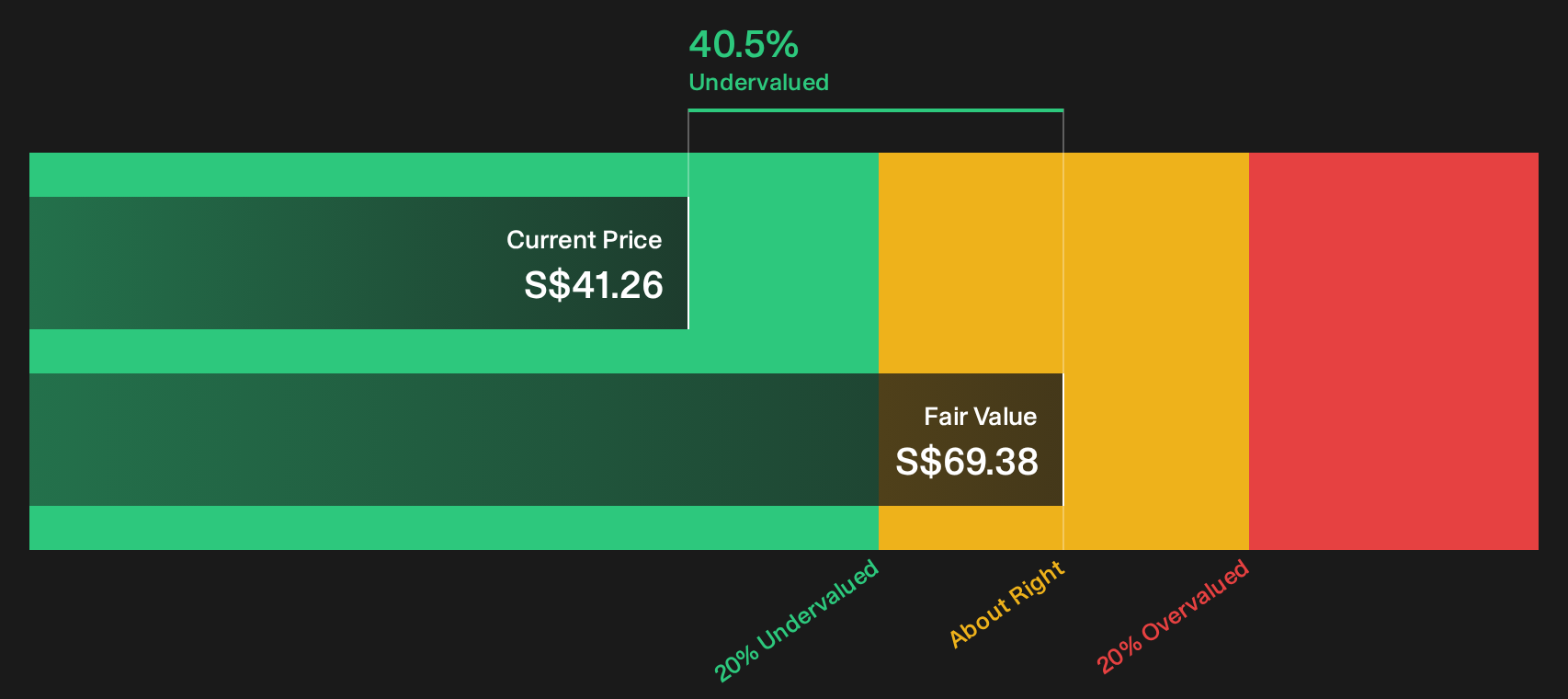
Running those assumptions through the model gives an intrinsic value of about SGD69.38 per share. Against the current share price, that implies the stock screens around 40.5% undervalued on this framework. Citi’s recent live transactions on Swift’s ledger, with United Overseas Bank expected to join the initiative, help explain why some investors may already be assigning value to future payments income even while the Excess Returns estimate still sits comfortably above the market price.
On the Excess Returns view, United Overseas Bank looks undervalued with a sizeable gap between estimated intrinsic value and where the shares trade today.
Our Excess Returns analysis suggests United Overseas Bank is undervalued by 40.5%. Track this in your watchlist or portfolio, or discover 183 more high quality undervalued stocks.
Is United Overseas Bank a Bargain on Earnings?
For a bank like United Overseas Bank, the P/E ratio gives a clear indication of what investors are willing to pay for each dollar of reported profit.
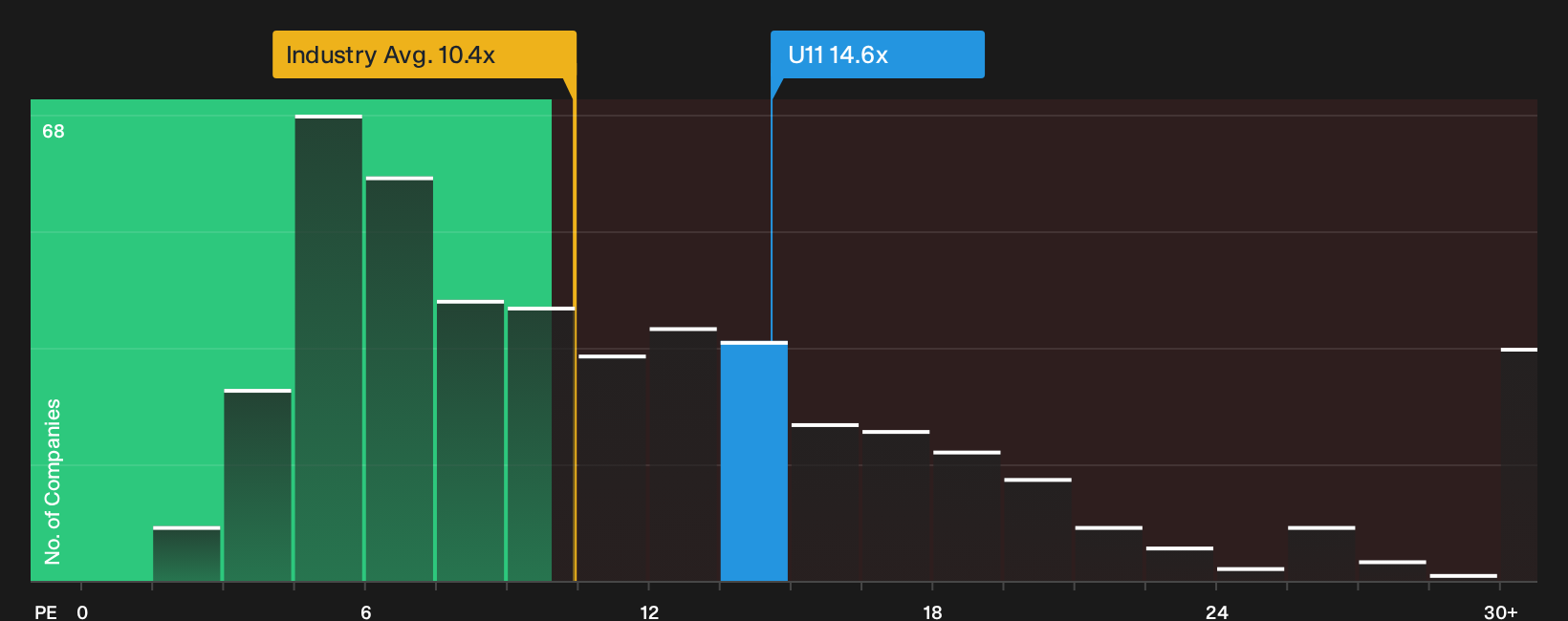
The stock trades on a P/E of 14.6x, which is slightly higher than the peer group average of 14.3x and above the wider Banks industry on 11.5x. The fair P/E that adjusts for United Overseas Bank’s size, business mix and risk profile is estimated at 17.2x. That is meaningfully above where the shares change hands today, which highlights a gap between what the model suggests investors might be prepared to pay and the multiple currently on offer.
Even after the attention around upcoming participation in Swift’s ledger initiative, the present P/E still sits below that 17.2x fair ratio. For holders who put weight on earnings-based comparables, the current pricing leaves room for the valuation to move closer to that benchmark if company performance and sentiment align with those assumptions.
On the P/E approach, United Overseas Bank appears undervalued relative to the fair multiple implied by its earnings profile.
See what the numbers say about this price — find out in our valuation breakdown.
The United Overseas Bank Narrative: What Would Justify Today's Price?
United Overseas Bank’s valuation gap only becomes meaningful once the future behind the numbers is clear. Simply Wall St Narratives on United Overseas Bank describe what mix of growth, profitability and earnings power would need to play out for the shares to be worth materially more or materially less than today’s price. Where a single ratio or model offers one result, these narratives set out the underlying path so you can monitor whether it actually unfolds.
Add your own narrative on United Overseas Bank and set out a number-driven case that other investors can react to as fresh results and news are released. Share a view on whether Citi’s move to live transactions on Swift’s ledger, with United Overseas Bank expected to join, significantly changes the long-term earnings profile and whether current pricing fully reflects any such shift.
Do you think there's more to the story for United Overseas Bank? Head over to our Community to see what others are saying!
The Bottom Line
United Overseas Bank screens as undervalued on both the Excess Returns intrinsic value estimate and the earnings multiple work, although the broader checks only point to a mixed picture. The key debate is whether that discount reflects hesitation about execution on projects such as Swift’s ledger or simply a lag in how quickly sentiment adjusts. For potential investors, the crux is whether United Overseas Bank can deliver the earnings profile that would justify a higher multiple without running into the kind of operational or adoption risks that would turn the current markdown into a value trap.
This article by Simply Wall St is general in nature. We provide commentary based on historical data and analyst forecasts only using an unbiased methodology and our articles are not intended to be financial advice. It does not constitute a recommendation to buy or sell any stock, and does not take account of your objectives, or your financial situation. We aim to bring you long-term focused analysis driven by fundamental data. Note that our analysis may not factor in the latest price-sensitive company announcements or qualitative material. Simply Wall St has no position in any stocks mentioned.
Have feedback on this article? Concerned about the content? Get in touch with us directly. Alternatively, email editorial-team@simplywallst.com