


3 Insurance Stocks That Could Benefit Most From Higher Bond Yields
Bond yields are jumping, inflation is sticky, and the era of easy money looks distant, which is quietly reshaping where long-term capital flows. Higher long-term rates can pressure some growth stories, yet they may improve the appeal of businesses that live off investment income and long-dated cash flows. This article walks through three US life insurers and annuity providers from our screener that appear positively exposed to this rate reset.
The stocks covered below are just a starting sample, and the full screen surfaced 14 more US life insurers and annuity providers with equally compelling narratives that are not covered in this article.
Identify your own highest conviction ideas by going straight to the US Life Insurers and Annuity Providers Benefiting from Higher Long-Term Yields screener to filter, analyze, and focus on the insurers that best match your risk and income goals.
Brighthouse Financial (BHF)
Brighthouse Financial sits squarely within the theme of US insurers that rely on long-term bond yields, with a business built around annuities and life policies that transform those yields into retirement income and household protection.
Brighthouse Financial generates most of its revenue from annuities in the U.S., with about US$3.5b from Annuities, US$1.4b from Run-off, US$1.1b from Life, and US$643 million from Corporate & Other, and the stock carries a market value of roughly US$2.9b.
"Ongoing regulatory pressures, including potential changes to capital requirements and tighter fiduciary standards, are likely to increase compliance costs and reduce profitability at a time when industry margins are already under threat from technological disruption and fintech competition, further constraining earnings growth."
The key issue now is how one unresolved pressure will shape the balance between the benefits of higher yields and the durability of Brighthouse Financial’s profitability.
That pressure point is exactly what makes the full narrative for Brighthouse Financial so important for judging whether higher yields are quietly rebuilding Brighthouse Financial’s earning power or just masking new fragilities.

Kansas City Life Insurance (KCLI)
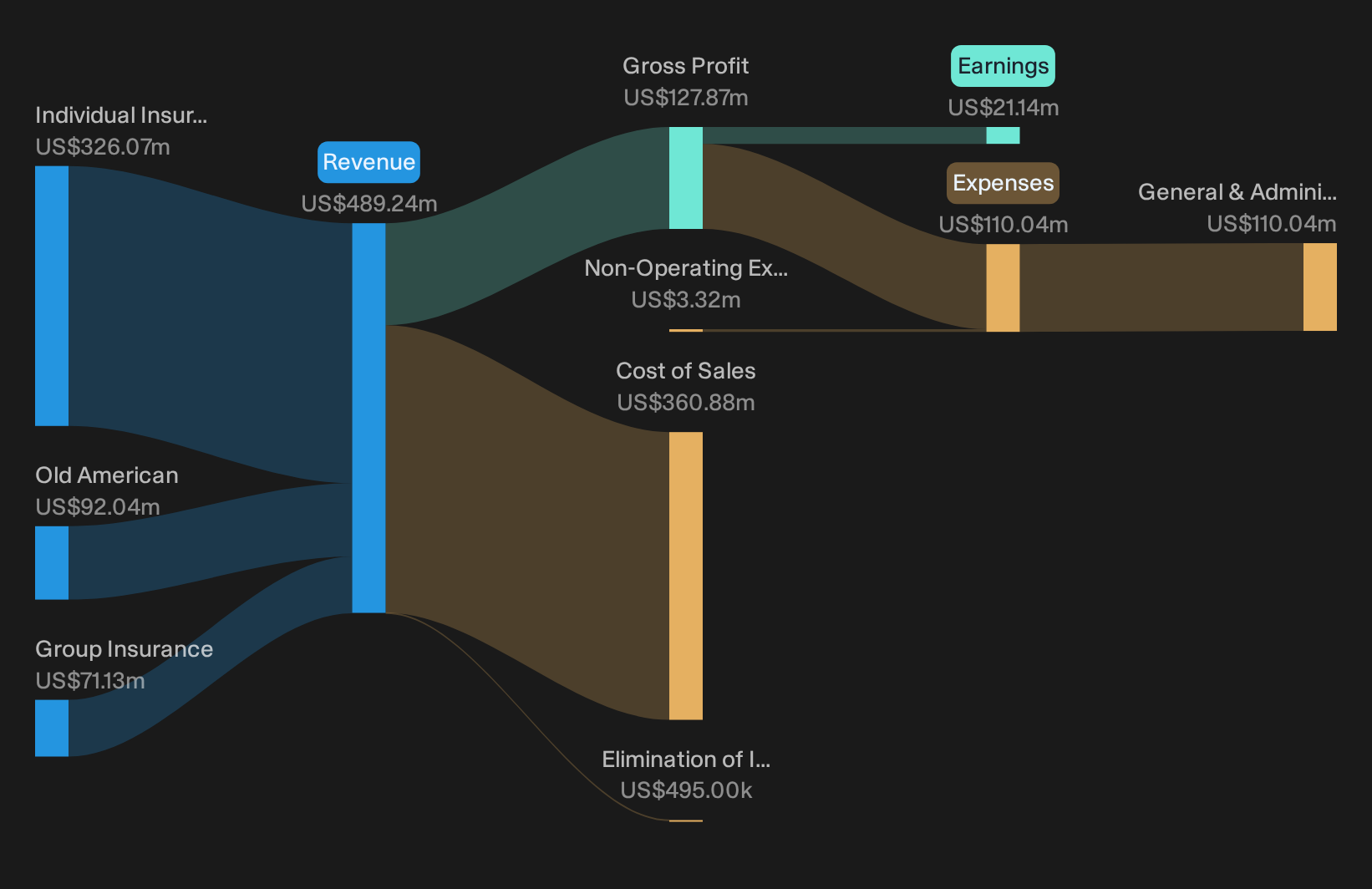
Kansas City Life Insurance is a traditional US life insurer that leans on long-duration investment portfolios, with about US$326 million from Individual Insurance, US$92 million from Old American, and US$71 million from Group Insurance, and it carries a market value near US$350 million.
Kansas City Life Insurance ties directly into the higher-yield theme because its long-term policies are backed by bond portfolios that can earn more as rates rise, and recent swings back to profitability suggest that the key issue is what happens if one unseen pressure on funding costs starts to bite into those richer investment coupons.
If that funding squeeze is on your mind, go straight to the 2 key rewards and 3 important warning signs (2 are major!) to see where Kansas City Life Insurance could surprise next.
Genworth Financial (GNW)
Genworth Financial combines mortgage insurance with long-term care and retirement-focused cover that relies on long-duration investment portfolios, a direct fit for a screener built around higher long-term bond yields. The business generates about US$1.3b from Enact, US$6.1b from the Closed Block segment, and US$35 million from Corporate and Other, and carries a market value near US$4.0b.
Genworth Financial is exposed to higher long-term yields through its long-term care and life-related liabilities, where richer bond income can help support promises made decades out. Investors get a US$4.0b stock whose appeal now quietly revolves around what happens if one rate-sensitive pressure shifts from helpful tailwind to a more demanding test of pricing discipline.
That potential turn in the rate wind is exactly why the analysis report for Genworth Financial could be worth a few minutes, especially if pricing power and capital flexibility matter to you.

Seeking Fresh Alternatives Before They Fly
Fresh ideas do not stay under the radar for long. The moment momentum picks up, the easiest entry points start dropping away. Scan these curated lists before the crowd and get in early.
- Target steady portfolio ballast with a curated list of solid balance sheet and fundamentals (23 results) that can help you focus on businesses built to handle shocks while others scramble.
- Ride potential breakout themes by scanning 89 AI infrastructure stocks that zeroes in on companies supplying the backbone for AI growth while it still feels early.
- Hunt under-the-radar pricing power with a hand-picked 31 high quality undervalued stocks that highlights quality operations where expectations have not yet fully caught up.
This article by Simply Wall St is general in nature. We provide commentary based on historical data and analyst forecasts only using an unbiased methodology and our articles are not intended to be financial advice. It does not constitute a recommendation to buy or sell any stock, and does not take account of your objectives, or your financial situation. We aim to bring you long-term focused analysis driven by fundamental data. Note that our analysis may not factor in the latest price-sensitive company announcements or qualitative material. Simply Wall St has no position in any stocks mentioned.
Have feedback on this article? Concerned about the content? Get in touch with us directly. Alternatively, email editorial-team@simplywallst.com