


Wayfair (W) Stock Could Be Fully Priced As Margin Progress Matters
Wayfair stock has delivered a steep 65.6% decline over the past five years, yet it still screens as overvalued on market multiples. This leaves current holders weighing recent gains against a valuation picture that is far from straightforward.
- The share price performance over five years is down 65.6%, which signals that long term investors have faced significant value erosion despite more recent strength.
- Wayfair’s value hinges on whether the business can translate its online scale into steadier margins and cash generation, while persistent pressure on profitability remains a key risk for the equity story.
- The broader valuation checks form a mixed picture rather than a clear bargain or clear overpricing, with the value score of 4 reflecting that ambiguity.
The issue now is whether Wayfair’s current share price fairly reflects the risks in its past five year return profile and the expectations embedded in its premium market multiples.
Compare Wayfair's mixed valuation story with other potential ideas by scanning 31 high quality undervalued stocks, which pairs stronger fundamentals with more grounded pricing.
Does Wayfair Look Pricey on Sales?
P/S is a useful lens for Wayfair because the business is still heavily defined by scale and revenue throughput rather than steady earnings.
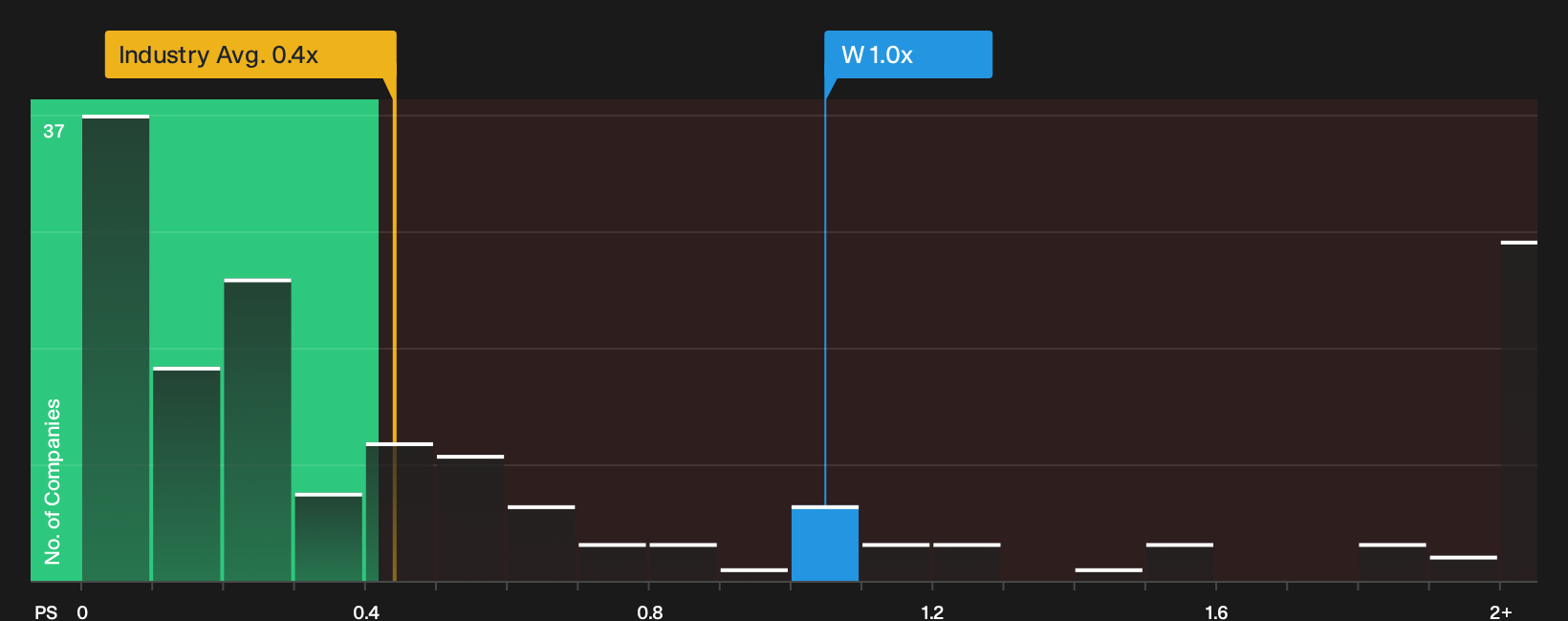
On this metric, Wayfair trades at roughly 1.0x P/S, compared with a Specialty Retail industry average of about 0.4x and a peer group closer to 1.4x. The fair P/S ratio for Wayfair, based on a model that weighs its risk profile, margins and growth expectations, is closer to 0.8x. That creates a gap between the current 1.0x multiple and what the framework suggests is more grounded pricing.
The stock appears to trade at a premium to the industry and a modest premium to its own modeled fair ratio, which already incorporates some execution and profitability risk. For holders, this indicates that the market is assigning a higher sales-based valuation to Wayfair than the underlying scorecard would support on this measure.
Wayfair stock appears overvalued on the P/S multiple, with the current price implying a richer sales valuation than the modeled fair ratio suggests.
See what the numbers say about this price — find out in our valuation breakdown.
The Wayfair Narrative: What Would Justify Today's Price?
Simply Wall St Narratives pick up where Wayfair's valuation puzzle leaves off by spelling out what would need to happen to revenue growth, margins and earnings for the shares to be worth meaningfully more or less than today’s price, and then framing each scenario as a thesis about the business that you can watch evolve over time on the Community page.
Wayfair splits opinion sharply, with one camp leaning into logistics and AI upside while the other worries that housing and margin risks still dominate.
Bull case: 37% undervalued
"Wayfair's early leadership in generative AI personal shopping and product discovery, leveraged through its replatformed tech stack and proprietary data, positions it to capture greater wallet share from younger, digitally-native homeowners, sharply increasing conversion rates and average order values, powering revenue growth beyond traditional e-commerce trajectories..."
Read the full Bull Case to see why Wayfair could be undervalued
Bear case: 10% overvalued
"Rising interest rates and persistent weakness in the housing market, including depressed housing turnover and flat to negative overall industry sales, could structurally limit Wayfair's addressable demand for big-ticket home furnishings, putting long-term pressure on revenue growth..."
Read the full Bear Case to see why Wayfair could be overvalued
Do you think there's more to the story for Wayfair? Head over to our Community to see what others are saying!
The Bottom Line
Wayfair stock screens as overvalued on market multiples, with the current P/S implying a richer sales tag than its risk and margin profile might justify. The valuation debate now turns less on whether the shares are cheap and more on whether the business can steadily lift profitability enough to earn that premium. Everything comes back to one hinge assumption, which is whether future margin progress and cash generation can catch up with the sales driven price investors are already paying today.
This article by Simply Wall St is general in nature. We provide commentary based on historical data and analyst forecasts only using an unbiased methodology and our articles are not intended to be financial advice. It does not constitute a recommendation to buy or sell any stock, and does not take account of your objectives, or your financial situation. We aim to bring you long-term focused analysis driven by fundamental data. Note that our analysis may not factor in the latest price-sensitive company announcements or qualitative material. Simply Wall St has no position in any stocks mentioned.
Have feedback on this article? Concerned about the content? Get in touch with us directly. Alternatively, email editorial-team@simplywallst.com