


Rivian (RIVN) Stock May Be Overvalued On Fair Value Yet Strong On Sales
Rivian Automotive has rewarded some patient holders over the past year, yet the past three years have still left anyone who bought early with a sizable loss, and the broader valuation checks still flag the stock as expensive rather than a clear bargain.
- The share price has fallen about 33.7% over the past three years, which means long-term holders are still in the red despite more recent strength.
- Interest in Rivian's R2 SUV program and factory floor tooling efforts, including work with Stratasys equipment, can support expectations for higher volume and better unit economics. At the same time, the recent CFO departure adds uncertainty around financial execution and capital planning.
- With a low value score of 2 out of 6, Rivian screens as overvalued on the broader set of valuation checks rather than as a clear discount opportunity.
The issue now is whether Rivian's current market price already reflects optimistic expectations for its future production ramp and profitability, or if there is still room for investors to be compensated for the risks they are taking on.
Spot opportunities beyond Rivian Automotive by scanning a curated set of companies that pair cash flow strength with attractive pricing using the 31 high quality undervalued stocks.Has Rivian Automotive Run Too Far on Sales?
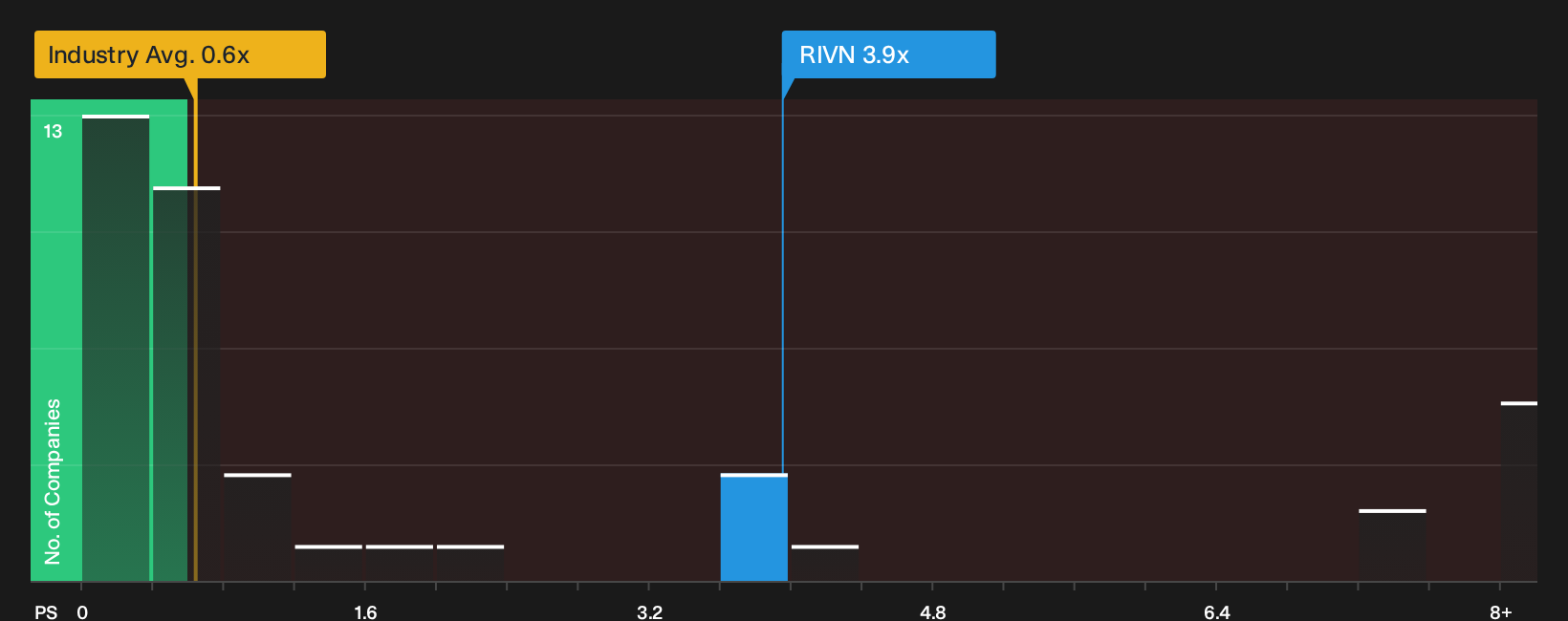
P/S tends to fit Rivian Automotive because the business is still loss making and investors are mostly paying for future revenue scale rather than current profits. On this yardstick, the stock trades at about 3.9x P/S, which is well above the auto industry average of roughly 0.6x and higher than the peer group average of about 0.6x. That is a large premium for a manufacturer that is still working to prove out sustainable free cash flow.
The fair P/S ratio from the model sits closer to 2.1x, which indicates that Rivian is trading at a richer multiple than would be expected after adjusting for its risk profile, growth outlook and current margins. Interest around the R2 program and recent tooling news with Stratasys may help explain why investors are willing to pay more for the shares. However, the valuation already reflects strong enthusiasm for future execution rather than leaving wide room for error.
On the P/S multiple, Rivian Automotive currently screens as overvalued relative to both tailored and sector benchmarks.
See what the numbers say about this price — find out in our valuation breakdown.
The Rivian Automotive Narrative: What Would Justify Today's Price?
Simply Wall St Narratives pick up where Rivian Automotive's valuation puzzle leaves off. They spell out which combinations of future growth, margins and earnings would need to hold for the stock to be worth materially more or less than today's price on the Community page. Each scenario links a fair value estimate to a specific storyline about Rivian Automotive's potential catalysts and key risks so you can track which version of events appears to be unfolding over time.
Rivian Automotive splits opinion sharply, with one camp leaning into R2 and software upside while the other worries about policy risk and cash burn.
Bull case: 17% undervalued
"Vertical integration in technology, especially in autonomy, battery, and software, combined with growing software & services revenue (including licensing via partnerships like with Volkswagen) is expected to open new high-margin revenue streams and diversify earnings, potentially strengthening EBITDA and net margins over time…"
Read the full Bull Case to see why Rivian Automotive could be undervalued
Bear case: 23% overvalued
"Shrinking policy support, cost inflation, and low demand threaten Rivian's margins, cash flow, and ability to justify ambitious expansion plans…"
Read the full Bear Case to see why Rivian Automotive could be overvalued
Do you think there's more to the story for Rivian Automotive? Head over to our Community to see what others are saying!
The Bottom Line
Rivian Automotive currently trades on market multiples that price in a confident path to higher production and better unit economics rather than offering a clear discount. The broader valuation checks lean toward overvalued, so any upside case depends on the business converting product interest and partnerships into sustained margin improvement. For holders and prospective investors, the key question is whether Rivian can execute that ramp and cash flow transition cleanly enough to justify paying a premium today.
This article by Simply Wall St is general in nature. We provide commentary based on historical data and analyst forecasts only using an unbiased methodology and our articles are not intended to be financial advice. It does not constitute a recommendation to buy or sell any stock, and does not take account of your objectives, or your financial situation. We aim to bring you long-term focused analysis driven by fundamental data. Note that our analysis may not factor in the latest price-sensitive company announcements or qualitative material. Simply Wall St has no position in any stocks mentioned.
Have feedback on this article? Concerned about the content? Get in touch with us directly. Alternatively, email editorial-team@simplywallst.com