


Genuine Parts (GPC) Stock Looks Below Fair Value Even With Split Risk
Genuine Parts stock has moved sideways over the past year but still shows a 5 year gain, while both the Discounted Cash Flow (DCF) intrinsic value estimate and market multiples suggest a cheaper valuation than the current share price.
- The stock has returned 26.6% over 5 years, indicating steady but not explosive long term progress for a long established distributor.
- Management’s plan to split Genuine Parts and Motion into two listed businesses may help highlight each unit’s cash generation. However, execution risk around the 2027 separation could affect how investors price those future cash flows.
- A value score of 4 out of 6 suggests a mixed picture rather than a clear bargain or clear overvaluation on the broader checks.
The key question is whether Genuine Parts’ current share price around US$133 reflects its intrinsic value estimate and the upcoming breakup of the business.
Look beyond Genuine Parts and see how other established businesses with room for potential re rating stack up in the 31 high quality undervalued stocks.
Is Genuine Parts a Bargain on Cash Flow?
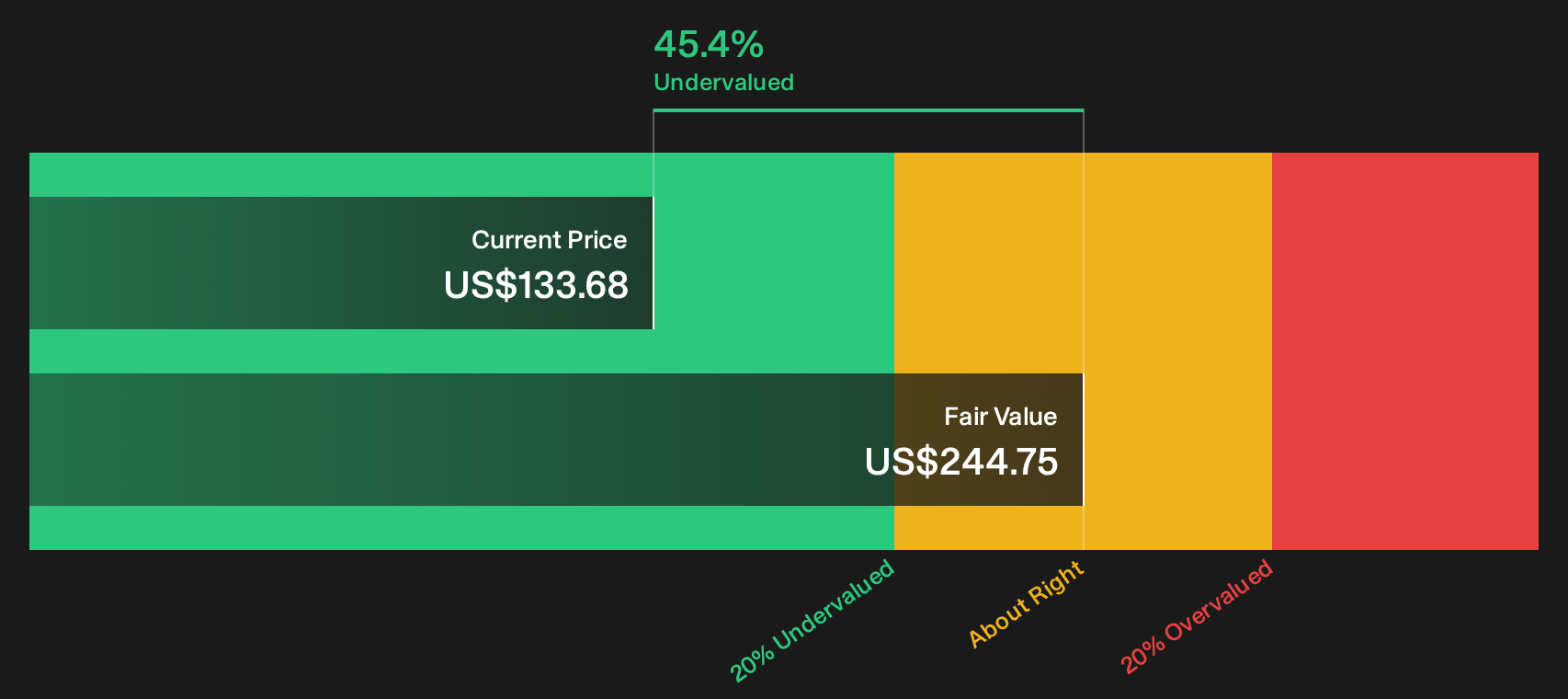
The Discounted Cash Flow (DCF) model here projects Genuine Parts’ future free cash generation and then discounts it back to today. On the latest figures, the business produced roughly $646 million of free cash flow over the past twelve months, with the model assuming growing cash flows rather than a decline. On those inputs, the 2 Stage Free Cash Flow to Equity approach lands on an estimated intrinsic value of about $244.75 per share.
Set against the current share price around $133, that suggests Genuine Parts appears roughly 45.4% undervalued on this DCF view. The planned 2027 separation into Genuine Parts and Motion, along with the new leadership line up announced for each unit, may help explain why the market could be slower to fully reflect those projected cash flows. On this cash flow based estimate, the shares appear undervalued, even with the upcoming split and leadership changes in view.
Our Discounted Cash Flow (DCF) analysis suggests Genuine Parts is undervalued by 45.4%. Track this in your watchlist or portfolio, or discover 31 more high quality undervalued stocks.
Does Genuine Parts Look Undervalued on Sales?
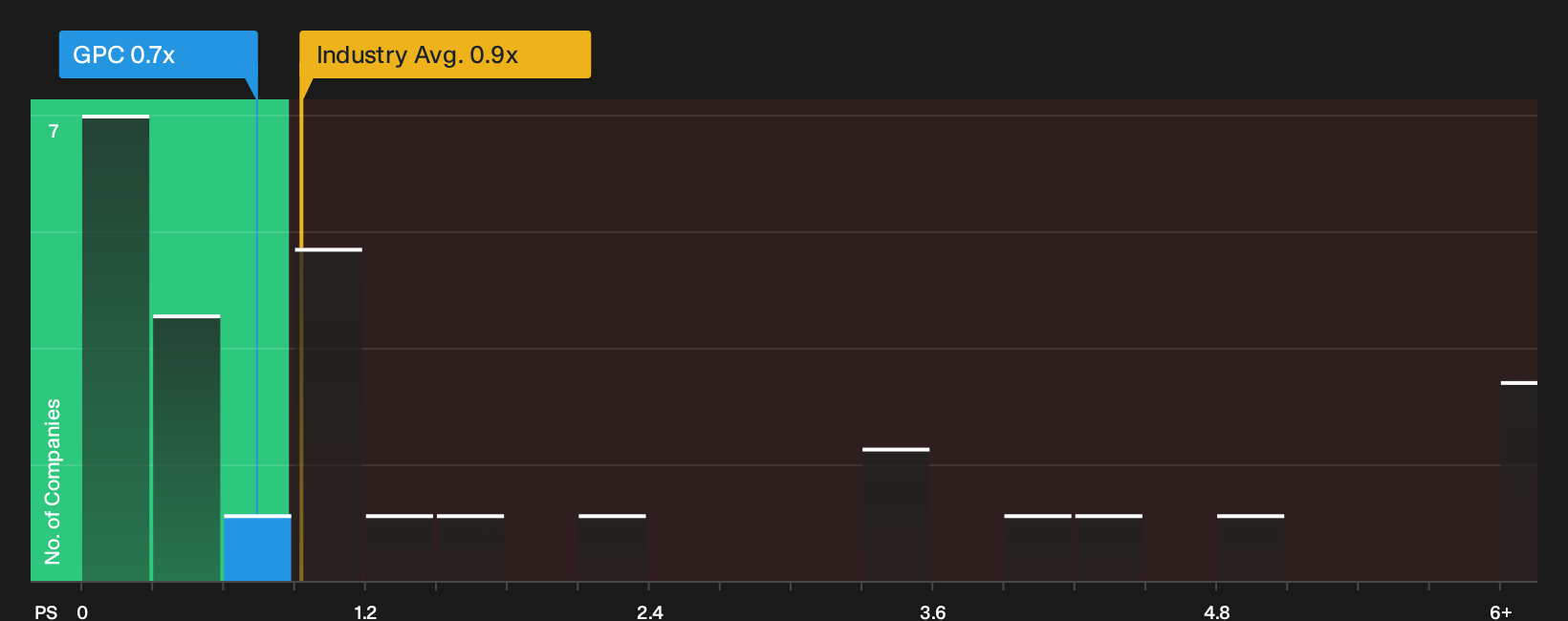
P/S works well for Genuine Parts because it is a mature distributor where revenue scale matters as much as reported earnings.
The stock trades on a P/S ratio of about 0.7x, very close to the 0.73x peer average in Retail Distributors and below the wider industry level near 0.9x. On the model’s fair ratio of roughly 1.0x, Genuine Parts screens at a discount to where its sales-based multiple might sit given its size, margins and risk profile.
The gap between the current P/S and that fair ratio is not huge, yet it still implies the market is giving limited credit for each dollar of Genuine Parts revenue at today’s price.
On the P/S yardstick, Genuine Parts stock appears undervalued relative to the sales multiple that the model suggests could be reasonable.
See what the numbers say about this price — find out in our valuation breakdown.
The Genuine Parts Narrative: What Would Justify Today's Price?
Simply Wall St Narratives for Genuine Parts pick up where the valuation numbers leave off. They spell out which assumptions on Genuine Parts' growth, margins and earnings would need to hold for the stock to be worth materially more or less than today. Rather than relying on a single multiple or one model output, each scenario lays out its own fair value logic so you can compare those expectations with the results that appear on the Community page over time.
Community views on Genuine Parts split sharply between those who see long term resilience and those who focus on separation costs and margin strain.
Bull case: roughly fairly valued
"Substantial investments in digital and e-commerce capabilities, including proprietary digital tools and expansion of online sales, position the company to capitalize on the ongoing market shift toward online and omnichannel auto parts distribution..."
Read the full Bull Case to see why Genuine Parts could be undervalued
Bear case: 10% overvalued
"Although the planned separation into Global Automotive and Global Industrial is advancing with cost allocations and regulatory filings, the additional estimated US$250 million of costs for Global Automotive and US$100 million for Global Industrial could weigh on earnings and compress segment EBITDA margins in the early years following the separation..."
Read the full Bear Case to see why Genuine Parts could be overvalued
Do you think there's more to the story for Genuine Parts? Head over to our Community to see what others are saying!
The Bottom Line
Genuine Parts screens as undervalued on both the Discounted Cash Flow (DCF) intrinsic value estimate and on sales based multiples, which point in the same direction rather than fighting each other. That said, the mixed broader checks and the planned separation into two listed entities mean the discount also reflects real execution questions. The crux is whether management can deliver the breakup without eroding margins and cash generation. If those separation costs stay contained and the units prove their earning power, today's gap between price and intrinsic value could either close over time or prove that the market was correctly cautious.
This article by Simply Wall St is general in nature. We provide commentary based on historical data and analyst forecasts only using an unbiased methodology and our articles are not intended to be financial advice. It does not constitute a recommendation to buy or sell any stock, and does not take account of your objectives, or your financial situation. We aim to bring you long-term focused analysis driven by fundamental data. Note that our analysis may not factor in the latest price-sensitive company announcements or qualitative material. Simply Wall St has no position in any stocks mentioned.
Have feedback on this article? Concerned about the content? Get in touch with us directly. Alternatively, email editorial-team@simplywallst.com