


Comstock Resources (CRK) Stock Could Be Cheap On Cash Flow But Pricey On Earnings
Comstock Resources is showing mixed valuation signals right now, with a Discounted Cash Flow (DCF) estimate pointing to meaningful upside while market based multiples suggest the stock screens on the expensive side. The share price has also been through a volatile few years, which adds another layer of complexity for anyone trying to decide what the current quote really implies.
- Over the past 5 years, Comstock Resources has delivered a total return of about 80.2%, which means long term holders have seen substantial gains even though the ride has been uneven.
- The announced US$1.65b SOCAR asset sale and US$450m drilling joint venture can support balance sheet repair and future production plans, but execution risk around large asset transactions and development spending may affect how quickly cash flows line up with investor expectations.
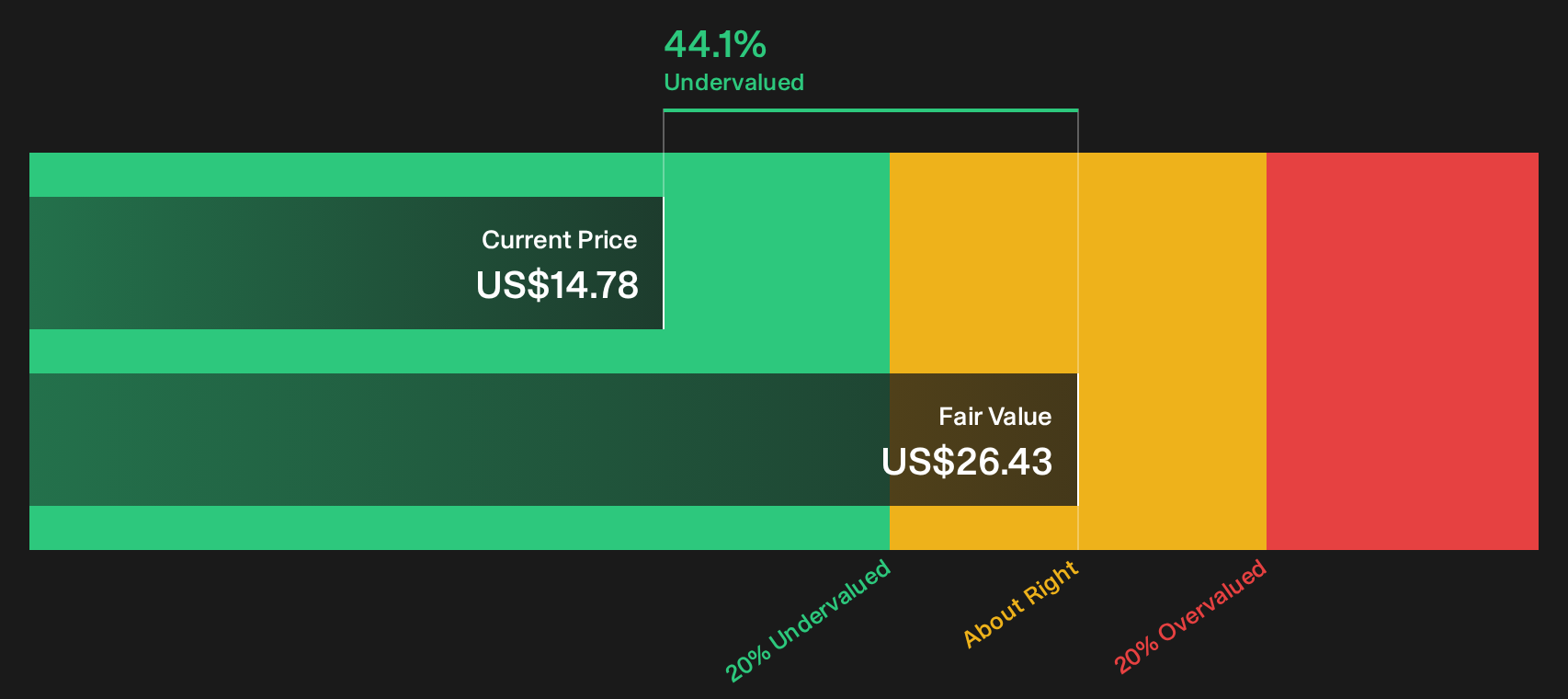
- On a broad set of valuation checks, Comstock Resources carries a mixed profile, with the Discounted Cash Flow (DCF) pointing to roughly 44.1% undervaluation while a fair value look at trading multiples leans the other way. As a result, the stock does not screen as a clear bargain or a clear overpricing overall and earns a value score of 4.0.
The issue now is whether the intrinsic value case or the earnings multiple view will prove more useful for judging where Comstock Resources should trade from here.
Spot opportunities beyond Comstock Resources by scanning 31 high quality undervalued stocks, which currently combines compressed valuations with solid fundamentals.Is Comstock Resources Still Cheap on Cash Flow?
The Discounted Cash Flow (DCF) framework here asks what Comstock Resources is worth based purely on the cash it could generate for shareholders over time. Recent twelve month free cash flow sits in a loss of about $716 million, so the model relies on a recovery path that turns those outflows into positive cash generation in the years ahead.
Based on those assumptions, the DCF yields an intrinsic value of around $26 per share. At that level, the stock would trade at roughly a 44.1% discount to the estimate. The recently announced US$1.65b SOCAR asset sale and US$450m drilling joint venture are part of the rationale for why the cash flow outlook used in the model anticipates a shift from heavy spending toward healthier free cash generation.
On this cash flow view, Comstock Resources appears undervalued relative to the DCF-based estimate of intrinsic worth.
Our Discounted Cash Flow (DCF) analysis suggests Comstock Resources is undervalued by 44.1%. Track this in your watchlist or portfolio, or discover 31 more high quality undervalued stocks.
Does Comstock Resources Look Pricey on Earnings?
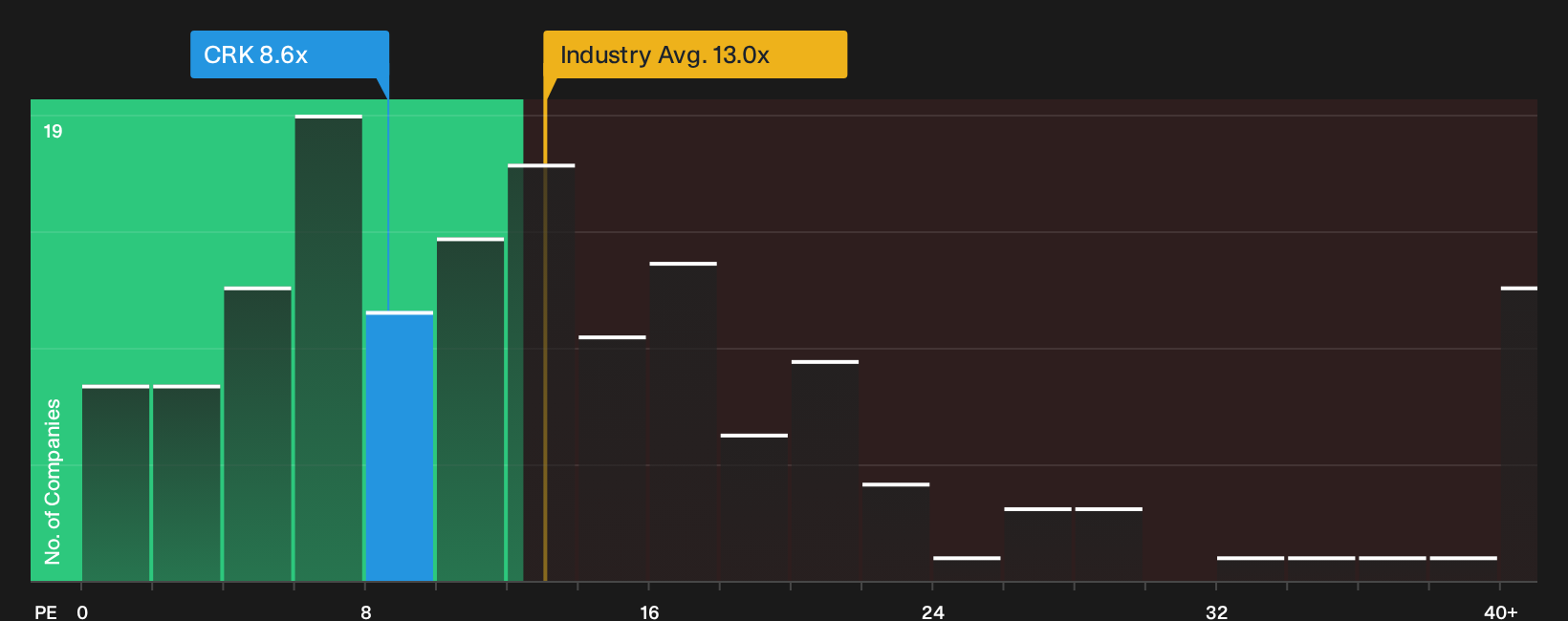
The P/E ratio suits Comstock Resources because the business is already generating earnings that you can compare directly with its share price. On this yardstick, the stock trades at about 8.6x, which sits below the wider oil and gas sector average of roughly 13.0x but above the 10.2x level seen across closer peers.
The tailored fair P/E for Comstock Resources, which adjusts for its risk profile, size and profitability, comes out nearer 6.2x. That is a clear gap versus the current 8.6x multiple, suggesting investors are paying a richer price than this framework would normally assign. The market is still ascribing a premium to the earnings stream, even though the broader sector and the model both point to lower reference points.
On the P/E numbers alone, Comstock Resources appears overvalued relative to the earnings multiple that would typically fit its profile.
See what the numbers say about this price — find out in our valuation breakdown.
The Comstock Resources Narrative: What Would Justify Today's Price?
Simply Wall St Narratives pick up where this valuation split for Comstock Resources leaves off by spelling out which growth, margin and earnings paths would need to play out for the shares to warrant a meaningfully higher or lower level than today. Each one treats Comstock Resources' fair value as a thesis about the business that you can revisit over time, and they sit on Simply Wall St's Community page for ongoing reference.
Community views on Comstock Resources are pulled wide apart, with one camp focusing on Western Haynesville upside and another fixated on concentration and cost risk.
Bull case: roughly fairly valued
"The recently announced strategic collaboration with NextEra Energy for potential gas-fired power and data center projects near Western Haynesville leverages proximity to major demand centers and existing infrastructure..."
Read the full Bull Case to see why Comstock Resources could be undervalued
Bear case: 48% overvalued
"Rapid acceleration of global renewable energy adoption and electrification is poised to erode long-term natural gas demand, which will place sustained downward pressure on Comstock's core revenues and diminish the value of their large drilling inventory in the Haynesville Shale over time..."
Read the full Bear Case to see why Comstock Resources could be overvalued
Do you think there's more to the story for Comstock Resources? Head over to our Community to see what others are saying!
The Bottom Line
Comstock Resources sits in a tug of war between a Discounted Cash Flow (DCF) view that flags meaningful intrinsic value upside and market multiples that still lean overvalued. The split comes down to timing and reliability of future cash generation on one side, and what investors are currently willing to pay for those earnings on the other. Broader valuation checks are mixed, so neither lens gets a clean win. The key issue from here is whether future cash flows from Haynesville focused projects materialise in line with optimistic assumptions, or whether execution and concentration risks indicate that the apparent discount reflects the market pricing in those threats.
This article by Simply Wall St is general in nature. We provide commentary based on historical data and analyst forecasts only using an unbiased methodology and our articles are not intended to be financial advice. It does not constitute a recommendation to buy or sell any stock, and does not take account of your objectives, or your financial situation. We aim to bring you long-term focused analysis driven by fundamental data. Note that our analysis may not factor in the latest price-sensitive company announcements or qualitative material. Simply Wall St has no position in any stocks mentioned.
Have feedback on this article? Concerned about the content? Get in touch with us directly. Alternatively, email editorial-team@simplywallst.com