


How Investors Are Reacting To GATX (GATX) Raised Full Year Guidance
- GATX Corporation recently raised its full-year guidance after reporting strong railcar leasing activity, high fleet utilization levels, and sizeable gains from asset sales.
- The update highlights how GATX’s mature fleet model and ability to redeploy railcars efficiently can translate operating execution into higher-quality earnings.
- We will look at how GATX's investment narrative is influenced by raised full-year guidance anchored in high railcar utilization.
GATX Investment Narrative Recap
For an investor to stay with GATX, the core belief is simple. High railcar utilization, disciplined fleet management, and a deep secondary market for assets can keep cash generation relatively resilient through different freight cycles. The raised full year guidance leans on that view, since it reflects strong leasing demand and effective redeployment rather than one off volume spikes.
In the near term, the key swing factor is whether high utilization and renewal activity in North America and India can offset softer conditions in Europe and lumpier remarketing gains. The biggest risk remains that the timing of heavy sale gains and delayed customer decisions in Europe makes quarterly earnings choppy, even if the underlying fleet stays busy.
The most relevant recent development is GATX lifting full year guidance on the back of strong railcar leasing activity, high fleet utilization, and sizeable gains from asset sales. That update ties directly to the main catalysts investors watch, which are lease rates, terms, and how quickly idle equipment finds a new home.
Those same data points also intersect with the main operational risks. High utilization and remarketing gains help offset interest costs and a dividend that is not well covered by free cash flow. At the same time, reliance on non cash earnings and timing dependent sale profits means execution around redeployment and the secondary market remains central to how steady results look from quarter to quarter.
GATX's current analyst narrative points to revenue of US$2.7b and earnings of US$472.8m by 2029, built on an assumed 12.8% yearly revenue growth rate and an earnings increase of about US$138m from US$334.6m today.
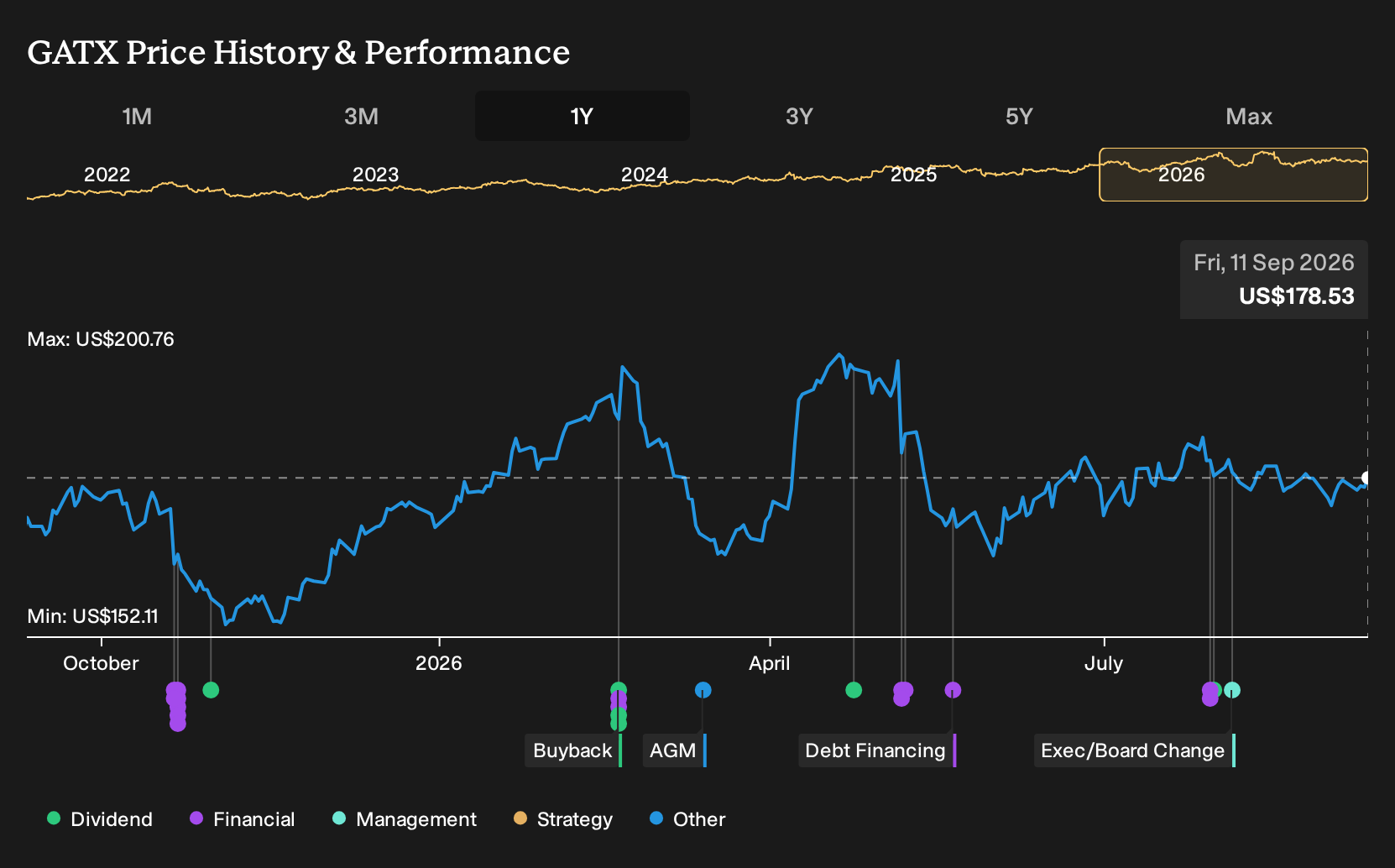
Uncover why GATX's fair value indicates a 22% potential upside to its current price, which could narrow quickly.
Exploring Other Perspectives
Two fair value estimates from the Simply Wall St Community span a wide band, from about US$50.59 per share up to US$218. That is a huge gap for the same GATX ticker. Such dispersion often reflects how differently private investors weigh risks like European softness or potential benefits from the Wells Fargo Rail deal. You should expect opinions to diverge and treat this as a prompt to explore several competing viewpoints rather than rely on a single narrative.
Explore another GATX fair value estimate, including one that suggests as much as 22% upside from the current price.
The Verdict Is Yours
Disagree with existing narratives? Extraordinary investment returns rarely come from following the herd, so consider relying on your own analysis and judgment.
- A great starting point for your GATX research is our analysis highlighting 5 key rewards and 3 important warning signs that could impact your investment decision.
- See our latest analysis for GATX. The report includes a comprehensive fundamental analysis summarized in a single visual, the Snowflake, which makes it easy to evaluate GATX's overall financial health at a glance.
Looking for more ideas beyond GATX?
If GATX has sharpened your thinking about asset intensive businesses, it can help to compare it with other listed companies that offer different mixes of balance sheet strength, income potential, and long term growth optionality. The Simply Wall St Screener is a straightforward way to surface those candidates quickly, then pressure test them against your own criteria.
- If you care most about financial resilience, start with businesses that keep leverage in check and maintain solid liquidity profiles by scanning our 11 resilient stocks with low risk scores.
- Income focused investors who want payouts backed by strong fundamentals can look for companies built around steady cash generation by reviewing the 6 dividend fortresses.
- For a broader hunting ground of quality stocks that may not yet be widely followed, cast a wider net by checking the 16 high quality undiscovered gems.
This article by Simply Wall St is general in nature. We provide commentary based on historical data and analyst forecasts only using an unbiased methodology and our articles are not intended to be financial advice. It does not constitute a recommendation to buy or sell any stock, and does not take account of your objectives, or your financial situation. We aim to bring you long-term focused analysis driven by fundamental data. Note that our analysis may not factor in the latest price-sensitive company announcements or qualitative material. Simply Wall St has no position in any stocks mentioned.
Have feedback on this article? Concerned about the content? Get in touch with us directly. Alternatively, email editorial-team@simplywallst.com