


EchoStar (ECHO) Stock Looks Fully Valued With Cash Flow And Sales Rich
EchoStar has delivered a very large 3 year gain, yet both its intrinsic value estimate and market multiples currently point to a stock that trades at a premium to what the underlying cash flows might support. For anyone watching EchoStar today, price action and valuation checks are pulling in the same direction, toward a richer market tag.
- The share price return over the past 3 years is about 396%, which puts recent strength front and center for anyone assessing what is already priced in.
- Future cash generation from EchoStar's business can support the current equity story, while any disappointment in cash flow timing or capital needs may weigh heavily on what investors are willing to pay.
- The broader checklist rates the stock at 1 out of 6, which leans expensive rather than a clear bargain on the usual valuation cross checks.
The issue now is whether EchoStar's current share price still leaves enough headroom above the intrinsic value estimate to justify taking on the risks that come with that premium.
Balance that 395.8% EchoStar run by scouting other premium priced stories that still show solid fundamentals through our hand picked solid balance sheet and fundamentals stocks screener (23 results).
Is EchoStar Getting Expensive on Cash Flow?
The Discounted Cash Flow model for EchoStar starts with the cash the business produces rather than reported earnings. On that score the latest twelve months show free cash flow of roughly $2.1b flowing out of the business, so the whole valuation hinges on a recovery to positive, sizeable cash generation over the coming years.
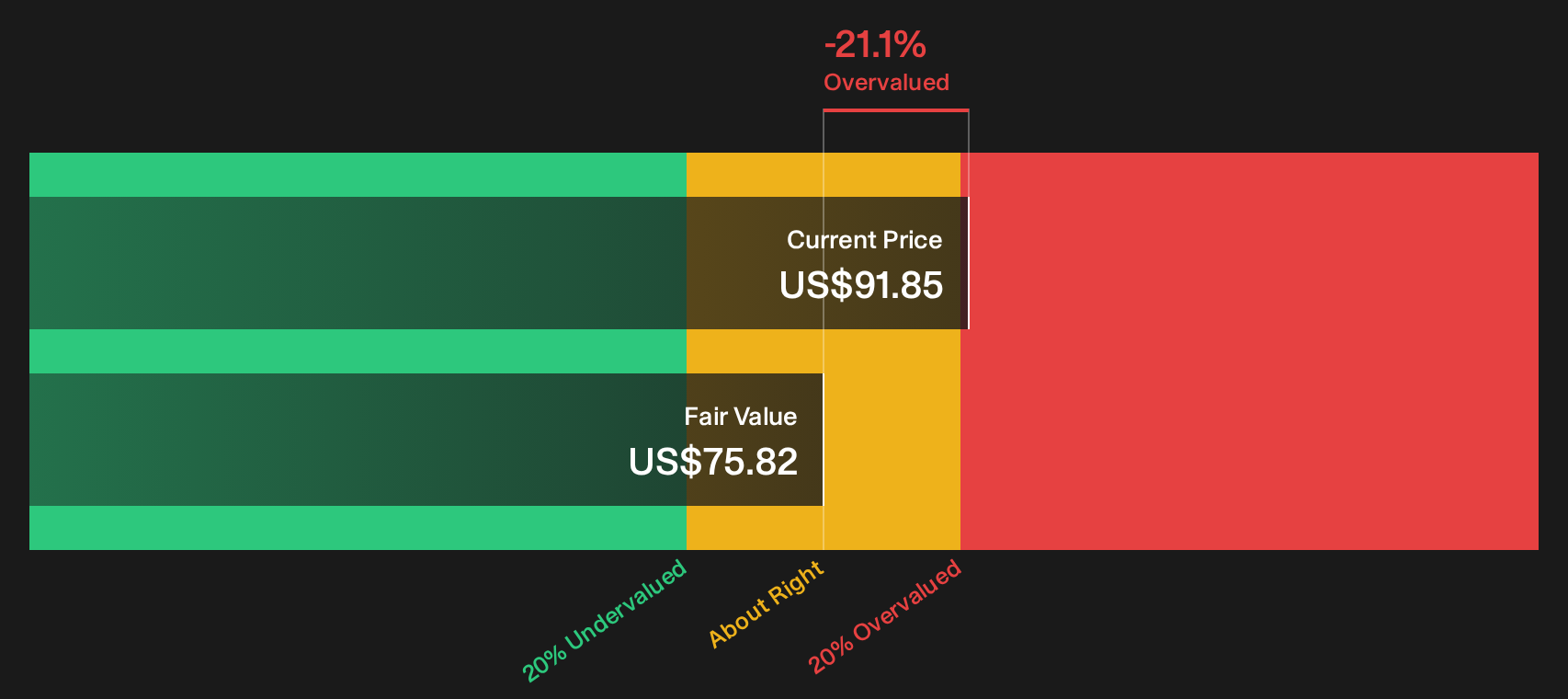
Analysts expect EchoStar to move into healthy positive free cash flow, with long range projections building toward roughly $1.9b a year, which feeds into an estimated intrinsic value of about $75 per share. With the current share price sitting above that figure, the DCF output indicates that the stock is trading at roughly a 23.3% premium to the modelled cash flows.
On this DCF view, EchoStar currently appears overvalued relative to the cash flow profile used in the model.
Our Discounted Cash Flow (DCF) analysis suggests EchoStar may be overvalued by 23.3%. Discover 31 high quality undervalued stocks or create your own screener to find better value opportunities.
Does EchoStar Look Pricey on Sales?
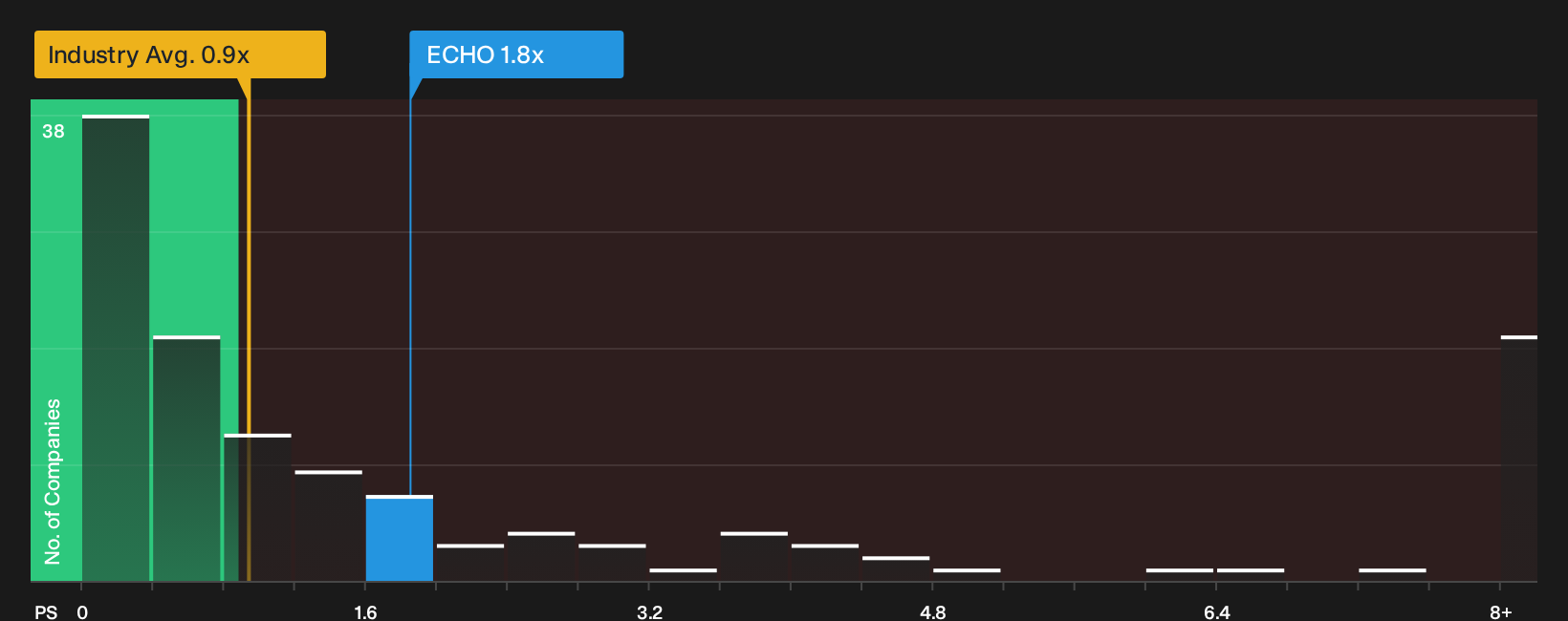
P/S works well for EchoStar because the business is being benchmarked on revenue rather than current earnings. On this measure the stock trades on a P/S of about 1.8x, compared with a Media industry average near 0.9x and a peer group closer to 1.0x. So buyers today are paying a higher price for each dollar of EchoStar revenue than for many sector peers.
The valuation model suggests a fair P/S ratio of roughly 1.3x once the company’s size, margins and risk profile are taken into account. That sits well below the current 1.8x P/S, which indicates EchoStar is priced at a clear premium even after adjusting for those fundamentals.
On this sales multiple, EchoStar stock screens as overvalued relative to both its sector and the modelled fair P/S ratio.
See what the numbers say about this price — find out in our valuation breakdown.
The EchoStar Narrative: What Would Justify Today's Price?
EchoStar’s valuation puzzle raises a simple question for investors who care about the story behind the numbers. Narratives on Simply Wall St’s Community page spell out which paths for EchoStar’s revenue, profitability and earnings would justify a meaningfully higher or lower share price than today. Each one treats fair value as a specific, trackable claim about how the business might evolve so you can see how that view holds up over time.
Community views on EchoStar are split wide apart, with one camp treating it as a space connectivity opportunity and the other focusing on execution and valuation risk.
Bull case: 27% undervalued
"EchoStar's investment in a unique wideband LEO direct-to-device satellite constellation, leveraging its global S-band and AWS-4 spectrum rights, positions it to address skyrocketing global demand for ubiquitous connectivity across consumer, enterprise, government, and IoT applications..."
Read the full Bull Case to see why EchoStar could be undervalued
Bear case: 112% overvalued
"Before the big spectrum shuffle, this company was struggling..."
Read the full Bear Case to see why EchoStar could be overvalued
Do you think there's more to the story for EchoStar? Head over to our Community to see what others are saying!
The Bottom Line
EchoStar now screens as overvalued on both the Discounted Cash Flow (DCF) intrinsic value estimate and on revenue based multiples, so the valuation debate really turns on how much optimism you think is already baked in. With those frameworks pointing the same way, the broader checklist reinforces the idea that the margin for error at the current tag looks thin rather than generous. The crux from here is whether EchoStar can deliver the cash flow recovery and business execution that supporters expect, or whether any stumble in timing, funding or project delivery prompts a rethink of how rich a multiple investors are willing to pay.
This article by Simply Wall St is general in nature. We provide commentary based on historical data and analyst forecasts only using an unbiased methodology and our articles are not intended to be financial advice. It does not constitute a recommendation to buy or sell any stock, and does not take account of your objectives, or your financial situation. We aim to bring you long-term focused analysis driven by fundamental data. Note that our analysis may not factor in the latest price-sensitive company announcements or qualitative material. Simply Wall St has no position in any stocks mentioned.
Have feedback on this article? Concerned about the content? Get in touch with us directly. Alternatively, email editorial-team@simplywallst.com