


Can Mastercard (MA) Balance Cheap Fair Value With Pricey Earnings?
Mastercard comes into focus with a split message on valuation, where the Excess Returns intrinsic value estimate points to meaningful upside while market multiples appear elevated and the recent share performance over the past year has been subdued.
- The stock has returned 68.2% over 5 years, which signals that long term holders have already captured a substantial gain that may influence how much further upside feels comfortable.
- New initiatives such as Mastercard Wallet Pay and recent moves into stablecoin rails can support expectations for future cash generation. At the same time, regulatory and technology execution risks around these payment platforms may weigh on how much investors are willing to pay today.
- The broader valuation checks give Mastercard a value score of 3 out of 6, which points to a mixed picture rather than a clear bargain or clear overvaluation.
The issue now is whether Mastercard's current price already reflects the intrinsic value indicated by the Excess Returns model, or if there is still a margin of safety for new capital.
Spot other payment and fintech stocks where valuation signals and new rails are pulling in different directions by reviewing 33 high quality undervalued stocks.Does Mastercard Look Undervalued on Excess Returns?
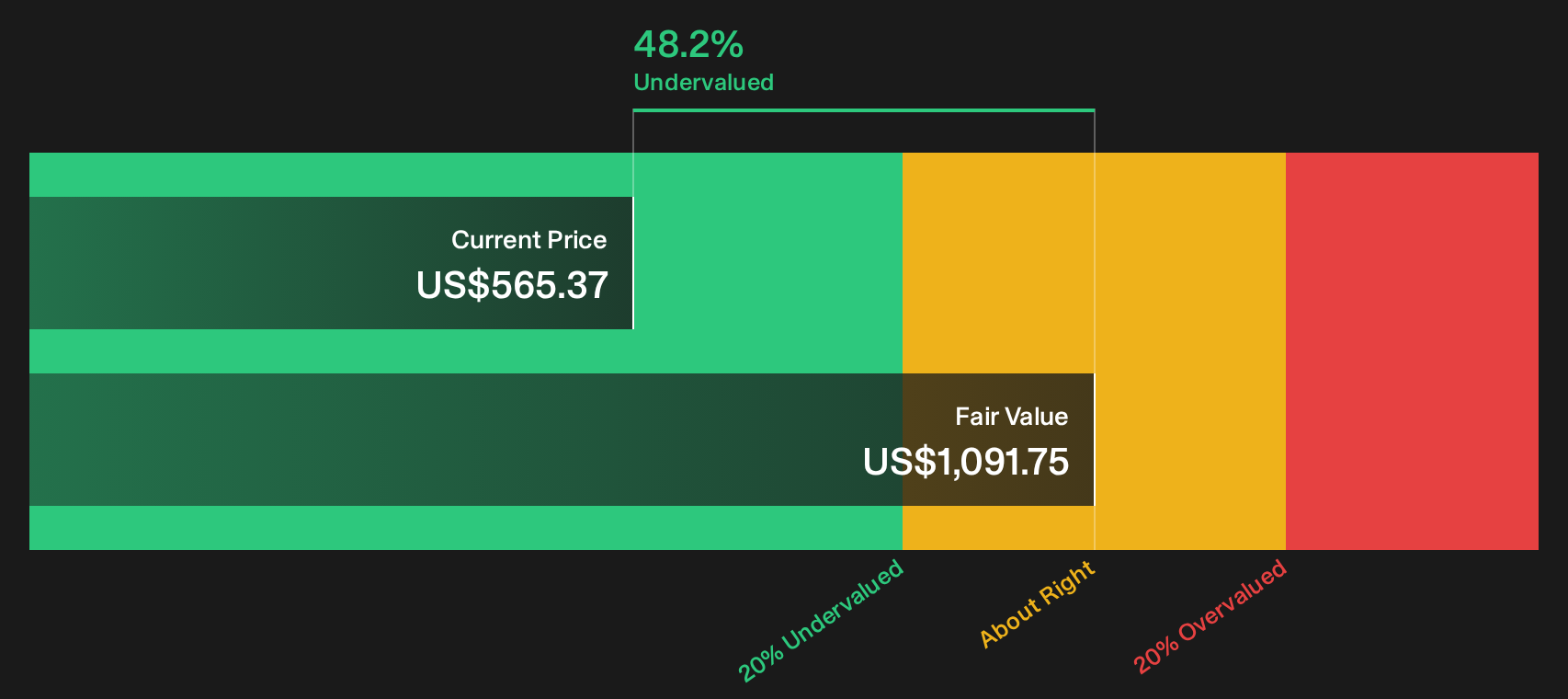
The Excess Returns model values Mastercard by estimating how much profit it can earn above its cost of equity on each dollar of shareholder capital. For this stock, that excess is large on the model’s inputs, which leads to an intrinsic value estimate of $1,092 per share.
Book value per share is modeled at $6.40, and stable earnings per share are set at $40.76, supported by an average return on equity of approximately 230.22%. The cost of equity is $1.31 per share, so the implied excess return of $39.45 per share is substantial. The stable book value stepping up to $17.70 supports the extension of those gains over time. With a current share price near $571, the model’s output suggests the stock trades at about a 48.2% discount to intrinsic value.
Mastercard’s push into Wallet Pay and stablecoin rails gives the market specific projects to focus on, yet the share price remains well below the level supported by this earnings power model.
On these Excess Returns assumptions, Mastercard appears undervalued relative to its modeled intrinsic worth.
Our Excess Returns analysis suggests Mastercard is undervalued by 48.2%. Track this in your watchlist or portfolio, or discover 33 more high quality undervalued stocks.
Has Mastercard Run Too Far on Earnings?
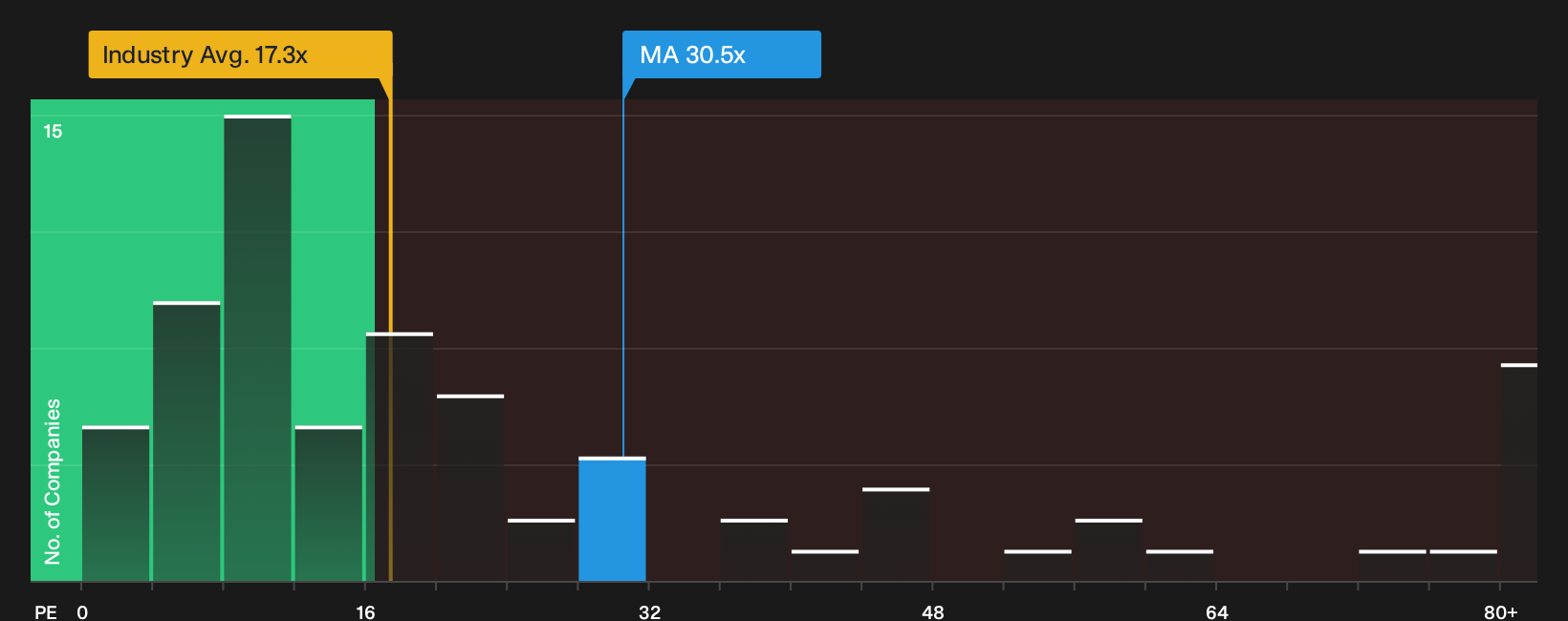
P/E is the cleanest yardstick for Mastercard because earnings remain the main anchor for how investors value this payments franchise. On that metric, the stock trades on about 30.5x, which is well above the Diversified Financial industry average near 17.3x and still below the peer group average of roughly 49.2x.
A more tailored benchmark, which adjusts for Mastercard’s profitability profile, scale and risk, points to a fair P/E closer to 21.5x. That suggests the current valuation carries a meaningful premium to what the model views as reasonable, even after factoring in Mastercard Wallet Pay, stablecoin rail projects and other growth initiatives that investors are watching closely.
On the P/E yardstick, Mastercard stock screens as overvalued relative to its modeled fair multiple.
See what the numbers say about this price — find out in our valuation breakdown.
The Mastercard Narrative: What Would Justify Today's Price?
Simply Wall St Narratives pick up where this Mastercard valuation puzzle leaves off. Narratives explain which assumptions about Mastercard's future growth, margins and earnings would need to hold for the share price to sit meaningfully above or below today's level. Each one links a fair value estimate to a concrete story about potential catalysts and risks, so you can observe over time which version of events seems to be unfolding. They are available on Simply Wall St's Community page.
Community views on Mastercard are split, with one camp seeing quality at a discount while another flags a rich price against rising competitive and regulatory risks.
Bull case: 25% undervalued
"Mastercard’s return on capital runs somewhere around 7–8x its cost of capital, few businesses anywhere get close to that…"
Read the full Bull Case to see why Mastercard could be undervalued
Bear case: 9% overvalued
"Valuation premium: Mastercard trades around 30× forward earnings, above industry average (~22×), leaving little margin for error…"
Read the full Bear Case to see why Mastercard could be overvalued
Do you think there's more to the story for Mastercard? Head over to our Community to see what others are saying!
The Bottom Line
For Mastercard, the Excess Returns intrinsic value estimate points to a sizeable discount, while the P/E work flags an overvalued multiple against peers and a tailored fair ratio. That split comes from different anchors. The intrinsic view leans on sustained excess returns on capital and funding needs, while the market-multiple lens leans on how much growth, regulatory resilience and competitive strength investors are willing to pay for today. The crux is whether Mastercard’s returns on capital and earnings quality stay strong enough for the current premium multiple to persist, or whether regulatory and technology execution risks around Wallet Pay and stablecoin rails end up justifying the higher price rather than the apparent discount.
This article by Simply Wall St is general in nature. We provide commentary based on historical data and analyst forecasts only using an unbiased methodology and our articles are not intended to be financial advice. It does not constitute a recommendation to buy or sell any stock, and does not take account of your objectives, or your financial situation. We aim to bring you long-term focused analysis driven by fundamental data. Note that our analysis may not factor in the latest price-sensitive company announcements or qualitative material. Simply Wall St has no position in any stocks mentioned.
Have feedback on this article? Concerned about the content? Get in touch with us directly. Alternatively, email editorial-team@simplywallst.com