


Why Postal Savings Bank Of China (SEHK:1658) Is Back In The Spotlight
Postal Savings Bank of China (SEHK:1658) drew fresh attention after announcing interim earnings along with a semi annual cash dividend of RMB 1.33 per 10 shares, giving investors updated income and profitability signals to weigh.
At around HK$5.42, Postal Savings Bank of China has logged a 12.68% 1 month share price return, while the 1 year total shareholder return is down 2.45%. Holders over three and five years have seen total shareholder returns of 64.28% and 30.14%, which suggests momentum has picked up again in the short term as investors digest the latest interim results and dividend announcement.
Scan how Postal Savings Bank of China compares with other income ideas by reviewing hand picked 164 dividend fortresses that pair yield with balance sheet strength.
The latest jump in Postal Savings Bank of China can look like a simple mood swing around the dividend news, or a clearer vote of confidence in the underlying franchise. The valuation now needs a closer look.
Price-to-Earnings of 6.6x: Is It Justified?
Postal Savings Bank of China now trades on a P/E of 6.6x, and that level sits at the low end of its peer group based on the provided fair-value checks.
The P/E ratio compares the current share price to earnings per share and gives a quick read on how much investors are paying for each unit of profit. For banks, this is often a go-to shortcut because earnings quality and return on equity tend to matter more than top line growth alone.
Postal Savings Bank of China screens as good value against its estimated fair P/E of 6.9x, which indicates the present valuation is slightly below that reference level. At the same time, the stock is described as expensive relative to the Hong Kong Banks industry average P/E of 5.4x, yet inexpensive compared to a peer average of 8.4x. This places it in a middle ground where the ratio could feasibly move closer to that fair level if current earnings quality and growth trends persist.
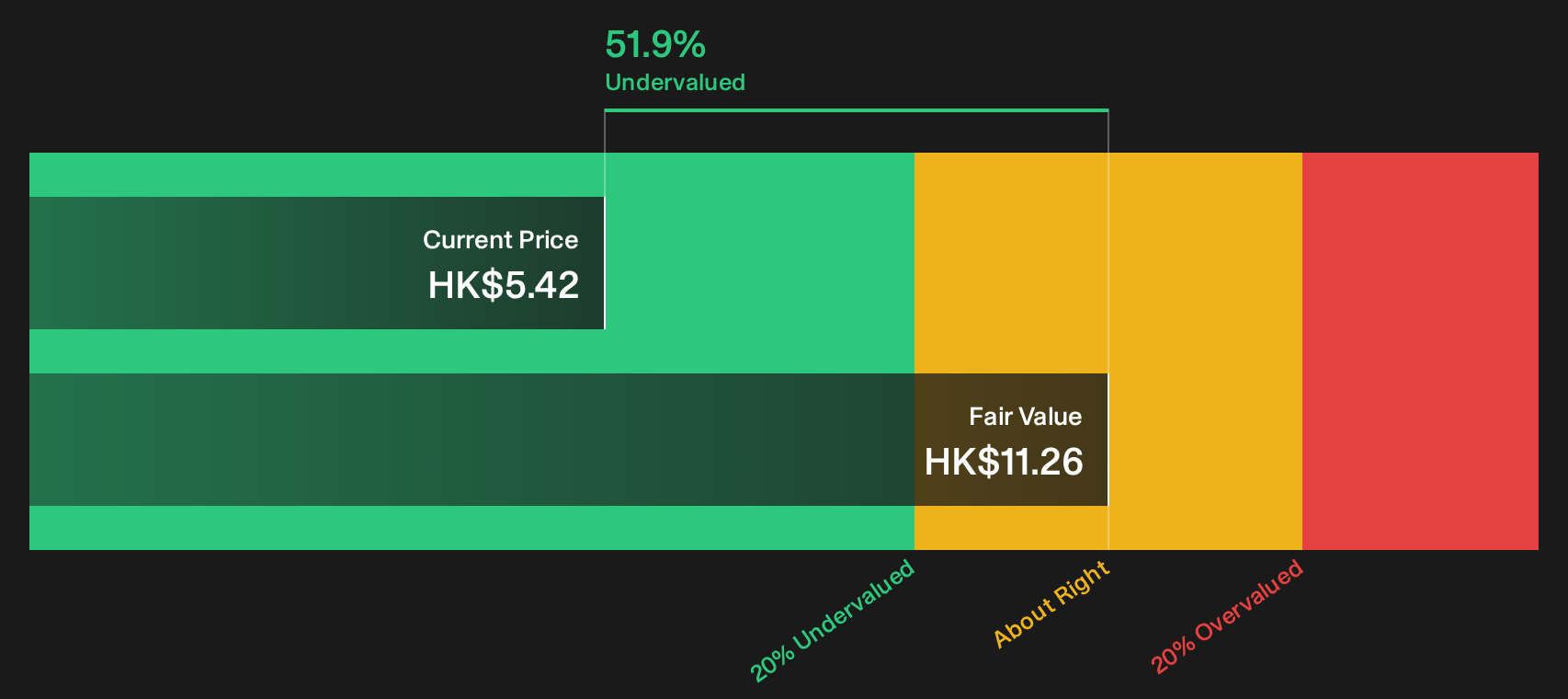
That fair value work sits alongside a much stronger verdict from the SWS DCF model, which suggests HK$5.42 is trading well below an estimated future cash flow value of HK$11.26 and labels the shares as 51.9% below fair value by that measure.
Explore the SWS fair ratio for Postal Savings Bank of China.
Result: Price-to-Earnings of 6.6x (UNDERVALUED)
Still, the narrative around Postal Savings Bank of China can change quickly if credit quality weakens or if policy shifts put pressure on net interest margins.
Find out about the key risks to this Postal Savings Bank of China narrative.
Another View on Postal Savings Bank of China’s Value
The SWS DCF model paints a far more aggressive picture. At HK$5.42, Postal Savings Bank of China is flagged as trading about 51.9% below an estimated cash flow value of HK$11.26, which frames the current P/E as only part of a much larger valuation gap.
This kind of split between earnings based pricing and cash flow estimates can point to either opportunity or a model that is too optimistic. The key question is which signal readers trust when weighing risk against potential reward.
Look into how the SWS DCF model arrives at its fair value.
Simply Wall St performs a discounted cash flow (DCF) on every stock in the world every day (check out Postal Savings Bank of China for example). We show the entire calculation in full. You can track the result in your watchlist or portfolio and be alerted when this changes, or use our stock screener to discover 184 high quality undervalued stocks. If you save a screener we even alert you when new companies match - so you never miss a potential opportunity.
Next Steps
Sentiment around Postal Savings Bank of China appears divided, with clear upside arguments on one side and meaningful questions about risk on the other. To consider both perspectives efficiently and form your own stance, review the 3 key rewards and 1 important warning sign.
Looking for more investment ideas beyond Postal Savings Bank of China?
If Postal Savings Bank of China has sharpened your focus on value and income, do not stop here. Broader ideas can sharpen your overall portfolio decisions.
- Target potential mispricings by reviewing a 184 high quality undervalued stocks that blends quality fundamentals with attractive value signals.
- Strengthen your capital preservation playbook by scanning a 97 resilient stocks with low risk scores that prioritises resilience and lower volatility profiles.
- Get ahead of the crowd by tracking a 621 high quality undiscovered gems that highlights fundamentally strong companies that are still off most investors’ radars.
This article by Simply Wall St is general in nature. We provide commentary based on historical data and analyst forecasts only using an unbiased methodology and our articles are not intended to be financial advice. It does not constitute a recommendation to buy or sell any stock, and does not take account of your objectives, or your financial situation. We aim to bring you long-term focused analysis driven by fundamental data. Note that our analysis may not factor in the latest price-sensitive company announcements or qualitative material. Simply Wall St has no position in any stocks mentioned.
Have feedback on this article? Concerned about the content? Get in touch with us directly. Alternatively, email editorial-team@simplywallst.com