


KB Home (KBH) Stock Looks Cheap On Earnings But Mixed On Value
KB Home stock has delivered a solid 30.7% gain over the past five years, yet the current checks on valuation send a more cautious signal after a weaker recent run. The share price has retreated in the shorter windows, and the broader scorecard now points to something closer to a mixed setup than a clear bargain.
- A 30.7% return over five years suggests KB Home has rewarded patient holders over the longer stretch, despite more recent weakness.
- Future pricing power in new home construction can support the case for the shares, while any pressure on housing demand or build costs may cap how much investors are willing to pay.
- On a composite view, KB Home screens as a mixed picture rather than clearly cheap or clearly expensive, with a value score of 3 out of 6 checks.
The issue now is whether the recent pullback, on top of that five year gain, leaves KB Home trading at a level that still offers an appealing risk and reward balance.
Compare KB Home's mixed valuation score and recent pullback with a curated set of potential value ideas by scanning 50 high quality undervalued stocks that share a focus on quality and price discipline.
Is KB Home Still Cheap on Earnings?
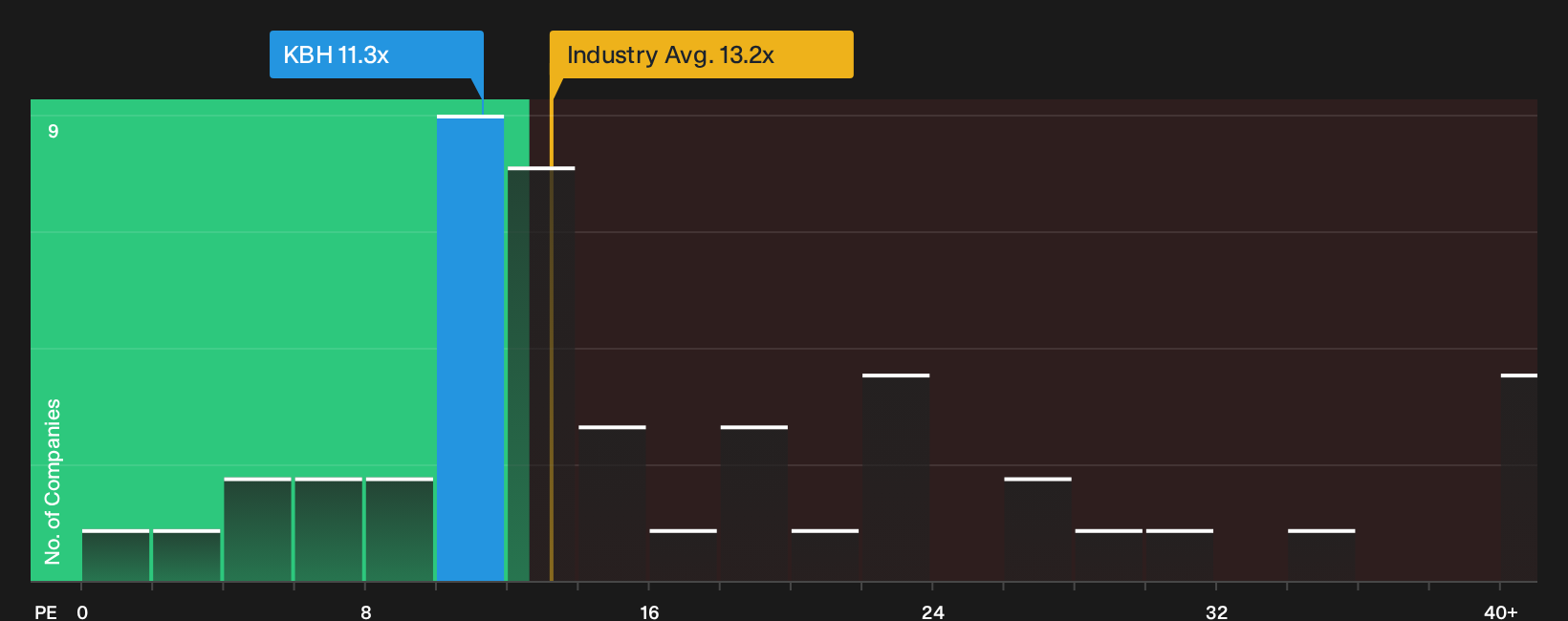
P/E works reasonably well for a builder like KB Home because earnings are a key yardstick for how efficiently it turns projects into shareholder profit. On this measure, the stock trades on a P/E of 11.3x. That sits below the Consumer Durables industry average of 13.2x and below the peer group at 14.3x.
The fair P/E that factors in KB Home's profile is 15.8x. Compared with the current 11.3x, that is a sizeable gap, which means the shares change hands at a lower earnings multiple than this framework suggests would be typical for a business with similar characteristics. For investors who focus on earnings power relative to price, KB Home currently screens on the cheaper side of the spectrum.
On the P/E yardstick, KB Home stock appears undervalued compared with both sector norms and the fair multiple implied by this model.
See what the numbers say about this price — find out in our valuation breakdown.
The KB Home Narrative: What Would Justify Today's Price?
KB Home's valuation puzzle only really comes into focus once you line it up against Simply Wall St Narratives. These spell out what kind of future on growth, margins and earnings would need to play out for the share price to look meaningfully higher or lower than it is today. Each scenario anchors a fair value to a clear storyline around potential catalysts and key risks, so you can track over time which version of KB Home's future is actually unfolding.
Community views on KB Home sit far apart, with one camp seeing meaningful upside potential and the other focused on demand and margin pressure.
Bull case: 34% undervalued
"KB Home’s build-to-order model and ongoing efforts to accelerate construction cycle times, now approaching 120 days, will allow the company to monetize its backlog more quickly…"
Read the full Bull Case to see why KB Home could be undervalued
Bear case: 16% overvalued
"Extended periods of elevated mortgage interest rates due to sticky inflation diminish affordability for entry-level buyers, directly suppressing KB Home's sales volumes…"
Read the full Bear Case to see why KB Home could be overvalued
Do you think there's more to the story for KB Home? Head over to our Community to see what others are saying!
The Bottom Line
KB Home screens as undervalued on earnings multiples, yet the broader checklist still flags a more balanced picture than a simple bargain label. The key question is whether that lower P/E reflects genuine mispricing or a fair discount for housing cycle and margin risk. Everything from here turns on how resilient demand and build economics prove to be, and whether investors eventually pay closer to peer multiples or keep pricing in those pressures.
This article by Simply Wall St is general in nature. We provide commentary based on historical data and analyst forecasts only using an unbiased methodology and our articles are not intended to be financial advice. It does not constitute a recommendation to buy or sell any stock, and does not take account of your objectives, or your financial situation. We aim to bring you long-term focused analysis driven by fundamental data. Note that our analysis may not factor in the latest price-sensitive company announcements or qualitative material. Simply Wall St has no position in any stocks mentioned.
Have feedback on this article? Concerned about the content? Get in touch with us directly. Alternatively, email editorial-team@simplywallst.com