


Bulls Are Working to Forge Bottoms in Cattle and Hog Prices
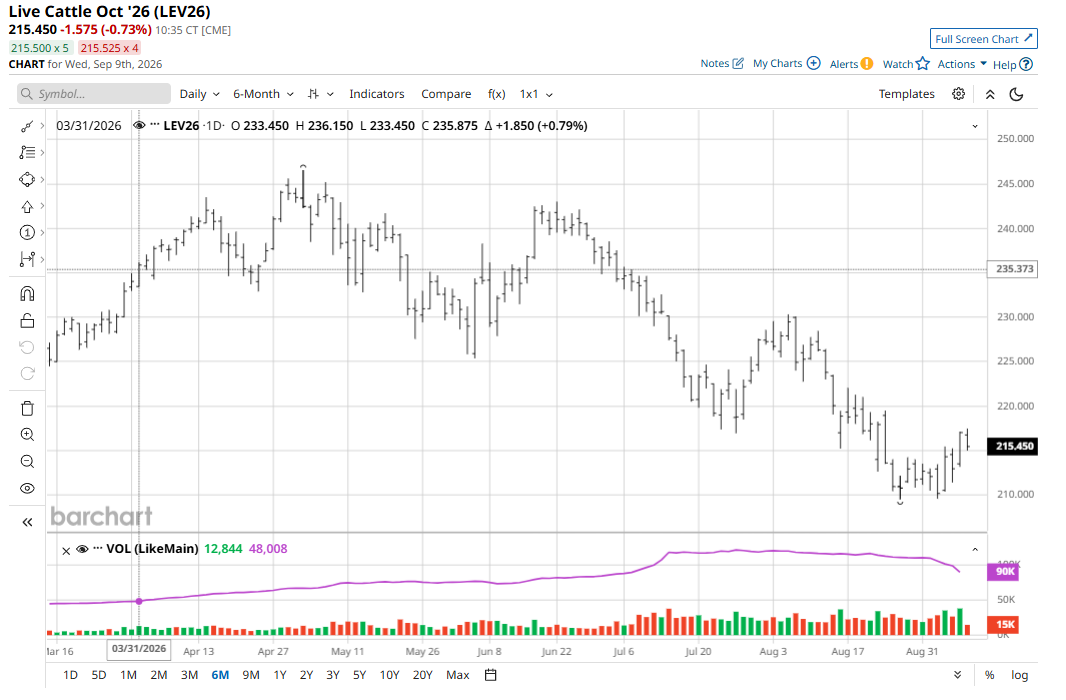
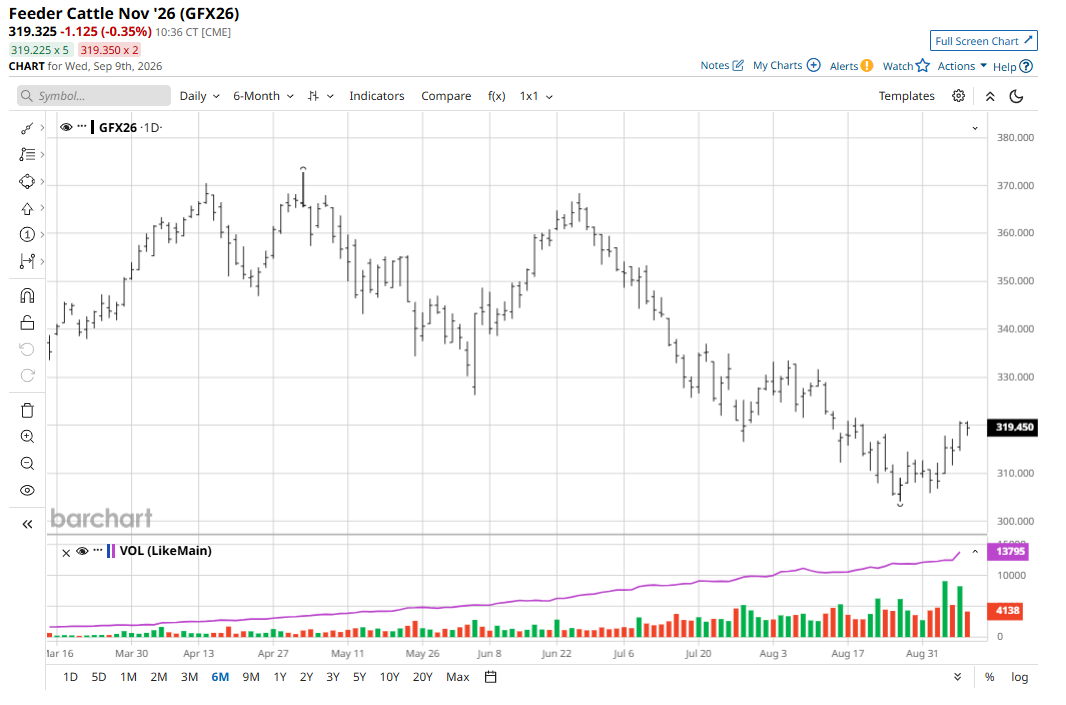
October live cattle (LEV26) futures on Tuesday rose $4.075 to $217.025 and hit a two-week high. November feeder cattle (GFX26) rose $5.725 to $320.45 and hit a three-week high. Both markets in morning trading on Wednesday were giving back some of Tuesday’s strong gains to start the holiday-shortened trading week.
The cattle futures markets on Tuesday saw more solid short covering and perceived bargain buying by the speculators. President Donald Trump’s recent overtures to get smaller U.S. beef processors ramped up appears to have also given a psychological boost to the cattle industry.
October live cattle futures continue to trade at a discount to the cash cattle market, which is also supportive for futures. USDA at midday on Tuesday reported cash cattle trading last week averaged $219.06. The agency said cash cattle trade the week prior averaged $219.25.
Cattle Trade Resumes at Douglas as New World Screwworm Cases Hold Steady
USDA’s Agricultural Marketing Service (AMS) reported that 800 Mexican feeder cattle entered the U.S. through Douglas, Arizona, on Tuesday, Sept. 8, restoring movement through the crossing following an equipment-related interruption. AMS described trade and demand as moderate and noted “a lower undertone,” while cautioning that there were no recent sales for comparison. All cattle reported were steers weighing 500–800 pounds. The resumption follows a shutdown that began Aug. 28 because of safety problems with a cattle inspection chute at Agua Prieta, across the border from Douglas. The crossing had initially reopened Aug. 24 under the USDA’s phased restoration of Mexican livestock imports.
Said respected ag markets watcher Jim Wisemeyer of Ag Bull Media: “Resumed imports offer Southwest cattle feeders another source of replacement animals. Sustained increases could ease competition for available feeder cattle and temper prices at the margin. That matters because USDA’s August outlook identified tighter domestic calf supplies for feedlot placement heading into late 2026 and early 2027. However, 800 feeder steers provide limited immediate relief to beef availability. These animals require additional growing and finishing before slaughter, so their contribution to beef production comes months later. A meaningful effect on national supplies and retail prices would require sustained, substantially larger movements.” He added, “The next market tests are whether Douglas maintains daily crossings, whether volumes expand, and whether USDA authorizes additional ports.”
The USDA’s Animal and Plant Health Inspection Service (APHIS) separately reported no additional confirmed New World screwworm cases. The cumulative total held at 48, with one animal case still active — a dog in Crockett County, Texas. That is encouraging for containment.
Fort Morgan, Colorado Beef Plant Set to Reopen
In the meantime, another potential positive for the cattle industry, including futures prices, is that Cargill’s Fort Morgan, Colorado, beef plant was scheduled to resume cattle slaughter during the week of Sept. 7, according to the company’s timetable. The restart follows workers’ Aug. 17 approval of a five-year labor agreement, clearing the way to reopen a major regional processing outlet after months of inactivity. The timing still needs confirmation. As of Wednesday, the actual resumption of slaughter and the plant’s operating rate could not be independently verified.
Lean Hog Futures Rebound, But Smithfield Foods Warns
October lean hog (HEV26) futures on Tuesday rose $1.95 to $84.25 but on Wednesday morning were giving back most of those gains. The latest CME lean hog index is down 54 cents to $90.54 as of Sept. 3. Today’s projected CME index price is down another 89 cents at $89.65. The national direct five-day rolling average cash hog price quote for Tuesday was $89.35.
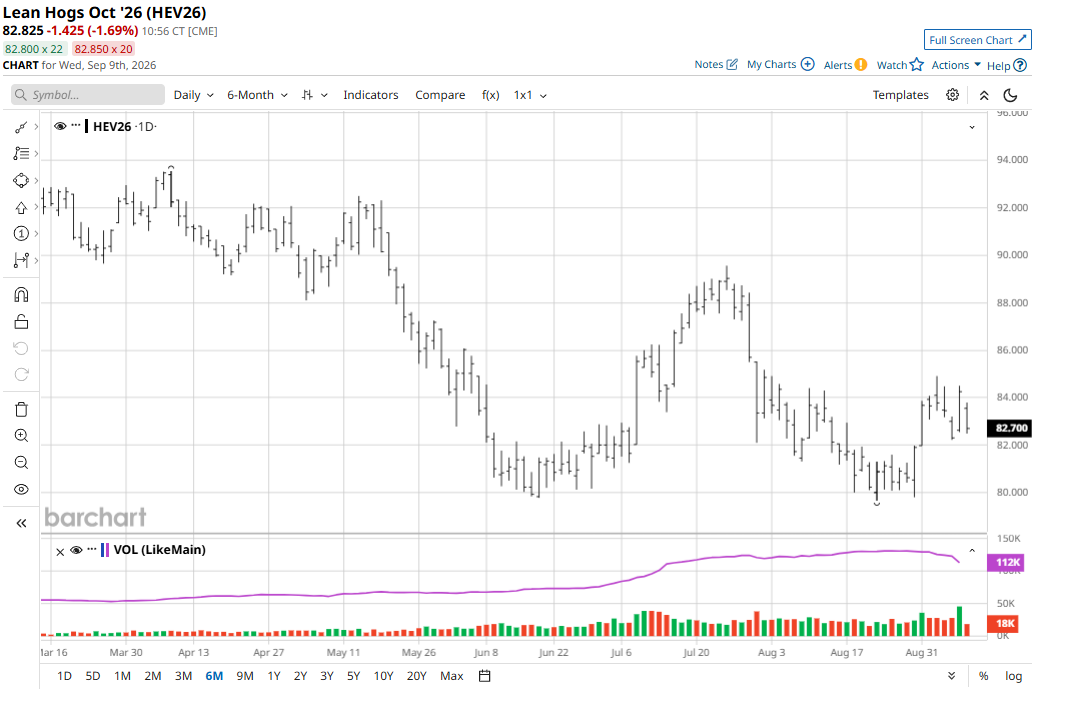
The selling pressure in lean hog futures on Wednesday came as Smithfield Foods warned on Tuesday that its fresh pork business is expected to swing to a third quarter adjusted operating loss as declining wholesale pork values compress processing margins, Reuters reported. The company also projected weaker hog-production earnings, signaling pressure on both processors and producers. Tuesday’s announcement was a guidance update ahead of an investor conference; third-quarter results are still forthcoming.
Smithfield now expects a $70 million to $90 million adjusted operating loss in fresh pork and $25 million to $45 million in hog-production profit. Total company adjusted operating income is projected at $115 million to $175 million. Those forecasts compare with year-earlier profits of $10 million in fresh pork, $89 million in hog production, and $310 million companywide. The new companywide range implies a roughly 44% to 63% decline from the third quarter of 2025.
Said Ag Bull Media’s Wiesemeyer: “The market implication is that cheaper hogs are providing insufficient relief to processors. A packer’s economics depends heavily on the relationship between the value of the pork it sells and the cost of the animals it buys. Falling hog prices can improve that relationship, but weaker wholesale pork values can overwhelm the benefit. Smithfield’s outlook indicates that the remaining spread is inadequate to support fresh pork profitability. For producers, that creates a potential second round of pressure. Persistent processing losses could encourage packers to bid less aggressively for hogs or reduce slaughter schedules. For the hog market, the next signals are whether pork cutout values stabilize, slaughter schedules hold and carcass weights remain manageable. A recovery in wholesale pork demand would offer a healthier route to restoring processing margins; improvement achieved mainly through lower hog bids would shift more of the adjustment onto producers.”
Let me know what you think. I enjoy hearing from my valued Barchart readers all around the globe. Email me at jim@jimwyckoff.com.
On the date of publication, Jim Wyckoff did not have (either directly or indirectly) positions in any of the securities mentioned in this article. All information and data in this article is solely for informational purposes. For more information please view the Barchart Disclosure Policy here.