


Did CFO Exit Just Shift Charter Communications (CHTR) Investment Narrative?
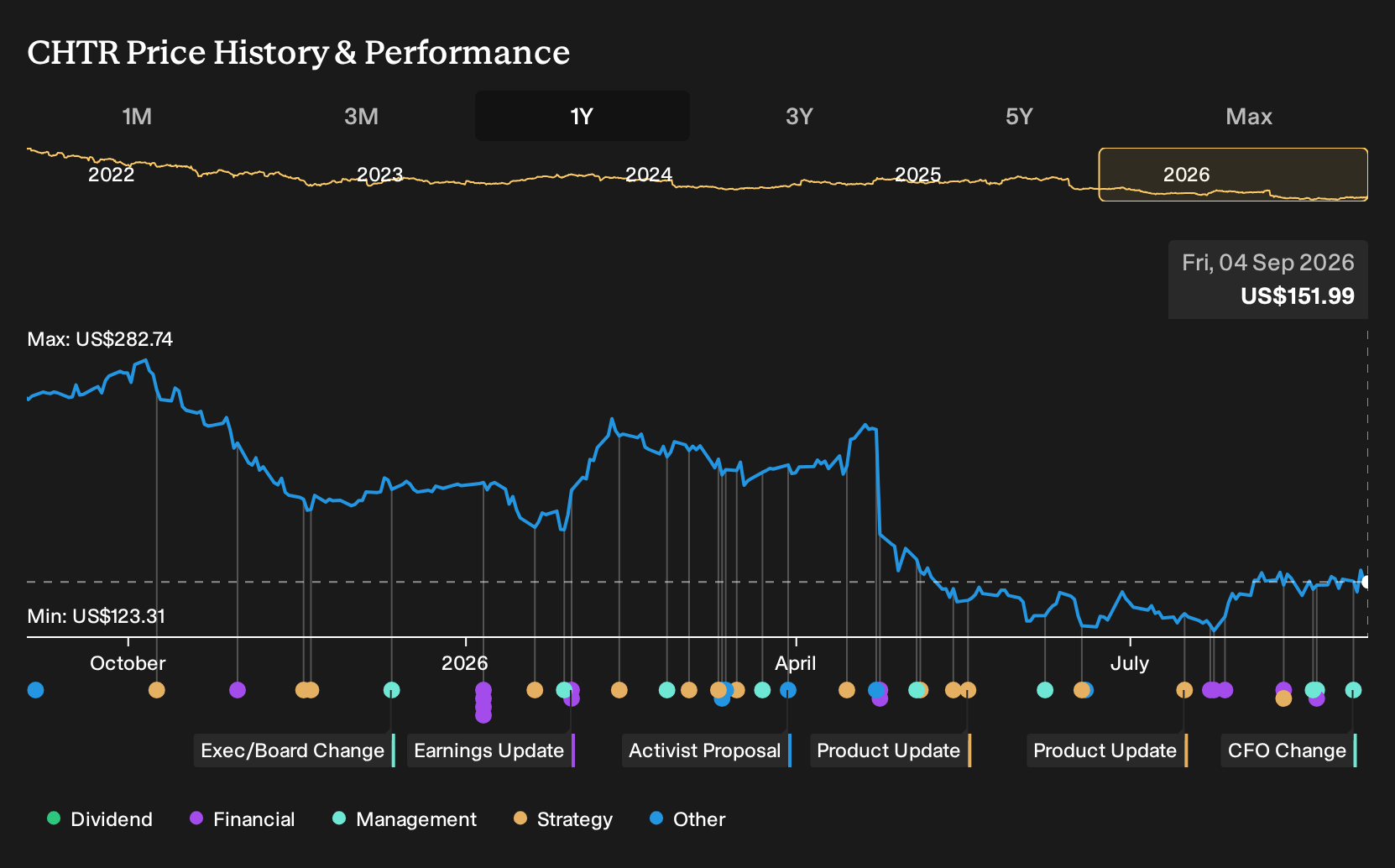
- Charter Communications reported that long-serving CFO Jessica Fischer, who has been with the business for nearly a decade and in the finance chief role since 2021, stepped down in October 2026. Executive Vice President and Chief Accounting Officer Kevin Howard was appointed as interim CFO.
- The appointment of Howard, who has overseen accounting, tax, reporting and ERP operations and previously led integration of major acquisitions such as Time Warner Cable and Bright House Networks, concentrates financial oversight in the hands of an executive deeply tied to Charter Communications' past transaction and systems decisions.
- Next, the focus shifts to how this CFO transition at Charter Communications, and Howard’s interim role, shapes the broader investment narrative.
Charter Communications Investment Narrative Recap
To own Charter Communications, you need to believe the broadband and mobile bundle can keep households sticky even as competition from fiber and wireless alternatives sharpens. In the near term, the story still revolves around broadband subscriber trends, Spectrum Mobile uptake, and how effectively the network upgrades and AI driven service changes can keep churn and support costs in check.
The CFO handover to Kevin Howard looks operational rather than thesis breaking. The bigger swing factor is how consistently Charter funds heavy network and spectrum spending while carrying roughly US$93.6b of debt. Interest coverage and capital intensity remain the key financial pressure points to watch over the next few quarters.
The Jessica Fischer exit and Kevin Howard’s interim appointment matter mainly for execution on those existing priorities. Howard already oversees accounting, tax, reporting, and ERP operations, and previously led integration of acquisitions like Time Warner Cable and Bright House Networks. That continuity should help keep financing, spectrum commitments, and DOCSIS 4.0 related spending aligned with Charter Communications’ current plan, which is important when interest payments are not well covered by earnings and capital needs are high.
Investors watching catalysts will likely link this to how smoothly Charter can keep pushing Spectrum Mobile and converged offers without disruption to funding or reporting discipline. Stable financial leadership can reduce the odds of messy surprises in leverage, capex timing, or share repurchases at a moment when analysts already expect flat revenue and earnings. Any sign that this transition complicates those operational levers would quickly change how the risk and reward trade off feels.
Yet there is a less obvious weak point that starts to emerge once you line up Charter’s leverage, interest cover, and...
Read the full Charter Communications narrative to see the case behind these numbers.
Charter Communications is modeled to reach about US$53.9b in revenue and US$4.9b in earnings by 2029, with analysts assuming fairly flat top line performance and no change from current earnings of roughly US$4.9b, so the consensus view implies essentially 0% yearly revenue growth and no earnings increase from today.
Charter Communications' forecasts put fair value at $184.41 compared with $151.99, implying a 21% upside to its current price that could narrow quickly.
Exploring Other Perspectives
The biggest disagreement around Charter Communications is not the CFO handover itself but how fragile earnings might already be. The most pessimistic analysts were projecting revenue of about US$52.2b and earnings of US$3.5b by 2029, well below consensus. That cohort sees execution risk as much higher, so this leadership change may reshape their story. Readers should treat this as a prompt to compare several viewpoints rather than rely on a single forecast.
To see how other investors are valuing Charter Communications, compare the 5 other fair value estimates for Charter Communications side by side with the current consensus figure.
Decide For Yourself
Disagree with existing narratives? Extraordinary investment returns rarely come from following the herd, so go with your instincts.
- A great starting point for your Charter Communications research is our analysis highlighting 2 key rewards and 2 important warning signs that could impact your investment decision.
- See our latest analysis for Charter Communications. The report includes a comprehensive fundamental analysis summarized in a single visual, the Snowflake, making it easy to evaluate Charter Communications' overall financial health at a glance.
Looking For More Investment Ideas Beyond Charter Communications?
Once you have a view on Charter Communications, it often helps to widen the lens and see how other businesses stack up on quality, balance sheet strength, and potential payout. The Simply Wall St screener can help you scan a broad set of stocks using clear fundamental filters rather than headlines or hype.
- If you want resilient balance sheets and solid fundamentals to anchor your watchlist, start with a list of solid balance sheet and fundamentals (24 results) that already meet strict financial health checks.
- For investors who care most about capital preservation and steadier risk profiles, filter for 83 resilient stocks with low risk scores that score well on volatility and business quality metrics.
- If cash returns matter to you as much as price moves, sort through 6 dividend fortresses that combine higher yields with underlying financial strength.
This article by Simply Wall St is general in nature. We provide commentary based on historical data and analyst forecasts only using an unbiased methodology and our articles are not intended to be financial advice. It does not constitute a recommendation to buy or sell any stock, and does not take account of your objectives, or your financial situation. We aim to bring you long-term focused analysis driven by fundamental data. Note that our analysis may not factor in the latest price-sensitive company announcements or qualitative material. Simply Wall St has no position in any stocks mentioned.
Have feedback on this article? Concerned about the content? Get in touch with us directly. Alternatively, email editorial-team@simplywallst.com