


Review of the first half of 2026: Shanghai and Shenzhen Stock Connect's average daily turnover of 345.3 billion yuan more than doubled year-on-year
The Zhitong Finance App learned that on September 7, the Hong Kong Stock Exchange released the review of the first half of 2026 of the Shanghai, Shenzhen, and Hong Kong Stock Connect. Record trading volume, expansion of eligible products, and active investor participation will drive the Shanghai-Shenzhen-Hong Kong Stock Connect to continue active trading in the first half of 2026. According to data from the Hong Kong Stock Exchange, the average daily turnover of northbound transactions in the first half of 2026 reached RMB 345.3 billion, more than double the same period last year (first half of 2025: RMB 171.3 billion), and 62.6% higher than last year (full year of 2025: RMB 212.4 billion). In terms of southbound transactions, the average daily turnover in the first half of 2026 reached HK$123.1 billion, surpassing the record of HK$121.1 billion set for the full year of 2025.
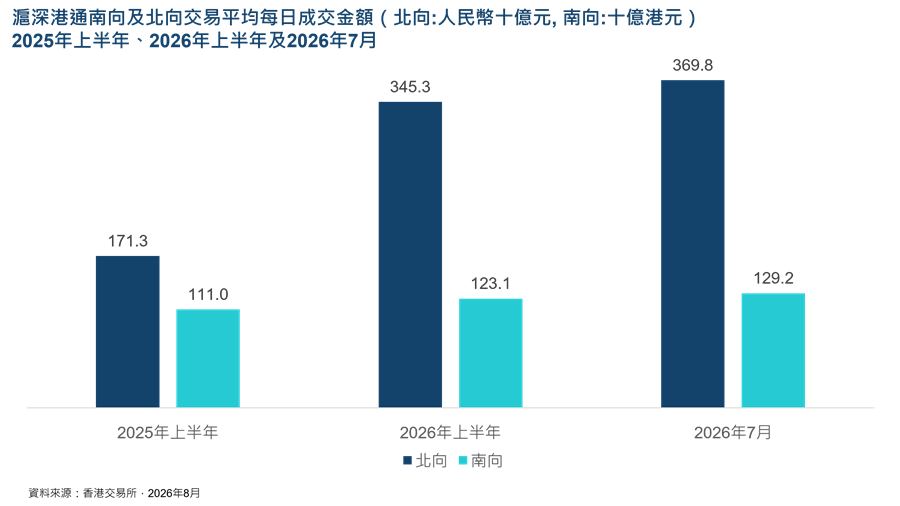
Shares in the technology industry, advanced manufacturing, and innovation-related industries are trading well. In terms of northbound trading, shares related to the A-share growth industry and the hard technology industry chain (including semiconductors and advanced manufacturing) are active. In the first half of 2026, a number of related shares were ranked among the top ten active trading stocks traded northbound.
The main impetus for the southbound deal also comes from technology and innovation-related sectors, including artificial intelligence and semiconductor companies listed in Hong Kong in recent years. Such enterprises have rapidly become investment targets for south-bound capital chases, reflecting that Hong Kong's growing technology ecosystem is creating new investment opportunities for mainland Chinese investors, and further establishing Hong Kong's role as an important bridge between innovative enterprises and international capital.
By the end of June 2026, the number of A-shares eligible for northbound trading had increased from 3258 at the end of 2025 to 3503. The new shares mainly come from the Science and Technology Innovation Board of the Shanghai Stock Exchange and the GEM Board of the Shenzhen Stock Exchange, covering industries such as technology hardware, biotechnology, the NEV industry chain and advanced materials. In the same period, southbound trading was also expanded, adding 47 Hong Kong-listed shares and 8 ETFs.
ETFs chose more diversification. By the end of June 2026, the number of eligible northbound ETFs increased to 365, further expanding the range of industries, topics and indices that international investors can invest in. In the first half of 2026, the average daily turnover of Northbound ETFs reached RMB 4.8 billion, up 44.1% from 2025.
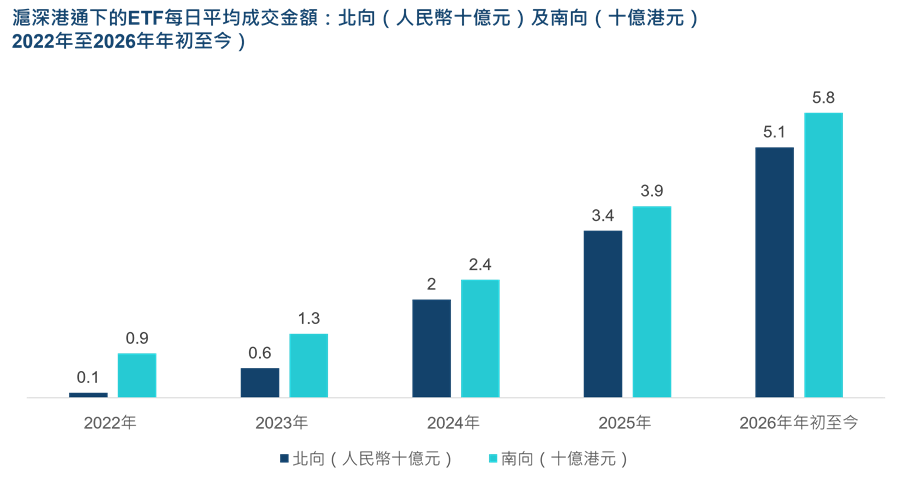
Meanwhile, the average daily turnover of Southbound ETFs reached HK$6.2 billion at the end of June 2026, accounting for 6.1% of the average daily turnover of the Hong Kong ETP market. Following the eligibility scope review in May 2026, the number of eligible southbound ETFs increased from 23 at the end of 2025 to 31.
New products include the “60/40” ETF. This type of product mainly invests in Hong Kong stocks, and can allocate no more than 40% of international market investment. As of the end of June 2026, a total of seven such ETFs were eligible for Hong Kong Stock Connect, covering investment themes in US and Korean technology, artificial intelligence, and global income strategies.
Overall, the Shanghai-Shenzhen-Hong Kong Stock Connect set a number of records in the first half of 2026, driven by factors such as active investor participation, the expansion of the range of eligible products, and the increasing popularity and scale of ETF investment. The Hong Kong Stock Exchange said it will continue to work with partners and stakeholders to promote the development of the connectivity ecosystem, open up more opportunities for investors and issuers, and further deepen capital ties between mainland China, Hong Kong and the global market.