


Questioned as the “ambassador of the AI bubble,” can Ellison respond to Wall Street with Oracle (ORCL.US) earnings this week?
The Zhitong Finance App learned that Oracle (ORCL.US) will release its financial report for the first quarter of the 2027 fiscal year this week, putting an end to what can be called the most turbulent 12 months in the company's 49-year history.
A year ago, Oracle's first fiscal quarter report pushed its stock price to a record 36% increase in a single day. The Austin, Texas-based tech giant told investors at the time that its remaining performance obligations (RPO) soared 359% to an astonishing $455 billion. The increase in this backlog was mainly due to a $300 billion agreement with ChatGPT developer OpenAI — a partnership that at the time was seen as a landmark endorsement of Oracle's transformation from a traditional database software company to a cloud giant.
However, the situation is not what it used to be. Since the boom a year ago, Oracle and its chairman Larry Ellison (Larry Ellison) have been on the cusp of the AI spending debate. A recent feature in The New York Times magazine discussed whether Ellison, as one of the richest people in the world, will become a “spokesperson for the AI bubble.”
Market concerns about the huge expenses required for Oracle's AI vision have caused its stock price to drop by more than 50% from its all-time high in September last year. Most of the attempts to bounce back over the past 12 months have gone nowhere. Oracle's relative strength line (which measures the performance of individual stocks compared to the S&P 500 index) is currently only 12 (out of 99), and its performance is very weak.
This makes the upcoming financial report once again a key litmus test for the market's confidence in AI infrastructure construction. Recent quarterly reports from Nvidia (NVDA.US) and cloud giants Amazon (AMZN.US), Microsoft (MSFT.US), and Google parent company Alphabet (GOOGL.US) all show that demand for computing power infrastructure continues to be strong.
Paul Meeks (Paul Meeks), managing director and head of technology research at Freedom Capital Markets, described Oracle's AI offensive as an extreme case of “good things turning bad.”
“The good thing is that this dormant company has been awakened and revenue has accelerated significantly; but the bad thing is that free cash flow has been negative for five consecutive quarters to support its ambitions,” Meeks said.
The huge amount of money behind the high revenue growth
From the revenue side, Oracle's AI bets did have immediate results. Overall revenue for the 2026 fiscal year increased by 17%, while the average annual growth rate for the 2019 to 2025 fiscal year was only 5.4%. The company even gave sales guidance of 90 billion US dollars for fiscal year 2027, corresponding to an increase of more than 30%.
The core driving force comes from Oracle Cloud Infrastructure (OCI), a business that challenges the three major cloud giants of Amazon, Microsoft, and Google, generated $18 billion in revenue in fiscal year 2026, an increase of 77% over the previous year. Cloud demand has further boosted the company's RPO (the amount of contracts signed but not yet confirmed as revenue), and as of May, its backlog of orders had reached US$638 billion.
But the other side of the coin is a sharp rise in costs. To meet the needs of customers such as OpenAI, Oracle is building a total of 4.5 gigawatts of data center capacity. In fiscal year 2026, Oracle's operating cash flow increased 54% year over year to US$32 billion, but capital expenditure more than doubled during the same period to reach US$55.6 billion, directly leading to negative free cash flow of US$23.7 billion. Just two years ago, Oracle's free cash flow was still positive at $11.8 billion, and capital expenditure was only $6.9 billion.
To fill the funding gap, Oracle announced in February this year that it plans to raise 50 billion US dollars through a combination of bond issuance and equity financing. Chief Financial Officer Hilary Maxson (Hilary Maxson) said in June that capital expenditure for the 2027 fiscal year will reach 90 billion to 95 billion US dollars, of which up to 25 billion US dollars will be covered by advance payments from cloud customers.
Oracle also shares part of the costs by letting customers buy their own advanced computing power chips. However, according to FactSet data, analysts expect Oracle's free cash flow (rolling for 12 months) to remain negative until fiscal year 2030.

Massive capital expenditure and continued burning of money have begun to erode Oracle's credit fundamentals. In July of this year, S&P Global Ratings downgraded Oracle's credit rating from BBB to BBB-, which is only one level higher than junk.
S&P stated bluntly in the rating report: “Oracle's rapidly expanding AI infrastructure business is increasing its overall credit risk, reflecting our more cautious view of the AI infrastructure industry, including rising capital expenditure requirements, uncertain profit paths, rapidly evolving industry competition, and high customer concentration.” The report specifically points out that OpenAI accounts for “about half” of Oracle's remaining performance obligations, and this customer concentration makes Oracle's stock price highly sensitive to OpenAI's dynamics.
Last September, Oracle also underwent a rare leadership change, which further exacerbated the company's upheaval. Clay Magouyrk (Clay Magouyrk) and Mike Sicilia (Mike Sicilia) were appointed as co-CEOs, and Safra Catz (Safra Catz), who has been CEO for a long time, was replaced as Executive Vice Chairman. In April of this year, Oracle also appointed a new chief financial officer.
The Ellison-centered leadership team promised to continue to invest heavily in the AI vision, but whether management can balance growth and financial discipline remains the focus of investors' attention.
Meeks pointed out that Oracle's history has attracted “value investors” seeking stable cash flow and annual dividends. “What they want is a turtle, not a rabbit. But now this company wants to be a rabbit.” This shift in the investor structure, compounded by deteriorating fundamentals, explains the sharp decline in stock prices.
Earnings expectations: Analysts are still generally bullish, but differences are growing
When Oracle releases its first fiscal quarter results, it will once again be given the opportunity to sell its vision to investors. The company also plans to host the annual “AI World” customer conference in Las Vegas at the end of October.
According to compiled data, analysts currently generally expect Oracle's adjusted earnings per share for the first quarter to be 1.73 US dollars, and revenue is expected to be 19.1 billion US dollars, up 28% year on year. This growth rate is far higher than the company's level of about 11% in the same period last year.
However, the gap between revenue growth and profit growth is worth paying attention to. The market expects adjusted earnings per share to increase by about 18.5% this quarter, which is significantly lower than the 28% revenue growth rate. This means that Oracle is sacrificing short-term profit margins in exchange for rapid expansion of the cloud infrastructure business.
This contrast is even sharper in comparison with hardware vendors. Take Micron Technology (MU.US), for example. Its revenue for the 2026 fiscal year is expected to increase by 246%, while earnings per share are expected to increase by more than 840% — Micron benefits from strong demand and pricing power for AI memory chips, while Oracle is more of a “person who paid for this feast.”
Despite this, Wall Street as a whole remains optimistic. According to the data, 80% of analysts gave Oracle a “buy” or equivalent rating, up from 67% a year ago. Of the 45 analysts, 42 gave a “buy” rating, 8 “hold”, and only 1 “sell.”
Jefferies analyst Brent Thill (Brent Thill) reiterated Oracle's “buy” rating, but lowered the target price from $320 to $290. He believes that the first quarter was Oracle's “seasonally weak” quarter, but “stock prices have been excessively suppressed, and risk and return seem favorable.” Investors will focus on OCI growth, which is expected to accelerate to 115%, and the latest progress in data center construction.
Morgan Stanley, on the other hand, raised Oracle's target price slightly from $207 to $210, maintaining a “neutral” rating. Analyst Sanjit Singh (Sanjit Singh) believes that Oracle's transformation to a cloud infrastructure leasing business still “has a long way to go,” but the stock price has fallen 25% since the last earnings report in June. “Given the quarterly stock price performance and current valuation, there is an opportunity for active tactical layout before the financial report.”
Bank of America Securities analyst Tal Liani (Tal Liani) is more optimistic, reaffirming the “buy” rating and the target price of $240. He wrote in a customer report: “Although Oracle's stock narrative mainly revolves around the cloud infrastructure business, we believe traditional software businesses are still an important part of the investment logic. We expect cloud SaaS revenue to grow 12.8% in the first quarter, up from 10.3% in the fourth quarter, thanks to continued cloud migration and increased customer productivity brought about by embedded AI capabilities.”
Options Market: Volatility Pricing and the “Wide Span Swap” Strategy
In the options market, traders' pricing of Oracle reflects investors' high uncertainty about this financial report. According to the observations of options analyst Michael Khouw (Michael Khouw) last Wednesday, options pricing suggests that Oracle's stock price may fluctuate by more than 10% by the end of the week, which is in line with the average for the past two years. The calculation of Oracle's closing price of $145 last Wednesday means that the company's stock price may break through $160 or fall below $130 after the earnings report is released.
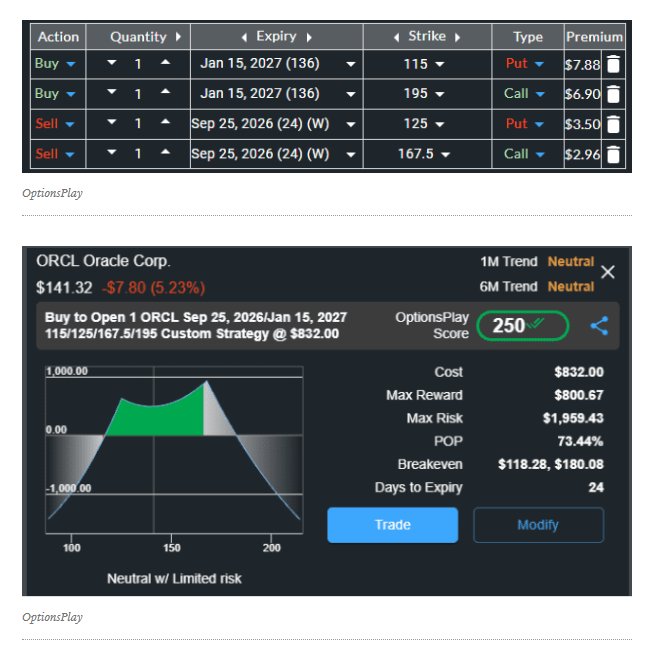
In order to adapt to this highly volatile environment, the bank proposed an option strategy known as a “strangle swap” (strangle swap, or double diagonal strategy): selling a $125/167.5 cross-style combination (selling $125 put options and a $167.5 call option at the same time) due on September 25, while buying a $115/195 wide-span package due in January, with a net debit of about $8.30. According to current pricing, the profit probability of this position is over 70%, and the break-even points at maturity are about $118 and $180, corresponding to a rise or fall of about 17%-18%, respectively.
The core logic of this strategy is to sell expensive short-term volatility, bet that long and short sides may continue to juggle over the next few months after earnings reports, while retaining long-term options to cope with huge fluctuations that actually exceed expectations.
“If the results of the financial report are only 'OK, 'or 'slightly underperforming,' rather than bringing about a fundamental turning point, then the rapid decline in time value of options due in September (that is, the 'collapse of volatility') will benefit us. And if Oracle (or OpenAI) has a major impact, positive or negative, the options contract due in January provides us with a buffer that naked sellers don't have — more time margin,” Library explained.