


Omdia: Global XR headset shipments in the first half of the year were 1.9 million units, down 38.7% year on year
The Zhitong Finance App learned that Omdia's latest data shows that in the first half of 2026, global XR headset shipments fell 38.7% year on year to 1.9 million units. Although the market acceptance of XR glasses continues to increase, since their market base is still small, the related growth is insufficient to offset the sharp decline in XR headset shipments. In 2025, the XR market contracted for the fourth year in a row after experiencing a high point during the 2021 pandemic.
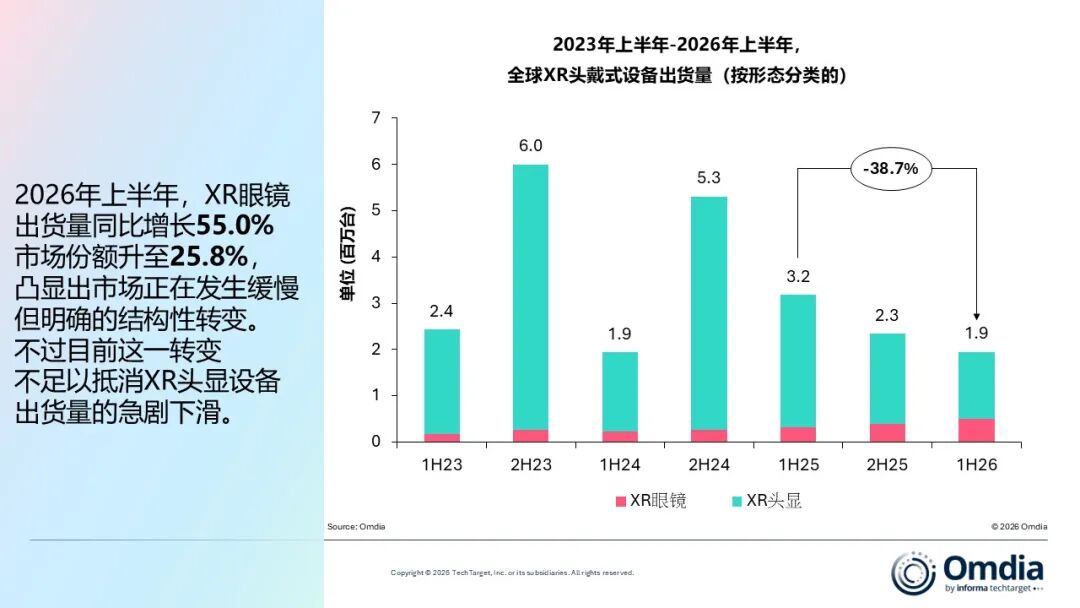
In the first half of 2026, XR glasses rose to 25.8% of total global XR headset shipments, a significant increase from 10.2% in the first half of 2025. This increase was almost entirely driven by tethered XR glasses (tethered XR glasses), of which RayNeo, VITURE, and XREAL together account for 93.1% of the market segment. Strong demand for products such as the RayNeo Air 4 and VITURE Beast series led RayNeo and VITURE to rank second and third in the overall XR headset market with 9.9% and 8.6% market shares, respectively.
“XR glasses are continuously gaining market momentum as consumers are increasingly willing to sacrifice part of their sense of immersion in exchange for a lower usage threshold.” Omdia senior analyst Ju Qiran said, “The lighter design, as well as usage scenarios familiar to consumers such as watching movies and games, are further lowering the popularity threshold for XR glasses.”
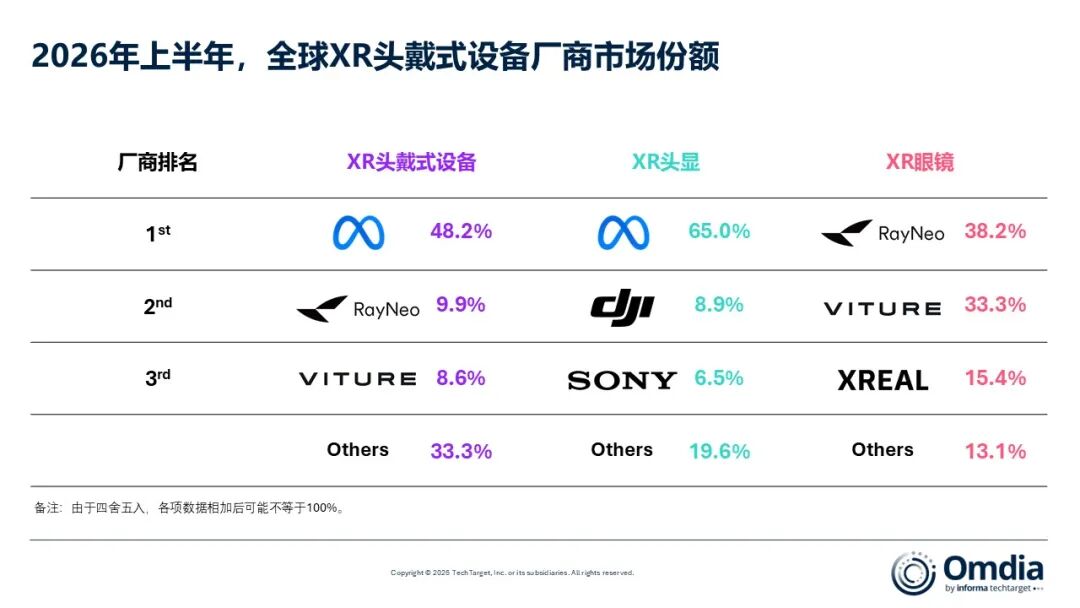
Meanwhile, despite continued weakening demand for the Meta Quest 3 and 3S, Meta maintained its leading position in the overall market; however, its market share fell sharply from 71.3% in the first half of 2025 to 48.2% in the first half of 2026.
George Jijiashvili, senior chief analyst at Omdia, said: “Meta has invested significant resources in headsets, but has never been able to replicate Quest 2's groundbreaking success. Although the Quest 3 and 3S provide superior specifications at an affordable price, they have failed to drive a significant upgrade cycle or substantially expand the user base. The headphone market continues to be sluggish, further confirming that it is still difficult for bulky headsets to gain widespread popularity outside of the core group of enthusiasts.”
Looking at the regional market, North America will still be the world's largest XR headset market in the first half of 2026, accounting for 43.9% of global shipments; Western Europe ranked second with 23.8%. Thanks to the strong popularity of external XR glasses in the local market, Greater China's share of global shipments increased the highest among all regions, from 11.9% in 2025 to 16.3% in the first half of 2026, surpassing the rest of the Asia-Pacific region and becoming the third largest regional market in the world.
Jijiashvili said, “The next stage in the evolution of XR will no longer require users to enter a virtual environment that is relatively separate from the real world, but will allow AI and spatial computing power to be integrated into everyday wearable devices in a more natural way. Moving from an occasional, closed immersive experience to higher-frequency, lighter, and less burdensome interactions will be the key for XR to break through the current core enthusiast circle and move to a wider user market.”