


The “thousand-fold profit” crypto investment giant made a big move: sell Solana and switch to heavy Bitcoin
Zhitong Finance App learned that when the cryptocurrency market experienced sharp fluctuations in August and Bitcoin once again reached the $80,000 mark, Mark Yusko, founder and chief investment officer of Morgan Creek Capital Management, made a major position adjustment decision that attracted widespread attention in the market. The institutional investment veteran, who manages billions of dollars in assets, revealed in an interview on the Crypto Banter podcast broadcast last Saturday (September 6) that he has sold about 90% of his Solana (SOL) holdings, making a profit close to 1,000 times the initial investment amount, and allocating about half of his personal net assets to Bitcoin and related assets.
Behind this investment decision, Yusko reflects years of deep thought on the cryptocurrency circuit — he has firm beliefs in Bitcoin's “digital gold” narrative, but fundamental doubts about the economic model of most altcoins.
Solana's “thousand times return” and exit logic
Yusko revealed in an interview that he obtained Solana's exposure through an early investment in Multicoin Capital's first fund, and this investment was probably the most profitable deal in his career. He described this revenue as about 1,000 times, and particularly thanked Multicoin co-founders Kyle Samani and Tushar Jain for their choices.
However, it was this amazing return itself that prompted him to make the decision to leave the field. Yusko said he decided to sell his position after learning that someone was planning to host a $2.5 million lavish party in Amsterdam — he sees this extravagance as a typical sign of excessive optimism in the market. “We sold 90%,” he said in an interview, later clarifying his previous statement of “selling everything.”
Yusko emphasized that the withdrawal was not due to hostility to Solana's network technology. Instead, he believes that the economic mechanisms of Solana, Ethereum, and other blockchain tokens fail to adequately reward token holders, and that holders cannot directly access fees or cash flows generated by their underlying networks. He made a similar distinction for Uniswap — praising its decentralized exchange product but criticizing its token because holders don't automatically receive financial benefits from the platform's business.
According to Yusko, initial coin offerings (ICOs) allow projects to raise capital through tokens, but these tokens do not provide ownership, claims, or the right to participate directly in cash flow. This is the core logic that distinguishes Bitcoin from other cryptocurrencies.
Bitcoin: “Half” of a person's net worth
In stark contrast to his cautious approach to altcoins, Yusko's allocation to Bitcoin is astonishingly strong. His personal portfolio currently has a highly centralized structure: approximately 45% is direct Bitcoin and Bitcoin-related investments, 45% is venture capital, and 10% is cash or other liquid assets.
“I didn't hold that much Bitcoin in the beginning, but then it grew to where it is now,” Yusko said of his Bitcoin holdings, adding that he is happy with the current allocation ratio. His holdings include Bitcoin itself and company shares holding the cryptocurrency, and he keeps his direct Bitcoin holdings in a cold wallet.
Yusko specifically mentioned Strategy (MSTR.US) shares, admitting that he regretted exchanging spot bitcoins for the stock, but still supports Executive Chairman Michael Saylor's overall strategy — using long-term debt that cannot be redeemed early to fund the purchase of bitcoins. He also used Strategy's floating interest rate preferred stock STRC as an income asset for short-term expenses, pointing out that the stock had a yield of around 12.5%.
Yusko suggests that most investors allocate 5% to 10% of their wealth in Bitcoin or similar currency hedging instruments. He believes that for young investors who have been investing for decades, it is reasonable to take higher risks in stocks and digital assets.
Asset allocation from an institutional perspective suggests market prospects: short-term prudence, long-term bullish
Although personal holdings are highly concentrated in Bitcoin, Yusko is not blindly optimistic about short-term trends. He expects Bitcoin's cyclical low to occur around October 5, 2026. He believes that the market is “super, super overbought,” and that the recent sharp rise is similar to a short market in a bear market, and warns that Bitcoin may fall to a low level of around 60,000 US dollars again before rebounding.
However, he refuted predictions that Bitcoin's price would drop to $30,000 or $40,000. A valuation model based on Metcalfe's Law — which attempts to link the value of the network to the number of its users — he estimates that Bitcoin's current basic value is around $10.5 million.
According to Yusko, Bitcoin is different from other cryptocurrencies because its primary investment value does not depend on the distribution of network revenue. He believes that Bitcoin is a store of value, and its fixed supply can withstand inflation and the long-term depreciation of government-issued currencies. He anticipates that the long-term value of Bitcoin will rise as governments issue more money to repay growing debts and demand for assets whose supply cannot be expanded increases.
“Scarcity is an advantage,” Yusko concluded.
Market background: Bitcoin hovers around the $80,000 mark, and macro headwinds are heating up
Bitcoin was fluctuating around $80,000 when Yusko's opinion was published. Bitcoin hit $82,272 last week, the highest since May 11, but then fell back below $80,000 due to strong US employment data. At the macro level, Federal Reserve Chairman Walsh's hawkish statement at the Jackson Hole meeting pushed the probability of an interest rate hike in September to more than 60%. Oil prices climbed above $90 due to geographical factors, further fueling concerns about inflation.
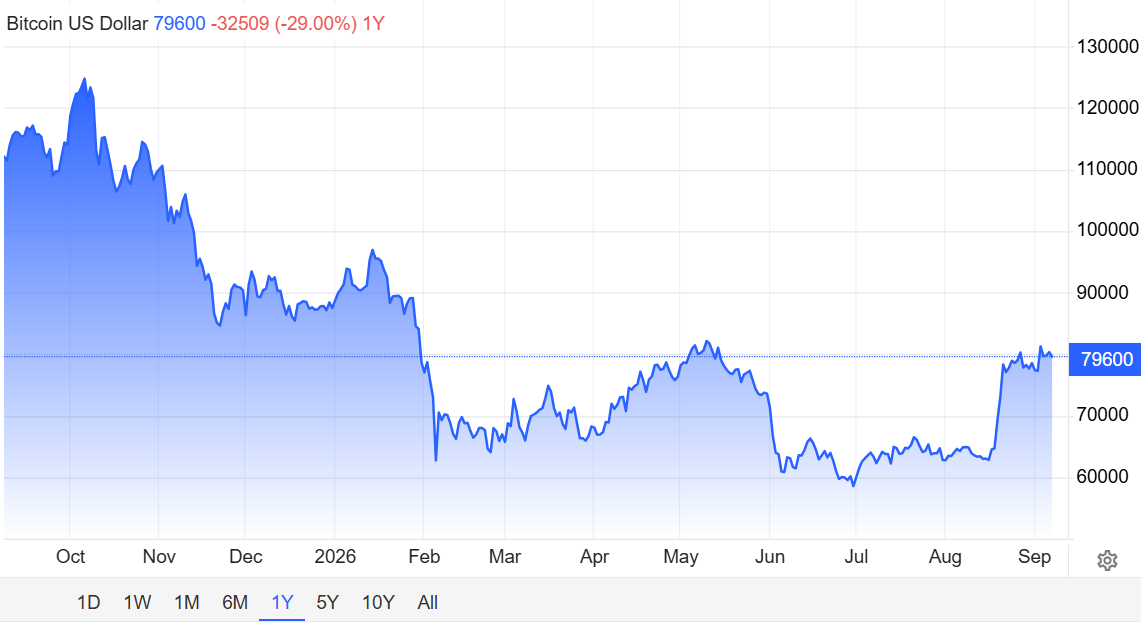
The internal signals in the Bitcoin market were similarly mixed. After experiencing strong summer inflows, US spot Bitcoin ETFs experienced large outflows for two consecutive days at the end of August. According to Glassnode data, there is a supply wall for long-term holders of about 880,000 bitcoins in the $83,000 to $86,000 range, which may constitute short-term upward resistance. Meanwhile, Strategy continues to buy around $80,000, becoming a key force in the fight against selling pressure.
Implications for asset allocation from an institutional perspective
Yusko's portfolio provides an inspiring example for long-term institutional investors — how to prepare for continued currency depreciation: combining direct holdings of Bitcoin and Bitcoin-related securities with venture capital while largely avoiding other mainstream tokens.
However, this centralized configuration also exposed him to significant risk exposure. If Bitcoin's current volatile market worsens further, or if the shares of Bitcoin holding companies perform worse than cryptocurrencies themselves, their personal wealth will face significant fluctuations.
According to Yusko, Bitcoin's long-term value logic is based on a simple proposition: as fiat currencies continue to depreciate due to the expansion of government debt, assets with a fixed supply will receive a continuous premium. For tokens such as Solana and Ethereum, he chose to settle down after a thousand times return — not because their technology is poor, but because their economic models fail to allow holders to share the true value of network growth.