


Is Visa (V) Overvalued After Its A2A Protect Upgrade?
Visa (V) has upgraded its A2A Protect platform, adding real-time risk insights and a unified fraud score that uses advanced AI and Featurespace technology to help banks spot account to account fraud before funds move.
For investors watching the share price, Visa’s recent product announcements, including the A2A Protect upgrade and new cybersecurity tools, come after a period of strong momentum. The company has reported a 90 day share price return of 15.92% and a 5 year total shareholder return of 73.20%, although short term returns have recently cooled slightly.
Scan beyond Visa and review a curated set of payment and financial infrastructure stocks by checking the 82 resilient stocks with low risk scores that combine resilience with measured risk profiles.
Bulls point to Visa’s fraud tools, steady revenue and income growth, and long term returns. Bears worry the stock’s recent run already prices that in. The valuation numbers are where those views meet next.
Most Popular Narrative: 90% Overvalued
The current Visa share price of $375.07 sits well above the most followed narrative fair value of $197.40. That gap is what drives the valuation debate right now.
Visa executes steadily on its three pillar strategy: Consumer Payments volume growing 8 9% in constant dollars driven by secular cash to card conversion and cross border recovery, CMS at ~20% initially decelerating to ~12% by FY30, VAS sustaining 20 25% growth before decelerating to ~15% by FY32 as the business matures. The DOJ antitrust case resolves with a monetary settlement and limited routing adjustments, painful but not structurally disruptive to the debit network economics.
Want to see what keeps this Visa narrative so confident despite that valuation gap? The story leans heavily on how volumes, margins and cash conversion play together over time. The assumptions are specific. The implications for free cash flow are even more so. The full breakdown shows exactly which levers need to keep working to justify today’s price.
Result: Fair Value of $197.40 (OVERVALUED)
Have a read of the narrative in full and understand what's behind the forecasts.
However, Visa’s narrative could be knocked off course if the DOJ antitrust case outcome is tougher than expected, or if account-to-account rails standardize more quickly.
Find out about the key risks to this Visa narrative.
Another View: Visa’s P/E Versus Peers
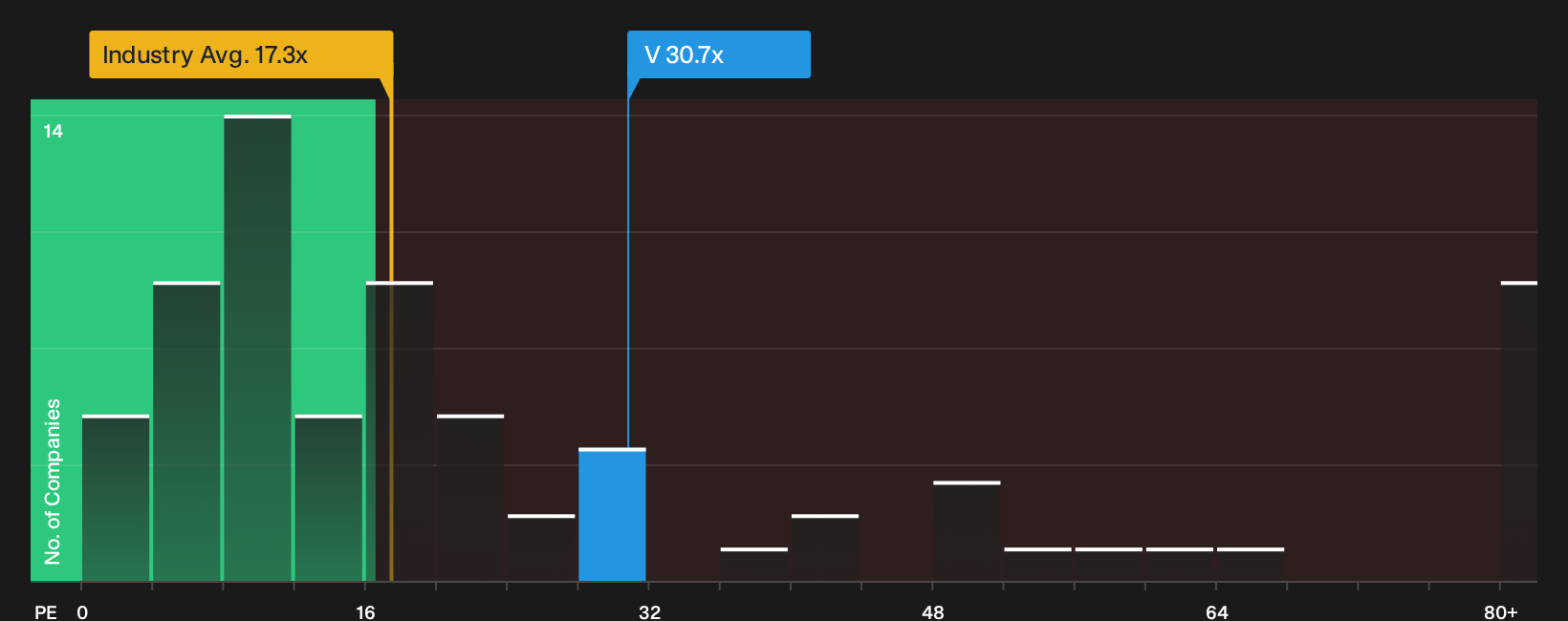
There is a very different story once the focus moves from narrative fair value to what investors are currently paying for Visa earnings. The stock trades on a P/E of 30.7x. That is lower than peer companies on 51.2x, yet above the US Diversified Financial industry on 17.3x and the fair ratio of 22.6x.
That mix of cheaper than close peers but richer than the broader industry and fair ratio suggests limited room for error if growth or margins fall short. It could also mean investors are paying up for quality. Which side of that trade off feels more realistic to you See what the numbers say about this price — find out in our valuation breakdown.
Next Steps
With mixed signals on Visa, from valuation debates to fraud tech momentum, it makes sense to check the underlying data quickly and decide where you stand. A useful place to start is the 3 key rewards and 1 important warning sign.
Looking for more investment ideas beyond Visa?
If Visa raises good questions for your portfolio, broadening your watchlist can help you spot other opportunities and avoid leaning too heavily on a single stock.
- Target dependable cash generators by reviewing companies on the 11 dividend fortresses that may suit an income focused approach.
- Hunt for potential mispriced opportunities by checking the 47 high quality undervalued stocks and comparing how their fundamentals stack up against Visa.
- Strengthen your downside protection by scanning the list of solid balance sheet and fundamentals (52 results) so you are not caught off guard when conditions become challenging.
This article by Simply Wall St is general in nature. We provide commentary based on historical data and analyst forecasts only using an unbiased methodology and our articles are not intended to be financial advice. It does not constitute a recommendation to buy or sell any stock, and does not take account of your objectives, or your financial situation. We aim to bring you long-term focused analysis driven by fundamental data. Note that our analysis may not factor in the latest price-sensitive company announcements or qualitative material. Simply Wall St has no position in any stocks mentioned.
Have feedback on this article? Concerned about the content? Get in touch with us directly. Alternatively, email editorial-team@simplywallst.com