


The price control of the world's largest producer of cobalt declared a failure! After a sharp rise of four times, it plummeted by 30%, and the enforcement of export quotas from the Democratic Republic of the Congo (DRC) was questioned by the market
The Zhitong Finance App noticed that the astonishing rise in cobalt prices is being reversed. As battery metal exports from the Democratic Republic of the Congo (DRC) pick up under the new strict control system, the largest producer's efforts to control prices are being severely tested.
In order to reduce oversupply and increase output value, the Democratic Republic of the Congo (DRC) has imposed restrictions on exports since the beginning of 2025 — first by introducing a total ban, then by implementing a quota system that is still in effect today. This led to a sharp rise in prices. As the main product exported by the Democratic Republic of the Congo (DRC), the price of cobalt hydroxide more than tripled in April.
However, due to a recovery in exports after the initial run-in period of the quota system, combined with concerns about global demand and pressure on the market from recycling, the price of cobalt has since fallen by nearly 30%.
The point is that although the actual export volume of mining companies in the Democratic Republic of the Congo (DRC) in the process of familiarizing themselves with the new regulations was lower than the quota approved by the government, and the export flow is still far below the level of a few years ago, the price correction has begun. This indicates that if companies use up all of their quotas and speed up shipments for the rest of the year, cobalt prices may fall further.
This possibility is likely to force the Democratic Republic of the Congo (DRC) to ponder major future interventionist policy decisions. The central question is what this influential national regulator will do with surplus metals that have accumulated as a result of unused quotas and are theoretically exportable.
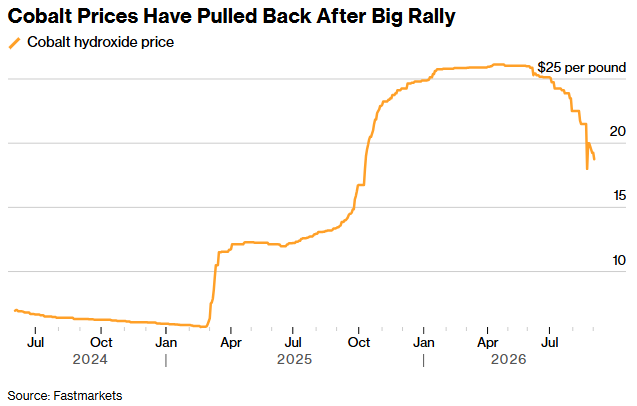
The price of cobalt fell after a sharp rise
According to government data, from the resumption of shipments in December to the end of June, the Democratic Republic of the Congo (DRC) exported a total of about 41,500 tons of cobalt. However, this only accounts for about two-thirds of the export volume approved by the “Strategic Minerals Market Supervision and Control Authority” (ARECOMS).
According to statistics compiled by the Ministry of Mines of the Democratic Republic of the Congo (DRC), the world's two largest cobalt mines (belonging to Luoyang Molybdenum and Glencore, respectively) accounted for only about 60% of their approved quota during this period.
Although exports from the Democratic Republic of the Congo (DRC) doubled to 1,1800 tons in a single month in June, the regulatory agency (ARECOMS) declined to provide another extension to mining companies at the end of the second quarter and instead required these companies to return all unused quotas to the government agency's own “strategic” quota.
The regulator itself does not operate the mine, nor does it have a trade department, and has yet to say whether and how it plans to use this expanded quota. It has previously stated that it will use these metals to support projects to “promote local processing of strategic minerals” and protect the economic interests of the Democratic Republic of the Congo (DRC). According to export data, a state-owned enterprise that monopolizes the procurement of cobalt from manual mining has an independent quota, and by the end of June, the quota had almost been fulfilled.
Since cobalt in the Democratic Republic of the Congo (DRC) is mined in conjunction with copper, mines are still producing large amounts of cobalt, and the Luoyang Molybdenum Industry has also been accumulating huge stocks. The Chinese company's two mines produced more than 65,000 tons in the first half of the year, while exporting less than one-fifth of that production.
Compared to the surge in production in 2024 (which initially prompted the government to introduce restrictions to deal with a sharp drop in prices), the amount of metals leaving the Democratic Republic of the Congo (DRC) is still small. Most of them are shipped to China, and due to the long transportation distance, it will take several months to be reflected in trade data. According to customs data, after experiencing a total import volume of only 6,200 tons in the first half of the year, the amount of cobalt hydroxide imported by China in July climbed to 4,852 tons.
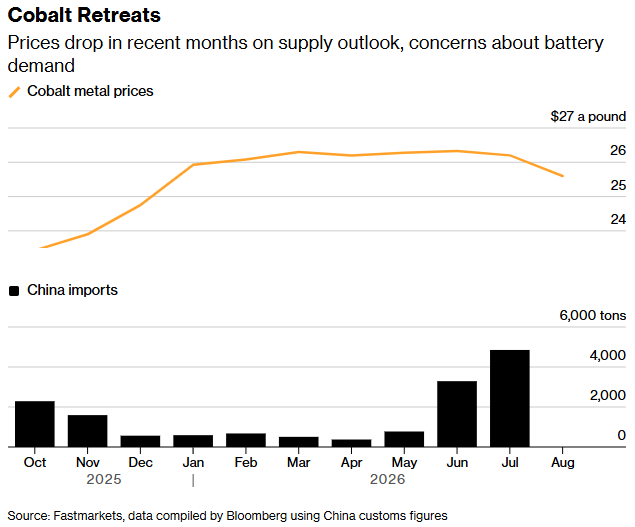
Cobalt prices have declined in recent months due to supply prospects and battery demand concerns
The consulting agency Beijing Antec Information Co., Ltd. said that although China's imports are lower than expected, prices may still face greater pressure in the short term.
Antec wrote in an August report: “Downstream demand is still weak, peak consumer electronics consumption has yet to start, and procurement activity in the battery sector continues to be sluggish.”