


From government interest expenses to AI financing costs, the sharp rise in global long-term interest rates is redrawing the economic landscape, and the “immunity” of the stock market is being tested
The Zhitong Finance App notes that the collapse in global bonds is driving up borrowing costs across the economy, forcing governments, businesses, and consumers to face the reality that high debt may persist for a long time.
Global treasury yields have climbed to multi-year highs: German 10-year Treasury yields have reached their highest level since 2011, Japan's 10-year Treasury yield remains above 3%, US 10-year Treasury yields hit their highest point since November 2023, and British Treasury yields have also hit a new high since 2008 in recent days.
The latest developments in this round of sell-off reflect the combined effects of the issuance of a large number of government bonds, the impact on oil prices that have once again raised concerns about inflation, and expectations that the central bank may maintain a tighter monetary policy for a longer period of time.
This trend may mean more than just another fluctuation in the bond market; the consequences will affect the entire economy and financial markets.
Robin Brooks, a senior researcher at the Brookings Institution, said, “This is a continuation of a medium- to long-term trend, and it will continue for many years.”
CIFC Asset Management's managing director Natalia Lodevsky also believes that there is room for further increases in yield, as huge debt issuance is colliding with a resurgence.
Government: Increasing Interest Expenses
Masahiko Loo, a senior fixed income strategist at State Street Investment Management, said that the government is one of the groups that are extremely vulnerable to rising yields. Sovereign debt burdens in most parts of the world are already high. Refinancing maturing debts at higher interest rates will gradually increase interest costs and put pressure on the fiscal situation.
Masahiko Loo said, “The most vulnerable sovereign countries are those that combine high fiscal deficits, high debt burdens, and dependence on external capital. Among developed markets, France is particularly prominent,” he pointed out the country's fiscal slump, lack of political will for fiscal consolidation, and election uncertainty.
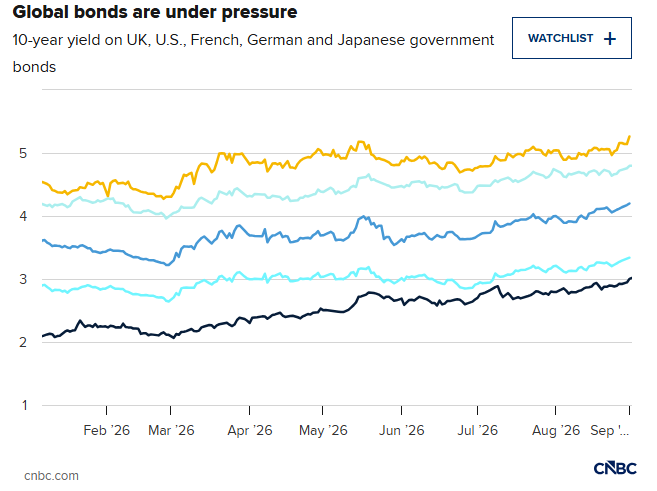
10-year yield on UK, US, French, German and Japanese government bonds
Across emerging markets, he added, countries facing “double deficits” remain particularly vulnerable, as rising global yields both drive up borrowing costs and increase financing risks.
“When debt, deficits, and external financing needs are intertwined, markets tend to become less forgiving,” he added.
Authorities can try to suppress yields by repurchasing bonds or changing the size and term of debt issuance. But such measures do not address the fundamental imbalance between excessive borrowing and investors' needs.
Deutsche Bank wrote in a recent report: “The higher the yield, the more troubling the long-term fiscal trajectory of many countries seems.”
Japan has shown this pressure particularly clearly. Government debt accounts for more than 200% of its GDP, making its fiscal position highly sensitive to rising borrowing costs. It is estimated that in fiscal year 2026, national debt service payments will account for more than 25% of government expenditure.
Businesses: Growth plans are being hit
Businesses will have to pay more to refinance or raise capital to expand their business. Companies with huge borrowing needs, weak balance sheets, or floating interest rate debt are particularly vulnerable.
Thomas Brown, portfolio manager at Keeley Teton Advisors, said that compared to their larger peers, small-cap companies tend to hold more variable rate debt, which means their interest expenses are likely to grow relatively fast as interest rates rise.
“The pressure point is on highly leveraged companies that are used to free money,” Loo said. Based on similar logic, he specifically pointed out that commercial real estate, private equity-backed companies, direct loan portfolios, and low-quality software companies were among the most affected areas. Many of these projects are funded on the assumption that capital will remain abundant and inexpensive.
The AI investment boom has added another new variable. Tech companies are issuing huge debts to build data centers and related infrastructure, making them compete with the government and other corporate borrowers for investor capital.
Larry Holzenthaler, senior portfolio manager at Catalyst Funds, said, “Massive amounts of debt have been issued to fund different AI projects, and the issuers of these debts are quite insensitive to prices.”
Higher benchmark yields can drive up financing costs even for healthy companies, and may cause certain factories, data centers, acquisitions, and other investment projects to become economically unviable.
Consumer: K-type extrusion
Longer-term increases in yield can be transferred to mortgages, car loans, and other forms of household credit. This burden will not be shared evenly.
Holzenthaler said, “The long-term end of the curve is very important because it not only drives up capital costs for companies, but also drives up capital costs for mortgage holders and the real estate market.”
Market watchers say lower-income consumers may be the first to feel pressured because they need to use a larger share of their income to pay down debts and buy necessities of life. Wealthier households may benefit from a higher return on their savings and are generally better able to afford higher monthly payments.
“For consumers, there's this K-type dynamic. As far as 'what percentage of my salary is spent on car loans, mortgages, and student loans', low-income groups clearly feel more pressure than the wealthy,” Holzenthaler added.
The effects may gradually become apparent as fixed-rate loans expire and households refinance. But if pressure from low-income consumers causes spending to weaken, the impact could spread to the entire economy.
Stock investors: facing pressure on yield
The stock market has shown resilience, supported by strong profits and optimism that AI will drive productivity. But rising bond yields have made safer sovereign debt more attractive than stocks, while also reducing the discounted value (present value) that investors can give companies future profits.
“At some point, higher yields will be a painful experience for the stock market,” Lodzewski said.
“The stock market did a pretty good job of ignoring or ignoring these rising yields... but in the end, it gradually began to be affected, and I think this is exactly what is happening.”
Nonetheless, rising yields also brought a clear winner: new bond buyers. Unlike the low-yield environment at the beginning of this century, higher coupon revenue now provides a buffer against further price declines.
Deutsche Bank estimates that the yield on US 10-year treasury bonds may rise to around 5.5% in the next year, and then capital losses due to falling bond prices will exceed the coupon income received by investors. If you look at it in a two-year time dimension, the yield will need to rise to around 6.4% before the total return becomes negative.