


After the Hong Kong Stock Connect came into effect, why is Deshit-B (02526) the most trackable AI target for southbound capital?
The Zhitong Finance App learned that as the September Hong Kong Stock Connect regular adjustment window approaches, the entry into concept stocks has once again become the focus of the market. However, historical data from multiple rounds of adjustments in the past shows that the transfer of the Hong Kong Stock Exchange did not bring about a general rise, but rather a deep differentiation based on fundamentals: some targets used liquidity dividends to begin revaluation, while others quickly declined after the conceptual hype faded away.
As far as the southbound capital continues to increase the AI circuit of Hong Kong stocks, the targets that are really worth tracking in this round of adjustments have never been the “interlocking” concept targets, but companies that also have “marginal improvements in liquidity, scarce fundamental barriers, and long-term industrial space.” Among them, Deshi-B (02526) of Hong Kong Stock Connect is expected to be included in this adjustment. As the first major global medical imaging model stock, it just stands at the intersection of industry changes and capital preferences.
1. Hong Kong Stock Connect Window Period: Expected premiums actually exist; fundamentals are the long-term value anchor
Regular adjustments to the Hong Kong Stock Exchange Standard are based on the Hang Seng Index's constituent stock review rules, combined with institutionalized arrangements for indicators such as market value, turnover, and liquidity. There is a time lag between the announcement and the official entry into force, creating a trading window where market expectations are fermented and capital is laid out in advance.
The financial engineering team of GF Securities carried out systematic statistics on a total of 18 adjustment samples from the second half of 2016 to the first half of 2025 in the “Hong Kong Stock Connect Stock Transfer Effects and Forecasts” released on July 10, 2026. According to the data, those transferred out showed continuous negative returns; while the average cumulative excess income from the inspection date to the effective date was positive, the corresponding win rate was only 54.2%.
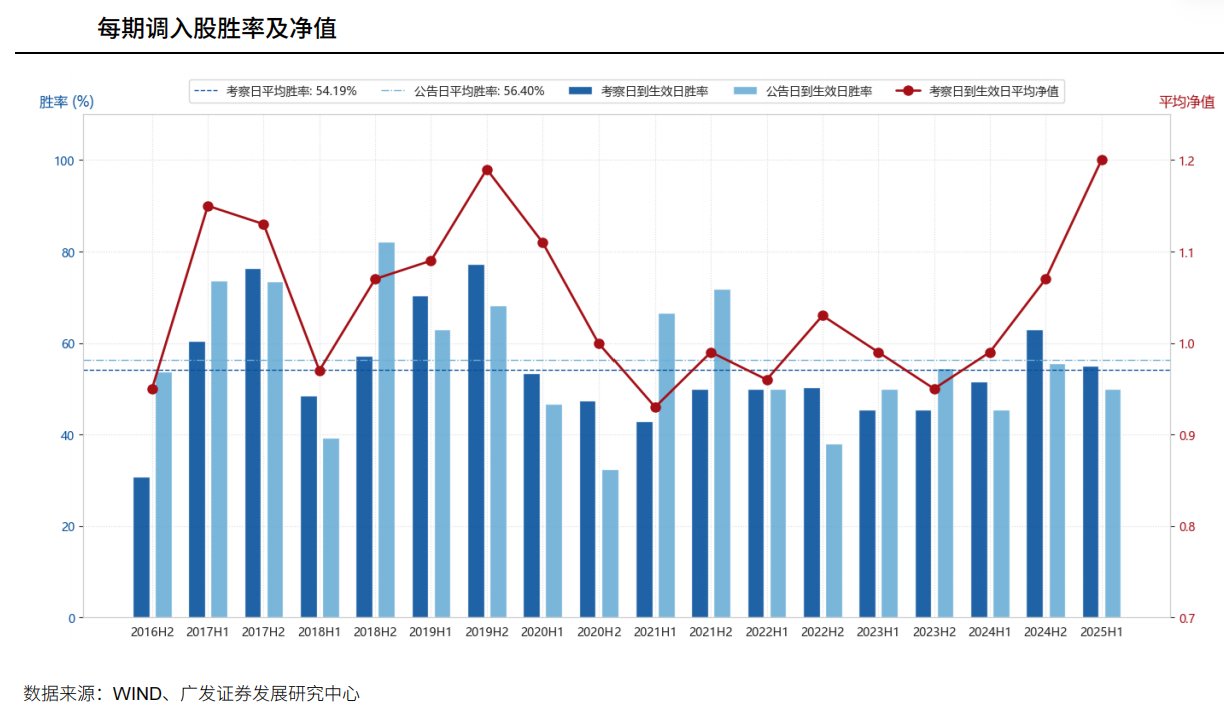
This set of data shows the essence of the Hong Kong Stock Connect adjustment effect: inclusion may indeed lead to expected premiums formed by passive index fund allocations and early active capital placement, but this effect is unstable, let alone the iron rule that “inclusion must rise.”
Southbound capital's pricing power in the Hong Kong stock market continues to rise, making this differentiation even more noteworthy. According to the Hong Kong stock investment research report released by Guoxin Securities in August 7, the cumulative net inflow of Hong Kong Stock Connect had reached about HK$5.48 trillion. The cumulative net inflow since 2026 was HK$373.9 billion, with a net inflow of HK$49.2 billion in the past month. Southbound capital is no longer a marginal participant in the Hong Kong stock market; it is one of the core forces influencing liquidity and pricing logic.
However, precisely because the Hong Kong Stock Exchange effect is widely recognized by the market, the hype surrounding the concept of “entry expectations” has also heated up. Some of the targets rose sharply due to market capitalization expectations before they were included, but fundamentals did not keep up at the same time. Eventually, after being officially incorporated, there was a trend of “falling as soon as it gets through”. The Securities Times's recent report on “entry” concept stocks sorted out market performance before and after multiple rounds of index adjustments, and quoted market participants as pointing out that some targets had problems such as concentrated equity and weak operating fundamentals.
In other words, the Hong Kong Stock Connect only opens up a trading channel; what really determines the company's value center is always the fundamentals. As far as southbound funding is concerned, the core issue in screening AI targets has never been “whether it can be accessed”, but “after entry, why is it worth holding for a long time”.
II. The main line of southbound capital AI layout: shifting from conceptual popularity to industrial implementation
Since 2026, Southbound Capital's allocation to the Hong Kong stock AI circuit has shown a clear main line upgrade: from initial upstream computing power hardware to more segmented fields such as basic large-scale models, industry applications, and AI life science, capital preferences have also changed from “subject popularity” to “performance delivery.”
Judging from capital flow data, the AI industry chain continues to occupy the lead in net capital inflows to the south. According to Guoxin Securities statistics, in the week from August 3 to August 7, Zhi Spectrum, Tiansu Smart, and British Silicon Smart ranked among the top net capital inflows of Hong Kong Stock Connect, with net inflows of about HK$2.0 billion, HK$580 million and HK$450 million respectively.
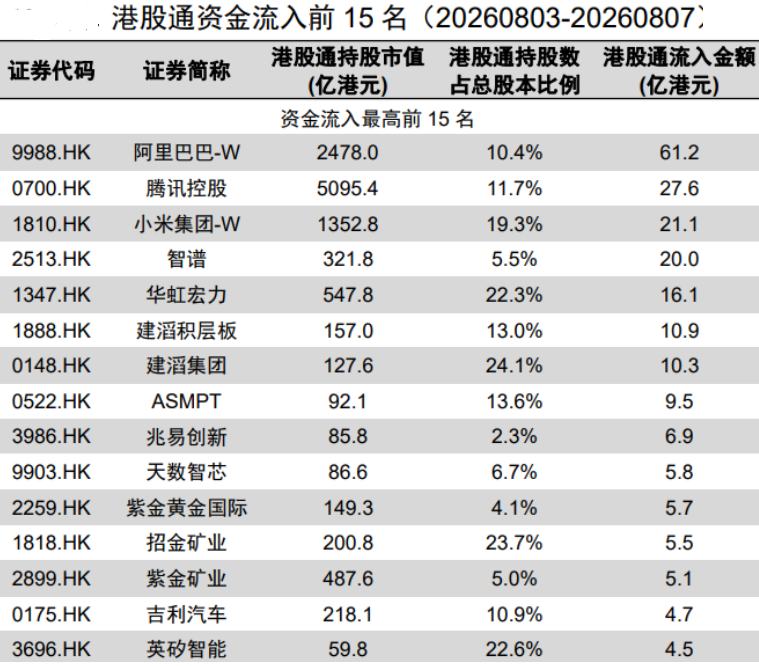
Meanwhile, MiniMax, which was added to the Hong Kong Stock Connect in August, also received a net purchase of over HK$10.6 billion in Southbound capital in a single month, exceeding that of Internet leaders such as Alibaba and Tencent Holdings, which shows how strongly Southbound Capital is pursuing high-quality AI targets.
Sorting through the AI targets that currently focus on southbound capital, it can be found that what they have in common is not that they have an AI concept, but rather that artificial intelligence has been deeply embedded in main business processes and has begun to form verifiable commercial value. Among them, Smart Spectrum, MiniMax, etc. represent the commercial exploration of general-purpose large models; Jingtai Holdings and British Silicon Intelligence represent the application implementation of AI in life science scenarios.
According to the company's announcement, Deshi Technology has been included in 23 Hang Seng Index series, and the relevant index adjustments will take effect in batches on September 7 and 14. What Deshi Technology has filled is an important gap in the industrialization of medical imaging AI.
Unlike GM large model companies that focus on C-side traffic and AI pharmaceutical companies focus on laboratory scenarios, Deshi Technology anchors medical imaging, a vertical track with clear clinical requirements, strict regulatory thresholds, and mature hospital payment systems, and has embarked on a differentiated AI industrialization path. For southbound capital, which is looking for high-quality assets along the AI industry chain, Deshi Technology provides a brand new segmented track configuration option that has not yet been fully priced.
3. The Scarcity of Deshi Technology: Industrialization Samples Constructed by Multiple High Barriers
Deshi Technology's scarcity does not only come from the label of “the first major medical imaging model”, but also because it has collected model commercialization revenue, platform-based production capacity, regulatory entry breakthroughs, and AI4S long-term scalability barriers, forming a comprehensive advantage that is difficult to replicate with other targets.
First, model service revenue was the first to be realized, and the commercialization path of the big model was verified.
According to the 2026 interim results, the company achieved total revenue of 108.7 million yuan in the first half of the year, an increase of 21.0%; of these, core model service revenue reached 94.541 million yuan, a sharp increase of 101.1% year on year, accounting for 86.9% of total revenue; overall gross margin remained high at 74.1%.
The key significance of this set of data is that the big medical imaging model is no longer a technical concept in a laboratory, but rather forms commercial revenue that can be independently measured and grown sustainably. The company's revenue structure is also shifting from traditional software and hardware sales to model training, deployment and value-added services at an accelerated pace, and revenue quality continues to improve.
Second, the industrialized platform system solves the problem of large-scale medical AI.
Deshi Technology has created not an AI diagnosis model for a single disease, but a complete “base model+industrial platform” system: the bottom layer is the iMediImage® medical imaging base model as the core, with 104 billion parameters and supports 19 medical image data types; the upper layer opens up a full link of data governance, intelligent labeling, model training, evaluation, publishing and application feedback through the iMedLoop™ platform.
As of June 2026, the platform has collected about 28.95 million labeling samples, bringing together more than 3,000 professional labeling personnel; working with 99 partner hospitals to promote 158 model projects, covering 43 human organs or application sites and 61 disease directions.
The core value of these 158 projects is not in quantity, but in verifying the reusability of underlying capabilities. Facing new clinical needs, there is no need to start data collection and model training from scratch. It can be quickly iterated based on base capabilities to form a “data-model-clinical” positive closed loop.
This is the essential difference between a platform-based enterprise and a single-point model company: the latter can only solve one problem, while the former can solve one type of problem continuously and efficiently.
Third, the world's first three-class certificate has been launched, breaking through the core barriers of regulatory compliance.
The commercialization of medical AI is not only a technical issue; it also has to cross the regulatory threshold. In May 2026, Deshi Technology's AI AutoVision® chromosome karyotype image-assisted diagnostic software obtained a Class III medical device registration certificate from the State Drug Administration. According to the company's disclosure, this is the world's first three-class medical device registration certificate approved based on medical imaging large-scale model technology, marking that the large model technology has officially passed high-level clinical compliance verification.
At present, the company's products and services have covered more than 400 medical institutions; according to Frost & Sullivan data, the company's market share in the karyotyping market segment is about 30.6%, ranking first in the country. From model training to regulatory approval to hospital-side commercialization, Deshi Technology has already gone through the full commercialization link of medical AI at the core. This capability is extremely scarce among domestic AI medical companies.
Finally, AI4S scalability opens up long-term value space.
The value of Deshi Technology goes far beyond auxiliary diagnostic tools, but also lies in its AI for Science (AI4S) industrial imagination space. The core of AI4S is for artificial intelligence to participate deeply in the entire process of scientific discovery, and medical imaging is one of AI4S's most foundational scenarios. Imaging data carries massive amounts of biological information on disease occurrence, development, and treatment response, and is the core carrier of medical research.
According to the company's disclosure, Deshi Technology has reached an in-depth cooperation with the Hong Kong Polytechnic University to jointly explore medical imaging analysis, basic medical models and automation of scientific research processes, and promote the upgrading of AI from diagnosis and treatment tools to scientific research infrastructure. Relying on platform-based capabilities, real questions raised by clinicians can be quickly transformed into model iterative directions, and scientific research results can also be quickly transformed into clinical products, ultimately forming a two-way promotion of clinical needs and technological innovation.
epilogue
Taken together, the inclusion of Hong Kong Stock Connect is more like an opportunity for Deshi Technology to discover value. The entry of southbound capital will improve the liquidity and market attention of the company's shares, and make more investors aware of the industrialization value of medical imaging AI.
However, what really supports the company's long-term valuation has never been the “entry” label, but the continuous growth of model service revenue, the continuous verification of platform-based capabilities, and the continuous expansion of clinical and regulatory layouts.
For southbound capital looking for high-quality AI assets, Deshi Technology provides a scarce sample: it is neither a simple conceptual AI company nor a traditional medical equipment company, but a rare medical imaging AI industrialization platform in the world that has completed the full “base model - data platform - regulatory product - clinical network - model service revenue” link.
With the official entry into force of the Hong Kong Stock Connect, the company is expected to enter the perspective of allocating more southbound capital and become a key tracking target in the AI sector of Hong Kong stocks, which has both fundamental support and room for long-term growth.