


Nvidia Stock Is Still Cheap, Reckons Fundstrat’s Tom Lee
Fundstrat Chief Investment Office and popular investor Tom Lee believes that Nvidia (NVDA) stock is still undervalued, even after posting another set of record numbers for its most recent quarter. “The thing that stands out is that Nvidia’s multiple is still very low. So, they’ve got these huge revisions. The stock hasn’t kept up. Now the P/E keeps contracting," Lee said in an interview with CNBC. In an earlier note, the analyst pointed out that “Nvidia’s 2028 revenue guide might help the stock push back to new all-time highs.”
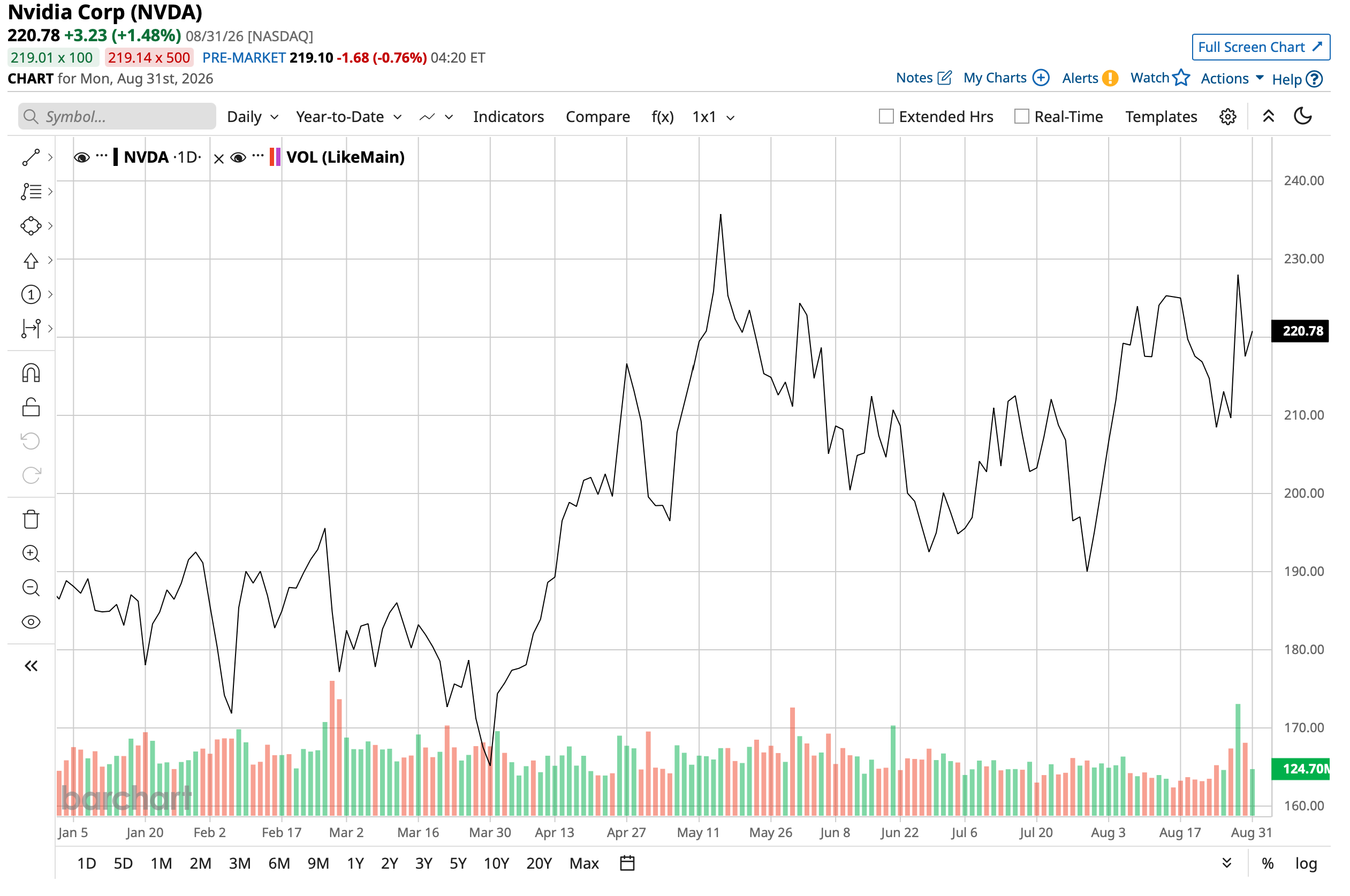
By Nvidia standards, 2026 has been a relatively quiet year. NVDA stock is up 20% on a year-to-date (YTD) basis. Yet, the stock has still managed to outperform the S&P 500 Index ($SPX), which has risen 12% over the same period. Further, with a gargantuan market capitalization of $5.2 trillion, NVDA stock offers a dividend yield of 0.45%.
But are Lee's assertions really correct? Is Nvidia still undervalued? Let's take a closer look.
Is Nvidia Undervalued?
We can compare Nvidia's valuation against three sets of numbers: the sector median, the multiples of peers, and its own historical average.
Compared to the sector median, Nvidia's valuation seems fair. Its forward price-to-earnings (P/E) ratio of 24.2 times is similar to the sector median of roughly 22 times. However, the price-to-cash flow (P/CF) ratio of 46.7 times and price-to-sales (P/S) ratio of 24.6 times are both above the respective sector medians.
Against its five-year historical averages, however, the same metrics are trading at considerable discounts. Nvidia has five-year average forward P/E, P/S, and P/CF ratios of 42.7 times, roughly 25 times, and 57.5 times, respectively.
Finally, in terms of peers, AMD (AMD) and Intel (INTC) are Nvidia's direct competitors, although Nvidia owns a stake in the latter. Nvidia is cheaper than both of these names on most valuation metrics. AMD has a forward P/E ratio of 73 times, a P/S ratio of 22.1 times, and a P/CF ratio of 91.8 times. Meanwhile, Intel's P/S multiple of 8.5 times and P/CF ratio of 39.9 times are lower than Nvidia's respective ratios, while its forward P/E multiple comes in at 88.9 times.
Accordingly, one can conclude that Nvidia appears to be undervalued, although how long that will last remains a question. Still, for a company that is at the center of the AI revolution and is the bellwether of the industry, even paying a slight premium would not be cause for much consternation.
Nvidia Keeps Soaring Higher
Nvidia set the bar even higher with its second-quarter results.
For starters, the company anticipates revenue growth of 70% in fiscal 2028. Management indicated that the projection could have been even stronger if not for supply-chain constraints.
Turning to Q2 fiscal 2027, Nvidia reported revenue of $96.2 billion, representing a 106% year-over-year (YOY) rise and exceeding consensus estimates. Data-center revenue advanced 117% YOY to $89 billion. For Q3 fiscal 2027, Nvidia projected total revenue of $108 million, plus or minus 2%.
EPS increased 120% YOY to $2.22, beating the consensus estimate of $2.09 and marking Nvidia's ninth consecutive quarter of outperforming profit forecasts.
Gross margins expanded to 75% from 72.4% in the prior-year period. The company's outlook for gross margins of 73.5% to 74.5% in Q3 2027 drew criticism from some observers seeking weaknesses in the investment case. Even so, shares of Nvidia advanced after the Q2 release, ending a four-quarter streak in which NVDA stock has declined following earnings.
One significant point raised during the Q2 earnings call was the fact that Amazon's (AMZN) Amazon Web Services, a leading cloud provider, plans to deploy 2 million Nvidia GPUs from the current quarter through Q2 fiscal 2029. This announcement helps ease concerns around major hyperscalers developing their own chips or application-specific integrated circuits (ASICs) to lessen their dependence on Nvidia’s products.
In Q2, net cash from operating activities climbed to $24.1 billion from $15.4 billion in the year-ago quarter. This included $7.8 billion in gains from equity investments in companies such as OpenAI, SpaceX (SPCX), CoreWeave (CRWV), and Nebius (NBIS). At the same time, accounts receivable increased by a notable $22.3 billion during the period, a development that has supported discussions around potential circular financing.
Overall, Nvidia ended the quarter with $22.4 billion in cash, substantially above its short-term debt of $1 billion.
What Do Analysts Think of NVDA Stock?
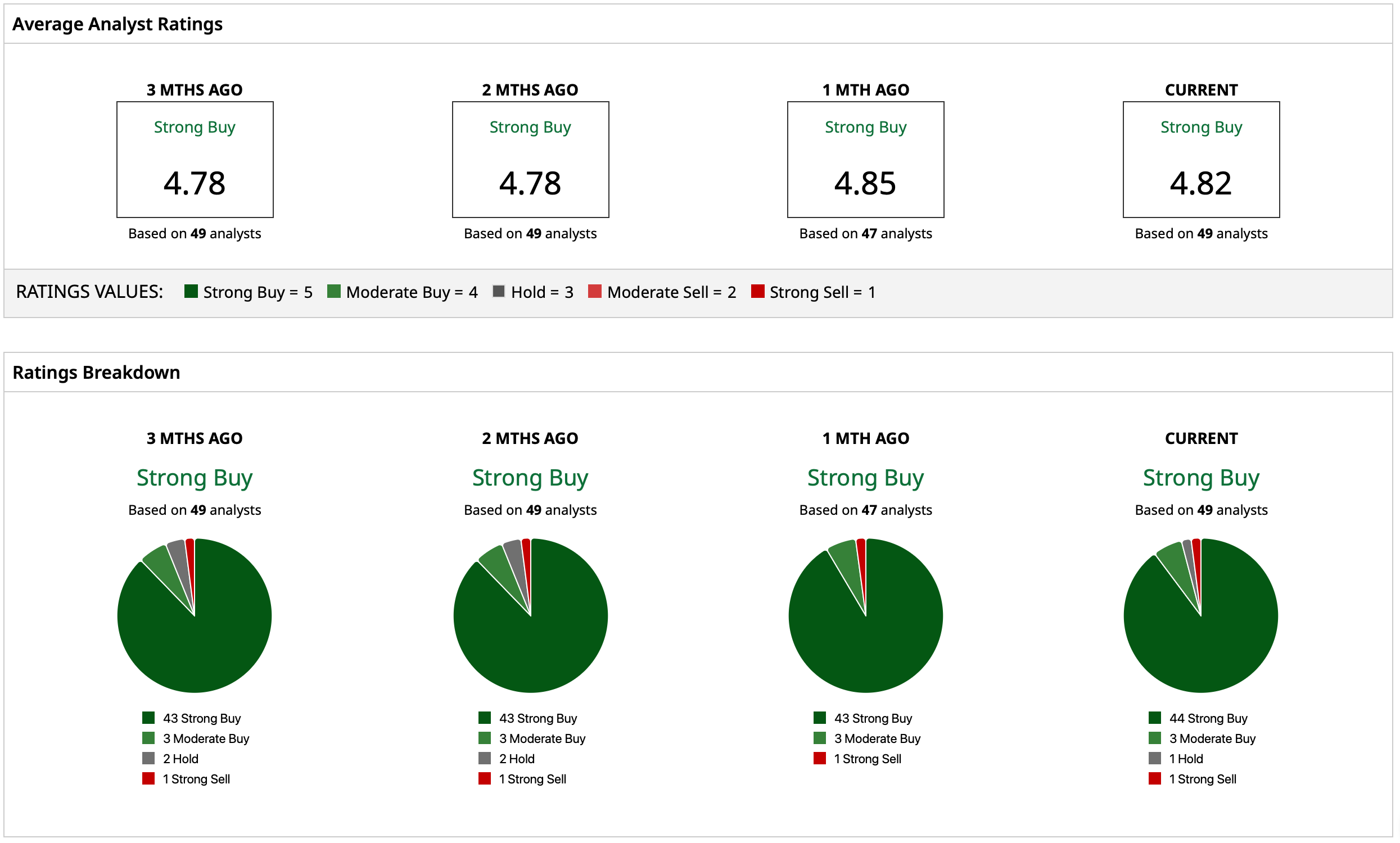
Taking all of this into account, analysts remain upbeat on NVDA stock. Overall, Nvidia has a consensus “Strong Buy" rating on Wall Street. Out of 50 analysts covering the stock, 45 have a “Strong Buy” rating, three have a “Moderate Buy” rating, one has a “Hold” rating, and one has a “Strong Sell” rating. The mean target price of $324.56 indicates potential upside of 45% from current levels.
On the date of publication, Pathikrit Bose did not have (either directly or indirectly) positions in any of the securities mentioned in this article. All information and data in this article is solely for informational purposes. For more information please view the Barchart Disclosure Policy here.