


Bank of America Hartnett warns that if the Treasury's bond repurchase program fails, risk assets will be under pressure
The Zhitong Finance App learned that Bank of America Securities strategist Michael Hartnett (Michael Hartnett) warned that if the US Treasury's plan to curb long-term treasury yields fails, the US dollar will face depreciation pressure and may trigger a wave of shortfall targeting risky assets such as AI computing giants and private credit. This trend may continue until the eve of the November mid-term elections.
Hartnett said that if Treasury Secretary Scott Bessent (Scott Bessent) “is unable to lower the 30-year US Treasury yield below 5%,” he expects the US dollar to weaken in the next few weeks, and risky assets such as AI hyperscale enterprises and private credit will face more short bets. He also pointed out that if the plan fails to achieve the expected results, the financial sector also faces the risk of being shorted.
Hartnett and his team believe that the Treasury's plan to step up the repurchase of long-term bonds is essentially equivalent to a “quantitative easing” operation, and is also the latest part of a series of “Bessent-style put options” measures to deal with the US government and AI industry financing threats. He wrote, “Policy fears aimed at 'repairing' the bond market should underpin rather than depress US bond yields.”
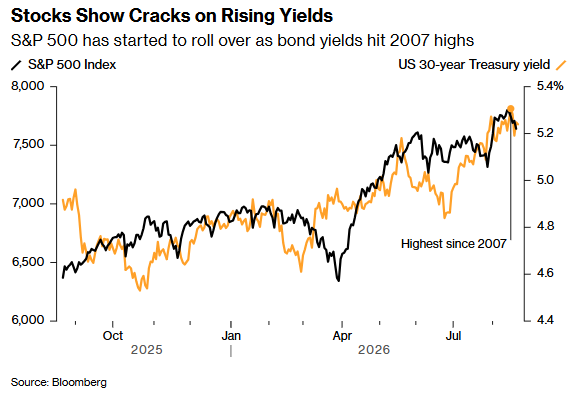
The US Treasury Department issued a statement on Wednesday (August 19) to expand the buyback program. Previously, the yield on 30-year US bonds had hit the highest level in nearly 20 years, and the 10-year yield also rose to a high level not seen since Trump took office as president. After the buyback news was announced, yields declined for a while, but bond prices recovered most of the increase due to lingering market concerns about the continued surge in US federal government debt. On Friday (August 21), the 30-year US Treasury yield hovered around 5.2%.
The bond market turmoil has spread to the stock market. Since Monday (August 17), the S&P 500 index has fallen 1.9% cumulatively due to market concerns about bond volatility once again, which is expected to end the previous three consecutive weekly gains.
As of now, Bank of America's long and short indicators are still showing “extreme bullish” signals. The strategist quoted EPFR data as saying that in the week ending August 19, funds focused on the US stock market attracted capital inflows of nearly 29 billion US dollars, the largest weekly inflow in three weeks. Meanwhile, the semiconductor sector's capital outflow continued until the third week, with a cumulative redemption amount of US$6.3 billion.