


Bloom Energy Calls Its Fuel Cells "Lego Blocks." Here's Why That Word Choice Is the Whole Investment Thesis.
Key Points
Modern data centers require significantly more energy than ever before.
Bloom Energy's solid-oxide fuel cells are factory-manufactured and portable and can be rapidly deployed.
The company is seeing a massive surge in demand, driven by commitments from major companies like Oracle and Brookfield Asset Management.
Fueled by cutting-edge Nvidia chips, data centers require more energy than ever before. As a result, the search for reliable power solutions is urgent. And because utility interconnection times can take years, hyperscalers are scrambling to find quickly deployable solutions.
Bloom Energy's (NYSE: BE) solid-oxide fuel cells have been likened to "Lego blocks" because they are factory-manufactured and transported on-site to meet the power requirements of data centers and other customers.
Missed Nvidia in 2009? This Rare Signal Is Flashing Again. In 2009, a "Double Down" signal flashed for a little-known chipmaker called Nvidia. For the first time in years, that same "Total Conviction" signal is flashing for a company 1/100th the size of Nvidia. Continue »
The "Lego" concept is at the heart of Bloom's investment thesis, and the company is experiencing historic demand as a result, sending the stock skyrocketing 2,078% since November 2024.
Bloom Energy's "Lego block" fuel cells provide a tremendous competitive advantage
Bloom Energy's high-temperature solid-oxide fuel cells are standardized, and this architecture enables these fuel cell systems to be stacked and scaled to support power deployments of up to hundreds of megawatts (MW). Because of its design and manufacturing processes, Bloom can manufacture, ship, and deploy its fuel cells in months rather than years.
The modular design not only makes deployment easier but also helps Bloom mitigate project risks. If construction on one site faces delays, the company can easily redirect trucks to deliver equipment elsewhere.
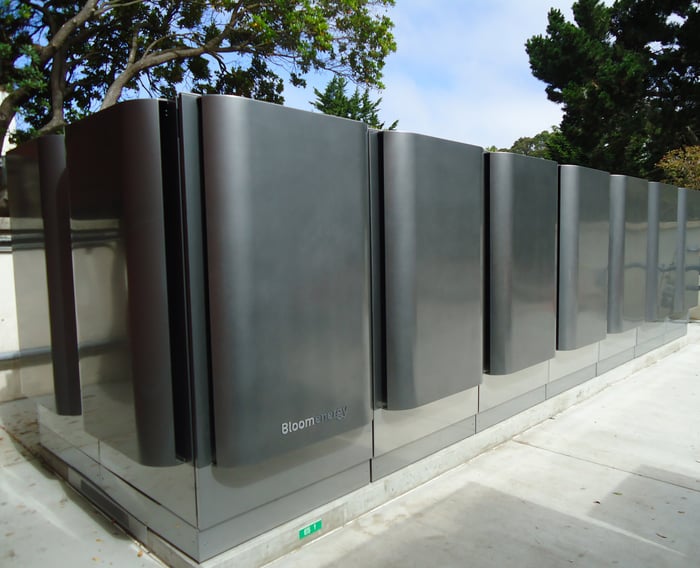
Image source: Bloom Energy.
An added benefit is that Bloom's modular fuel cell blocks can be serviced or replaced while the rest of the system remains online. Finally, these fuel cells can run on a variety of fuels, including abundantly available natural gas, with the option to run on hydrogen as the infrastructure for that option expands.
These features make Bloom's fuel cell technology highly appealing to companies like Brookfield Asset Management, which is investing massive amounts of capital to build out data centers, as well as hyperscalers and technology companies such as Oracle, CoreWeave, and Intel.
Bloom's revenue is booming as demand surges
Bloom is experiencing a historic surge in demand, and its financials reflect this. In the second quarter, the company earned a record $1.065 billion in revenue, representing a 166% increase year over year. In addition, its blended gross margin increased 6% to 34.3%.
The company continues to score big wins. In April, Oracle committed to Bloom for a power block of up to 2.45 gigawatts at the Project Jupiter AI factory in New Mexico, replacing previously planned gas turbines and backup diesel generators with Bloom Energy Servers.
In June, Brookfield Asset Management expanded its strategic financing framework fivefold, from $5 billion to $25 billion. In addition, Bloom Energy has been selected to power Nebius's AI infrastructure build-out, including expanded funding from Industrial Development Funding of up to $1.7 billion.
Bloom Energy is seeing tremendous growth in demand for its "Lego block" fuel cells, thanks to a slew of benefits that are making them a popular choice among data center developers. As long as hyperscalers continue to invest heavily in the data center build-out, Bloom Energy should benefit.
Courtney Carlsen has positions in Bloom Energy, Nvidia, and Oracle. The Motley Fool has positions in and recommends Bloom Energy, Brookfield Asset Management, Intel, Nvidia, and Oracle. The Motley Fool has a disclosure policy.