


The “consumer barometer” sounded the alarm! Walmart (WMT.US) Q2 US same-store sales hit a 6-year low, rarely far below expectations, and full-year profit guidance fell short of expectations
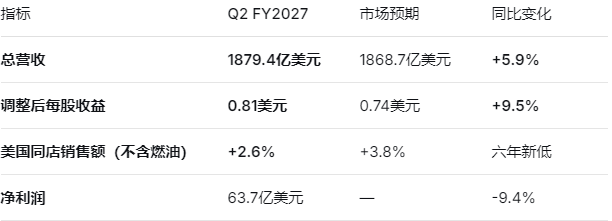
The Zhitong Finance App learned that before the market on Thursday, Walmart (WMT.US) announced financial results for the second quarter of the 2027 fiscal year ending July 31: revenue of US$187.94 billion (up 5.9% year over year) exceeded market expectations of US$186.87 billion, and adjusted earnings of US$0.81 per share were also higher than expectations of $0.74. However, this impressive report card was completely overshadowed by a core indicator — US same-store sales (excluding fuel) grew by only 2.6%, the lowest level in more than six years, far below market expectations of 3.7% to 3.8%. After the financial report was released, Walmart's stock price plummeted by more than 7% before the market to 106 US dollars, with a market value of about 900 billion US dollars.
Core data: Revenue and EPS both exceeded expectations, and the same store's growth rate fell below the psychological threshold
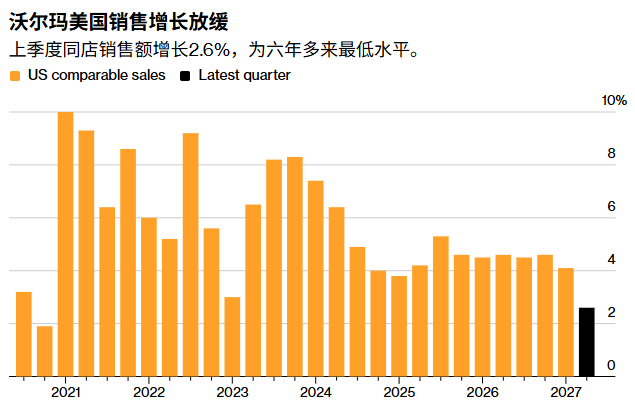
Walmart's same-store sales in the US increased by 2.6%, which was not only lower than analysts' expectations of 3.8%, but also the slowest growth rate since 2019. Excluding fuel sales, this growth rate slowed for the second consecutive quarter.
In terms of consumer behavior, the average transaction volume increased by only 1.1% this quarter, far lower than 3.1% in the same period last year; the number of transactions increased by 1.5%, which is also a significant slowdown from the 3% growth rate in the first quarter. This means that the frequency with which consumers arrive at the store and how much money they spend each time is decreasing.
Pharmacy business dragged down, same-store sales growth hit a six-year low
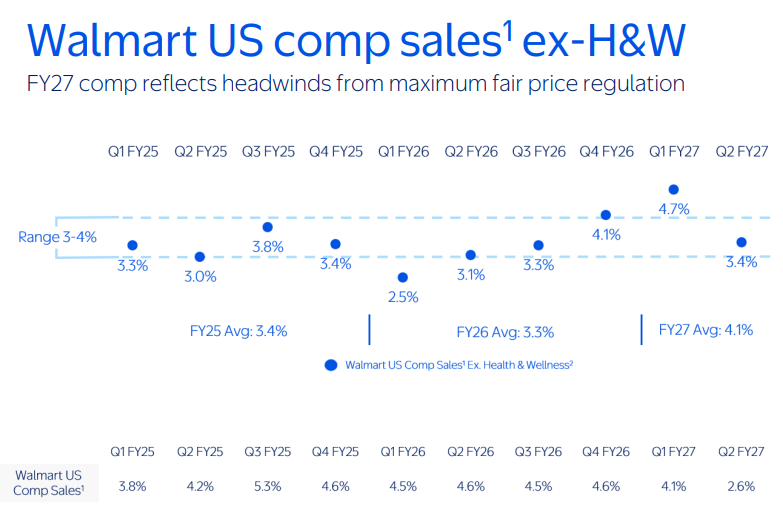
Walmart clearly stated that the pharmacy business was a core drag under pressure on this quarter's results. Drug price negotiations promoted by the federal government in accordance with the Inflation Reduction Act led to a drop in the price of related drugs, which had a negative impact on overall sales of about 900 basis points.
Excluding the impact of the pharmacy business, Walmart's core same-store sales in the US actually increased by 3.4%. Excluding the drag from pharmacies, this core growth rate is still slightly lower than Wall Street expectations, but it is close to the lower limit of market expectations, indicating that the pharmacy business is almost all the reason why it fell short of expectations this time.
There are also clear signs of differentiation on the consumer side. The average customer unit price for the quarter increased by only 1.1%, far lower than 3.1% in the same period last year, which is the same as the growth rate in the first quarter; the number of transactions increased by 1.5%, lower than the 3% growth rate in the first quarter. This means that consumers are still shopping, but are more cautious in single spending and tend to look for more cost-effective products.
Changes in consumer confidence should also not be overlooked. High oil prices continue to put pressure on the disposable income of low-income households. In August, the consumer confidence index declined for the first time in three months, and the labor market also showed signs of weakness. As a retail trend vane serving more than 150 million customers every week, the slowdown in Walmart's same-store sales growth is causing deep concern in the market about the weakening of the overall consumer environment.
Tariff refunds: $2.9 billion of “fortune falling from the sky”
The most notable figure in this quarter's earnings report is the IEEPA tariff refund of approximately US$2.9 billion.
Walmart CFO John David Rainey revealed that the company is eligible to claim a tariff refund of approximately US$2.9 billion and has received most of the payment so far. This refund contributed 750 basis points to the quarterly results; if this revenue were excluded, Walmart's adjusted revenue growth rate would still reach the upper limit of the previous 7% to 10% guidance range.
Walmart made it clear that the tariff refund will be used to lower the price of the product. The company has implemented more than 11,000 product price cuts in US stores this quarter, and plans to continue the price reduction effect until the second half of the year.
The other side of tariff refunds is fuel cost pressure. Rainey said that Walmart is also expected to face additional cost pressure of more than 2 billion US dollars this year associated with rising fuel prices. High fuel prices have led to a marked reduction in consumer spending for low-income households.
Highlights: E-commerce and advertising's “high growth engine”
Despite the slowdown in core retail growth, Walmart continues to maintain high growth in emerging business areas:
Global e-commerce sales: 23% increase, including Walmart's US e-commerce growth of 24% and Sam's Club's US e-commerce growth of 26%;
Walmart US store delivery: 40% increase;
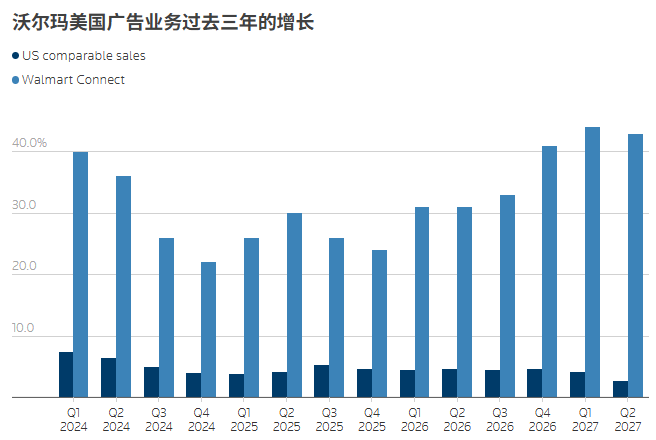
US advertising business Walmart Connect: 43% increase;
Net sales in third party markets: increased by more than 50%;
Global advertising revenue: an increase of approximately 38%;
Membership fee revenue: Double-digit growth, with net new Walmart+ members hitting a new high in the second quarter.
Walmart CEO John Furner said in a statement: “Our e-commerce growth over the years proves that customers choose Walmart because we can provide a wide range of products at affordable prices, fast, and convenient methods. At Walmart, they can buy anything.”
Full year guidance: revenue increases, EPS falls short of expectations
Increase in full-year guidance — The full-year net sales growth guide was raised to 4% to 5% from 3.5% to 4.5%; the full-year adjusted earnings per share guide was raised from $2.75 to $2.85 to $2.87. However, profit guidance was insufficient — the median EPS guidance value of $2.835 for the whole year was lower than market expectations of $2.90.
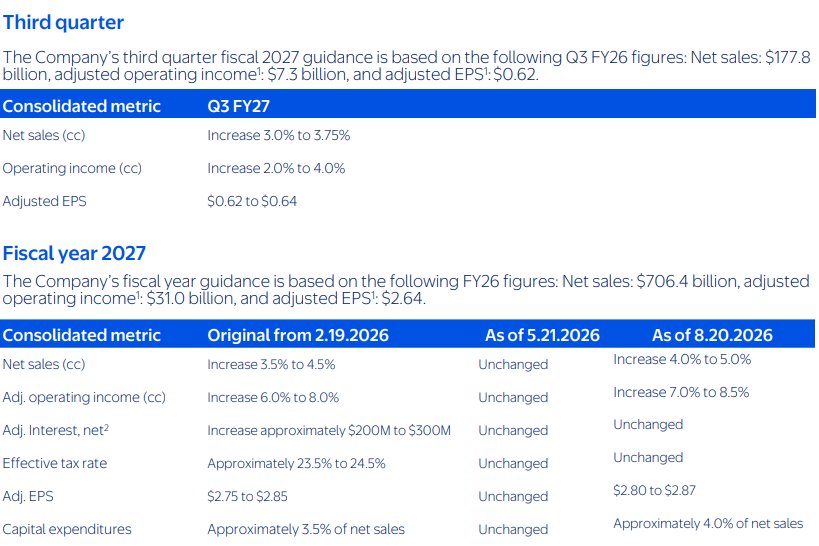
This contradictory guideline of “raising the whole year but falling short of expectations” is the core logic of the market voting with its feet. Investors are worried: if Walmart — a retailer that has always had an advantage in the downturn in consumption — starts to see signs of slowing growth, then an inflection point in the overall consumer economy may be approaching.
The guidance for the third quarter is more conservative — EPS is expected to be $0.62 to $0.64 (median value of $0.63), far below market expectations of $0.69; the net sales growth target is only 3% to 3.75%.
Behind the conservative guidelines is a careful judgment on consumption prospects. Rainey said that the company continues to feel that consumers are under financial pressure, especially against the backdrop of rising gasoline prices. Although consumers are still resilient, Walmart wants to “further reduce prices and reduce pressure on consumers' wallets.”
The growth rate of the same store fell below the “psychological threshold”, and competitive pressure increased
After the earnings report was released, Walmart plummeted by more than 7% in the premarket. The core reason was that same-store sales growth fell below the 3% psychological barrier.
In the “Walmart Premium” market for several years, the market has become accustomed to the retail giant continuing to exceed expectations. The current same-store growth rate not only fell short of expectations, but also hit a six-year low, triggering deep concern in the market that US consumption momentum is stalling.
Brian Jacobson, chief economic strategist at Annex Wealth Management, hit the nail on the head: “For the consumer economy, this is like Nvidia announcing a slowdown in growth. Walmart has always had the upper hand in the downturn in consumption, but this tailwind may be fading.”
Since this year, Walmart's stock price has dropped by a cumulative total of about 13%. This sharp pre-market drop further erased weak gains during the year.
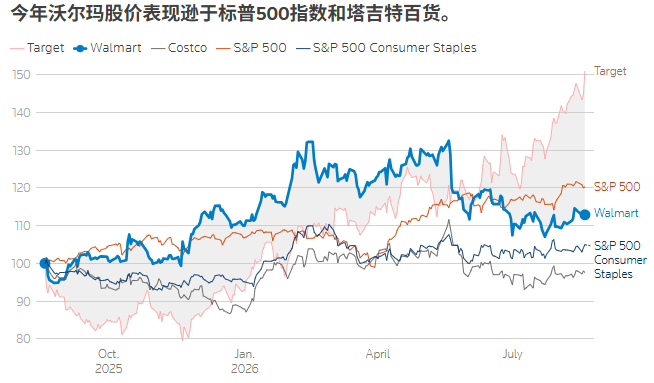
In terms of the competitive landscape, Target is benefiting from the gradual recovery of business transformation. Kroger and market openers are also actively reducing food prices to compete for market share. The competitive pressure faced by Walmart cannot be ignored.
Placer.ai's customer traffic data further confirms this differentiation: Target's overall store traffic increased 4.7% year over year in the second quarter, while Walmart only grew 0.7%. Target is recovering from previous years of product strategy mistakes, while Walmart is facing a higher and higher comparison base after several years of strong growth. In the face of increasingly intense competitive pressure, whether Walmart can maintain its “low price every day” position while maintaining profit growth through high-profit businesses such as advertising, e-commerce, and membership will be a core focus for the next few quarters.
Walmart's growth engine's “shift moment”
Walmart's second-quarter earnings report is a typical example of a “shift in growth.” Revenue exceeded expectations, e-commerce grew rapidly, advertising business soared 43%, and $2.9 billion in tariff refunds — these data prove that Walmart is still the most dominant presence in the retail industry. But the US same-store growth rate has fallen to a six-year low, consumer spending has shrunk, and the annual EPS guidance falls short of expectations — these signs are also clear: the smooth consumption trend that once supported the “Walmart Premium” is turning into a headwind.
Walmart, led by Furner, is transforming into an “omnichannel retail platform” — using e-commerce, advertising, and membership fees to build a second growth curve. But as high oil prices continue to squeeze low-income households, when consumer confidence falls for the first time in three months, and when the labor market shows signs of weakness, Walmart's “basic market” is being tested.
As one analyst said, Walmart has been the biggest beneficiary of the downturn in consumption. But as consumers move from “downgrading consumption” to “reducing consumption,” even the world's largest retailers are not immune to the gravitational pull of the economic cycle.
Economic barometer worries
As the largest retailer in the US, Walmart's performance has always been viewed as an important weather vane for the health of the US economy. This time, the same-store sales growth rate fell to a six-year low, compounded by multiple signals such as shrinking consumer spending, high fuel costs, and a weak labor market, which is increasing the market's concerns about the weakening of consumer-side growth momentum.
As Walmart CEO John Furner said, “Customers choose Walmart because we offer a wide range of products that are affordable, fast, and easy to shop.” But when consumers are starting to “count the flowers” even in the face of Walmart, the US economy's consumption engine may be losing some of its momentum. However, this financial report “both revenue and profit exceeded expectations, but same-store sales hit a six-year low” is the clearest footnote on this subtle turn.