


Bessent lowered interest rates on US bonds, and the US dollar became the biggest “victim”! Alternative safe-haven currencies and foreign exchange in emerging markets have surged
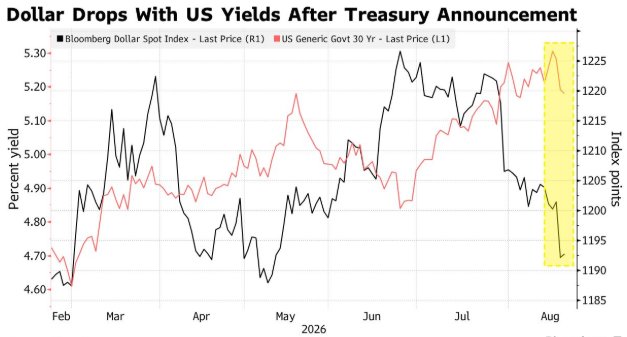
The Zhitong Finance App learned that when US 30-year Treasury yields soared to 5.337% earlier this week, hitting a new high since 2007, the “pricing anchor” of global assets was undergoing the most intense revaluation in decades. Just as markets worry about long-term borrowing costs getting out of control, US Treasury Secretary Scott Bessent threw a bombshell — doubling the scale of liquidity support repurchase operations for 10-year to 30-year treasury bonds from at least $2 billion to at least $4 billion each time.
This operation quickly dampened long-term yields: the 30-year US Treasury yield plummeted by nearly 10 basis points to 5.18% within a few hours after the news was announced. However, Bezent's “bailout” triggered a ripple effect in the global foreign exchange market — the Bloomberg dollar index fell to a three-month low, and the yen, the Swiss franc, and the New Zealand dollar became the biggest winners.
A comment by Akiki Omori, Japan's chief fixed income strategist at Deutsche Bank, is like a nail stuck in the market's interpretation: “The Ministry of Finance can buy back its bonds, but it can't buy back dollars.”
From “predictable rules” to “most interventionism”: a 180-degree shift in policy philosophy
The US Treasury Department announced on Wednesday that it will raise the upper limit of liquidity support repurchase operations for 10-20- and 20-year nominal interest-bearing treasury bonds from 2 billion US dollars to at least 4 billion US dollars. The new regulations will take effect on September 9 and continue until the end of the Japanese refinancing quarter on November 4.
The choice of this point in itself is a strong signal. Just two weeks ago, the Ministry of Finance had just released its quarterly refinancing report. John Briggs, head of US interest rate strategy at Natixis, pointed out that if this plan were announced in a regular announcement, the market reaction would not be as strong; however, “the choice at this point shows that officials don't like what happened at that time.”
Akiki Omori called Bezent “the most interventionist finance minister in decades,” and pointed out that this move marks a clear shift in the “regular and predictable” debt management principle that the Ministry of Finance has long been pursuing. Ironically, in 2024, Bezent criticized former Treasury Secretary Yellen for adopting a similar strategy — reducing long-term financing costs by increasing the issuance of short-term treasury notes, believing that this is tantamount to artificially influencing the market. Now he's on this path himself.
Citigroup said bluntly: “In our opinion, this move is to control long-term returns, not to maintain the normal operation of the market.” Wall Street exclaimed that this is essentially a “disguised OT (reverse operation)” — a classic tool to reduce long-term interest rates by trading treasury bonds of different maturities in the post-crisis era of the Federal Reserve.
The “sacrifice” of the dollar: the cost of depressing yields is being paid by green banknotes
Bezent's buyback operation is pushing the dollar into an awkward situation. Mohit Kumar, Europe's chief economist at Jefferies International, believes that “any form of yield control will weaken the dollar.”
Gerald Gan, chief investment officer at the Singaporean family office Reed Capital, said bluntly: “The dollar is undoubtedly the biggest victim.” He believes that Bezent is deliberately reducing long-term real interest rates and sending a signal that the weakening of the US dollar will be tolerated to keep the economy running. Gan said it would “further diversify investments and reduce dependence on the US dollar.”
Andrew Canobi, Franklin Templeton's head of fixed income in Melbourne, broke this window of paper: Beisent “is actually saying that we are prepared to sacrifice a dollar's strength in exchange for basically manageable term returns.” He added, “You always have to have a pressure relief valve. ”
The Bloomberg dollar index fell about 0.8% on Wednesday and hovered further at a three-month low on Thursday. The US dollar index DXY once fell to 98.708. According to options market data, the first reaction of traders was to increase their short positions in the US dollar, with the strongest demand for the euro and the pound. Dutch International Group strategist Chris Turner said that the Ministry of Finance's decision to increase the scale of long-term treasury bond repurchases “reduced one of the major threats facing risky assets this summer,” but the dollar is under pressure as a result.
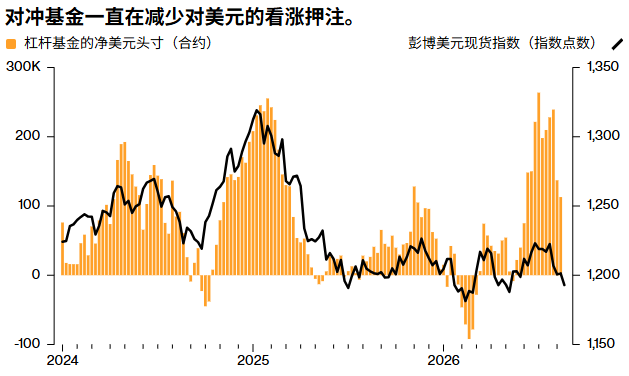
Evercore ISI strategists pointed out that “Basent would welcome these exchange rate changes because the Trump administration has been promoting the benefits of a weak dollar” — believing that this will help improve America's competitiveness and reduce trade deficits.
The policy puzzle is being completed: from interfering with the yen to suppressing long-term debt
Washington's recent policy mix is reshaping the market's long-term confidence in the dollar. Just a few weeks ago, the US teamed up with Japan to implement the first joint foreign exchange intervention since 1998 to buy yen together. Bessent also hinted that the Federal Reserve's tools may be used to finance subsequent interventions if necessary. Now, with the “yield control” of long-term debt buybacks, a broader policy picture is emerging: Washington seems increasingly willing to trade market intervention for manageable borrowing costs. Traders are likely to view this as an attempt to “suppress US fiscal sustainability and the Federal Reserve's anti-inflationary credit market pricing.”
Masahiko Loo, senior fixed income strategist at State Street Investment Management, pointed out that although the US dollar is still supported by AI-driven capital inflows to US stocks and rising oil prices in the short term, the latest measures reinforce the narrative of long-term de-dollarization and currency depreciation. As countries' sovereign AI programs and data center construction spread beyond the US, “the special capital inflow advantage enjoyed by the US today may gradually erode.”
Overseas demand for US debt is cooling down at the same time. According to data released by the US Treasury Department on Monday, the total amount of US debt held by overseas investors fell to 9.299 trillion US dollars in June. As America's largest overseas “creditor”, Japan's holdings fell to 1.116 trillion US dollars in June, reducing its holdings by 26.4 billion US dollars in a single month.
Deutsche Bank strategist George Saravelos put it bluntly that this is “gentle financial suppression.” State Street Investment Management's senior fixed income Loo pointed out that the latest measures have strengthened the narrative of long-term de-dollarization and currency depreciation. As sovereign AI programs and data center construction spread outside the US, the special capital inflow advantage enjoyed by the US today may gradually erode.
The “structural limitations” of buybacks: temporary painkillers or Pandora's box?
Although Bezent's intervention stabilized the bond market in the short term, Wall Street is generally skeptical about its long-term effects.
Brian Jacobsen, chief economic strategist at Annex Wealth Management, called the move a “temporary pain reliever,” and stated that “we are in an era of fiscal dominance and modern monetization.” He further warned: “The Federal Reserve is powerless in influencing long-term interest rates. The Treasury will now issue more short-term debt because demand for long-term debt is weak. Even if the Federal Reserve raises interest rates, the Treasury is actually injecting more short-term debt in similar currencies into the economy. ”
Jack McIntyre, portfolio manager at Brandywine Global Investments, put it more bluntly: “What can really lower long-term interest rates is the economic slowdown or the resolution of the Iranian conflict. I'm not sure if we've reached that point.”
The fundamental factors driving up US bond yields have not changed: the US fiscal deficit is expected to reach 1.9 trillion US dollars, inflation continues to rise above the Federal Reserve's 2% target, and the flood of AI corporate bonds and government bonds compete for investors. Saravelos described this as a kind of “mild financial suppression.”
“Basent put options” enhance the appeal of arbitrage trading, and alternative assets ushered in a “window of opportunity”: yen, gold and Swiss franc, and foreign exchange in emerging markets strengthened
Amid the pressure on the dollar caused by Bezent's operation, alternative assets are ushering in new opportunities.
Akiki Omori expects the yen to be the biggest beneficiary in the next three to six months. Washington's recent actions are removing two major factors that have previously weakened the yen: first, Japan had to sell US Treasury bonds to finance intervention measures, and the other is the pressure brought about by rising long-term US yields. He is also bullish on gold, followed by the Swiss franc and the euro as an alternative to the dollar.
Market data confirms this trend. The yen, the Swiss franc, and the New Zealand dollar were the biggest winners against the US dollar on Wednesday. Gold also received an immediate boost after the buyback news was announced.
The analysis indicates that traders are likely to see this as an attempt to suppress the market's fiscal sustainability and the Federal Reserve's anti-inflationary credit pricing”, which provides structural support for alternative assets.
MSCI Emerging Markets FX Index hits record high
At the same time, emerging market currencies hit new highs, and the weak US dollar increased the appeal of popular transactions, offsetting the impact of a new round of oil price increases. The US Treasury announced plans to increase government bond buybacks, leading to a weakening of the US dollar. So-called arbitrage trading was boosted as a result. This makes the dollar cheaper as a financing currency for investing in high-yield emerging market currencies.
“Basent put options — or, say, someone oversees the US Treasury bond market — reduced one of the main threats to risky assets this summer, and should keep arbitrage trading strategies popular,” said Chris Turner, head of global markets at Dutch International Group.
The MSCI Emerging Markets Currency Index rose 0.2%, rising for the second consecutive trading day. The Thai baht led the rise, rising 0.6% to a two-month high; the Philippine peso also rebounded from a record low. The Czech Koruna is the best performing currency in the European, Middle East and Africa (EMEA) market.
In other foreign exchange markets, the Indonesian rupiah hit a two-month high against the US dollar. Commerzbank said that FTSE Russell decided to postpone the adjustment of the stock index this week, which mitigated a potential stock market-related disadvantage faced by the Indonesian rupiah. The Jakarta Composite Index was among the best performing stock indices in the world on Thursday.
Commerzbank economists Henry Hao and Moses Lim said in a report: “The FTSE Index may still reduce the weight of limited freely tradable shares in September, but this decision temporarily delays the risk of these stocks being downgraded to frontier market stocks.”
The won lagged behind other major currencies this week after hitting an 11-month high on the previous trading day. Meanwhile, the South Korean stock market rose for the first time this week, and the KOSPI index recorded its biggest one-day gain this month.
Samsung Electronics and SK Hynix were the main drivers behind the 2% rise in the MSCI Emerging Markets Stock Index, mainly due to market expectations that shareholder returns will reach record highs. TSMC's stock price has also risen. The company is another major stock in the index and a beneficiary of the artificial intelligence boom.