


Omdia: African smartphone market shipments fell 7% year on year in the second quarter
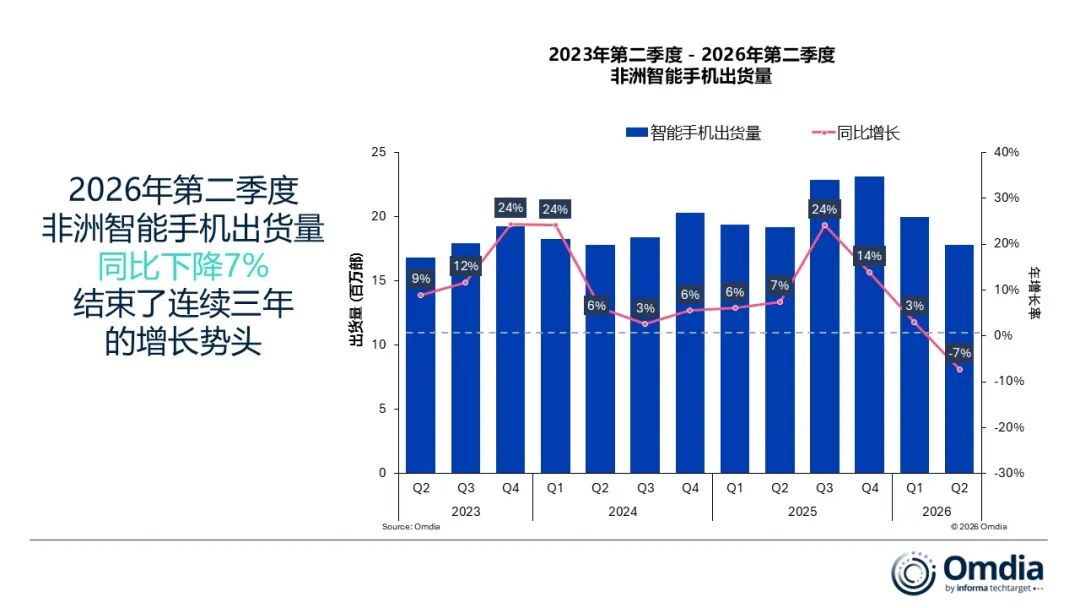
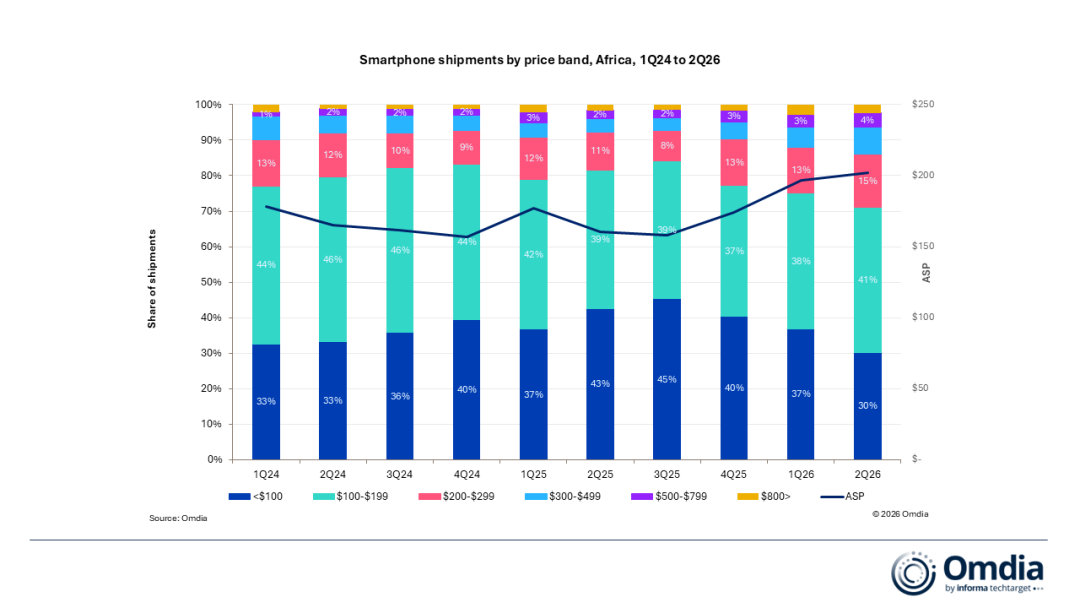
The Zhitong Finance App learned that according to Omdia's latest research, in the second quarter of 2026, the African smartphone market experienced a year-on-year decline for the first time in three years, with shipments falling 7%. As equipment prices continue to rise, consumer purchasing power across the African market is under greater pressure. Among them, entry-level markets under $100 are particularly prominent. This price range has long been an important entry point for Africa's emerging middle class to achieve digital connectivity, but shipments fell 34% year over year to nearly 3 million units. Rising memory costs and supply chain adjustments driven by AI demand are further increasing the supply and price pressure on entry-level smartphones.
Manish Pravinkumar, chief analyst at Omdia, said: “We are seeing the African smartphone market being forced to move to a higher price range. “Manufacturers are no longer able to profitably produce smartphones that cost $75, and consumers with internet needs are increasingly looking to increase their budgets and switch to buying devices over $200.”
South Africa grew 17%, while Egypt and Kenya declined due to cost and policy factors
Market performance differences between countries are obvious, reflecting differences in local market structures and policy environments. South Africa had the most outstanding performance, with a year-on-year increase of 17%, mainly driven by increased consumer purchasing power and the continued transformation of the market to 5G devices. As more and more consumers buy entry-level devices, the importance of the South African market to manufacturers such as Honor and Samsung has further increased.
Nigeria fell 11% year over year, and retailer sales performance weakened as prices rose and consumers delayed purchases. The Egyptian market fell 26%. According to data from the mobile communications department of the Federation of Egyptian Chambers of Commerce, local production input costs have risen 50% since January, prompting manufacturers to sharply raise product prices in the middle of the second quarter. These price increases disrupted traditional sales channels and caused some consumers to delay switching flights.
The Kenyan market declined by 15%, mainly affected by rising equipment prices, especially in the price range below $150. Market demand is still mainly concentrated in this segment.
Samsung achieves growth, audio adjustment strategy, 26% price increase reshapes African smartphone market
Pravinkumar said, “The average smartphone price increased by $41 year over year to $202, replacing the aggressive price reduction trend in the second quarter of 2025. This not only reflects a shift in the market to higher-priced products, but also the rise in product prices within various price ranges, and is reshaping the market rankings of African smartphone manufacturers.”
The market-leading manufacturer Telecom (including TECNO, Infinix, and iTel) saw a 14% drop in shipments and a decline in market share. Since it has strong market coverage in the market under $100, it is more clearly affected by a sharp contraction in demand in the entry-level market.
As market demand moved to a higher price range, Samsung performed strongly, and shipments increased 15%. This is due to its strategic inventory management, which allows it to maintain a months' inventory buffer for major models such as the Galaxy A07 and A17.
Honor maintained its growth momentum for the second consecutive quarter, mainly due to its focus on the $300 and more resilient middle and high-end market. This has reduced its impact on entry-level market parts supply restrictions. Meanwhile, Honor continues to focus on markets such as South Africa, which accounts for about 60% of its shipments in the African region.
The African smartphone market has entered a period of adjustment, and manufacturers are re-examining their affordability strategies
Pravinkumar said, “The African smartphone market is entering a period of adjustment. Omdia expects the market to decline by 26% in 2026, ending three consecutive years of growth. Equipment financing will become an increasingly important part of manufacturers' affordability strategies, especially as equipment prices rise and consumers find it more difficult to bear the one-time cost of purchasing a machine. As one of the leading manufacturers in the field of equipment financing in Africa, Voice is planning to further strengthen this capability while advancing its overall product portfolio strategy. Xiaomi is also actively exploring financing cooperation to expand consumers' purchasing channels for high-value devices and expand its business beyond the entry-level market. As cost and exchange rate pressures continue, the next stage of market competition will depend on whether manufacturers can effectively balance product affordability, shipment volume, and profitability.”