Guojin Securities: AI capital expenditure squeezes out sovereign debt, US bonds, long-term interest rates may rise, or force the Federal Reserve to ease
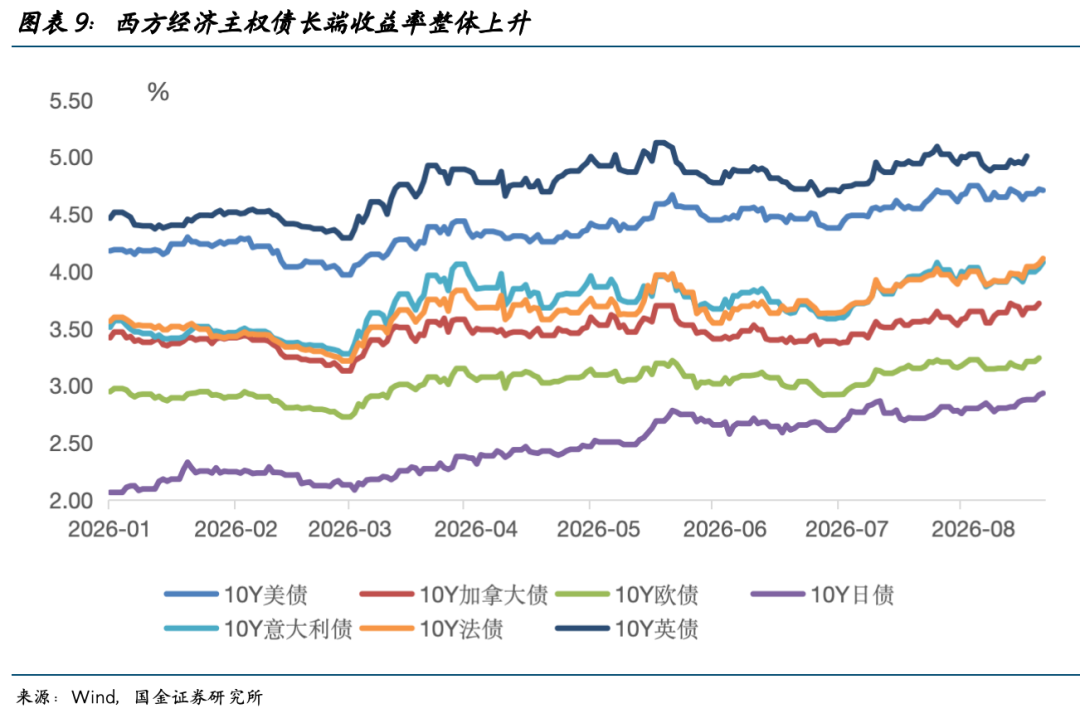
The Zhitong Finance App learned that Guojin Securities released a research report saying that long-term interest rates on US bonds have recently risen sharply, and both 30-year and 10-year yields have risen to multi-year highs. The core contradiction in this round of upward momentum is the crowding out effect of AI capital expenditure on long-term capital — tech giants are shifting from cash producers to long-term capital seekers, competing with sovereign debt for capital, and market carrying capacity has declined markedly. The secondary conflict stems from the Federal Reserve's discounting in credibility and long-term inflation concerns caused by high oil prices. Looking ahead to the future market, continued expansion in demand for AI financing, worsening global long-term capital supply and demand, and negative feedback on Japan's asset allocation may force the Federal Reserve's easing and gold to rise further.
Guojin Securities's main views are as follows:
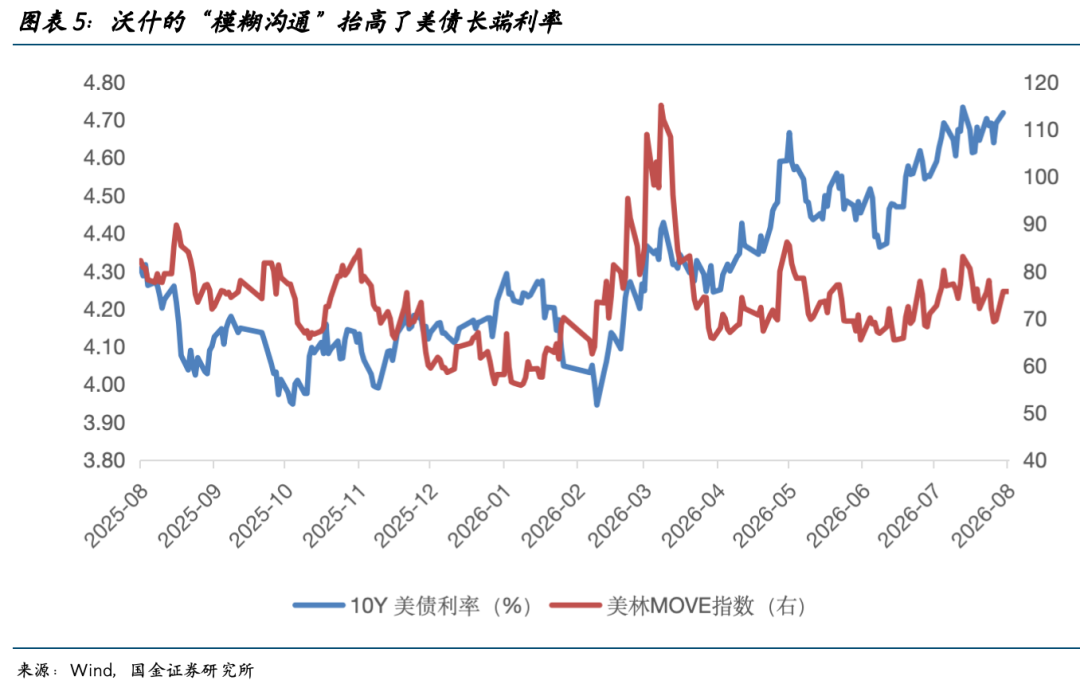
This week, long-term US bonds once again became the focus of the global market. On August 18, the 30-year US Treasury yield once rose above 5.32%, a record high since 2007, and the 10-year term also surpassed 4.7%. We believe that this round of long-term interest rate increases can be summed up as one major contradiction, two minor contradictions, and a gray rhino.
The main contradiction is that technology companies' huge demand for external financing has raised real interest rates and had a crowding out effect on sovereign bonds.
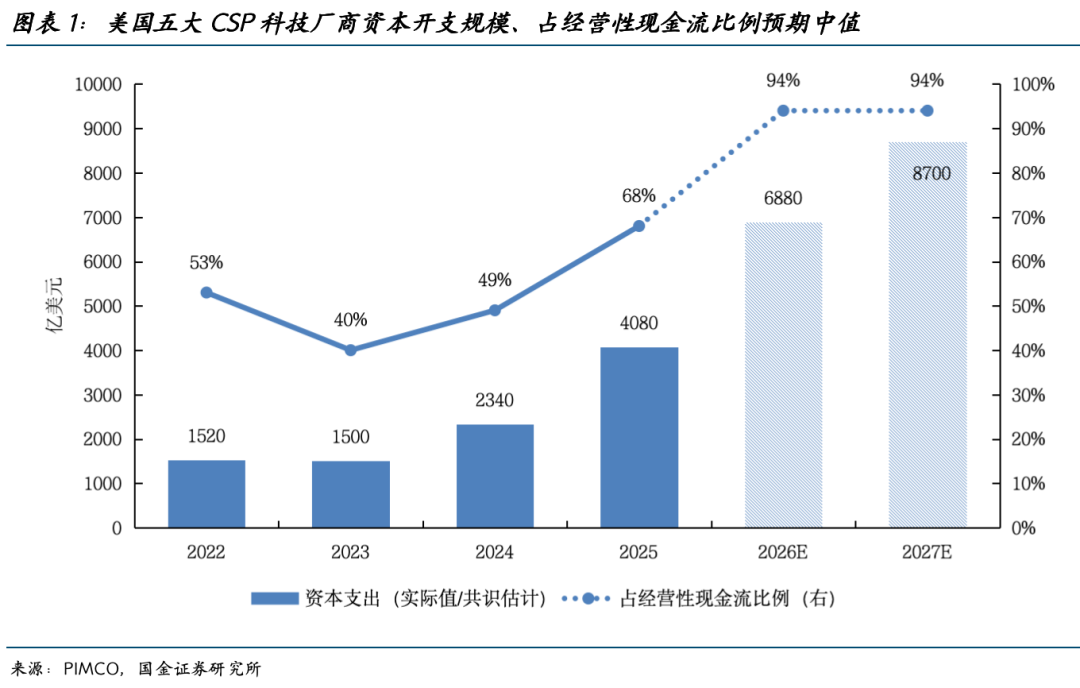
Over the past ten years, an important characteristic of large US tech companies was extremely abundant cash flow. They were one of the biggest cash producers in the entire capital market, but now AI Capex is changing this attribute. Currently, the market generally expects the capital expenditure of the five largest hyperscale data center operators to reach US$750-800 billion in 2026 and further rise to US$1.0-1.1 trillion in 2027.
PIMCO previously predicted that from 2026 to 2027, Capex will be equivalent to about 94% of the operating cash flow of the five major hyperscalers, and as the recent investment plans continue to improve, this ratio may now be close to 95% to 100%. The five companies' 2026 bond issuance scale is about 250 billion US dollars, equivalent to about one-third of Capex's; bond issuance in 2027 is likely to rise further to 400 billion US dollars, accounting for about 35% of Capex's size.
This means that tech giants are shifting from cash flow creators, stock buybacks, and financial asset buyers to long-term capital requirements. At the same time, however, the US government's need for fiscal financing has not declined, even if it has switched to a short-term financing strategy. When private companies with the best credit quality in the world begin to compete with the world's largest issuers of sovereign debt for long-term capital, it will inevitably lead to a crowding out effect.
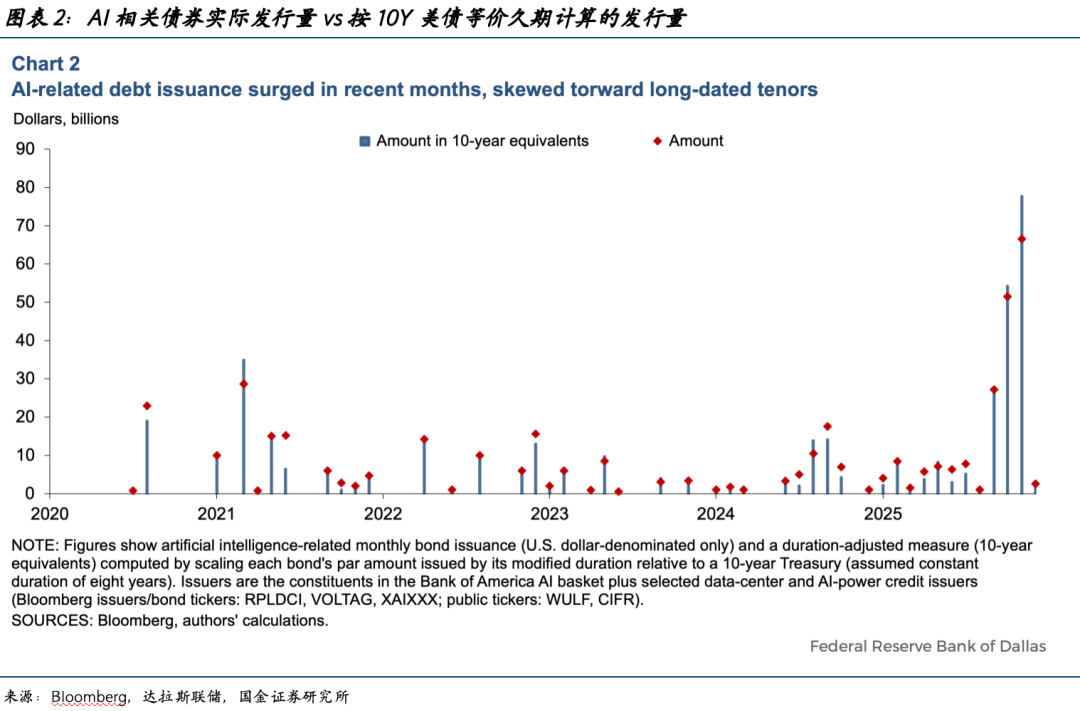
The Dallas Federal Reserve has estimated that if the issuance of AI-related investment-grade corporate bonds reaches 300 billion US dollars this year, this year it may form a 10-year equivalent long-term supply of about 360 billion US dollars. This scale is about one-eighth of the long-term supply of US Treasury bonds.
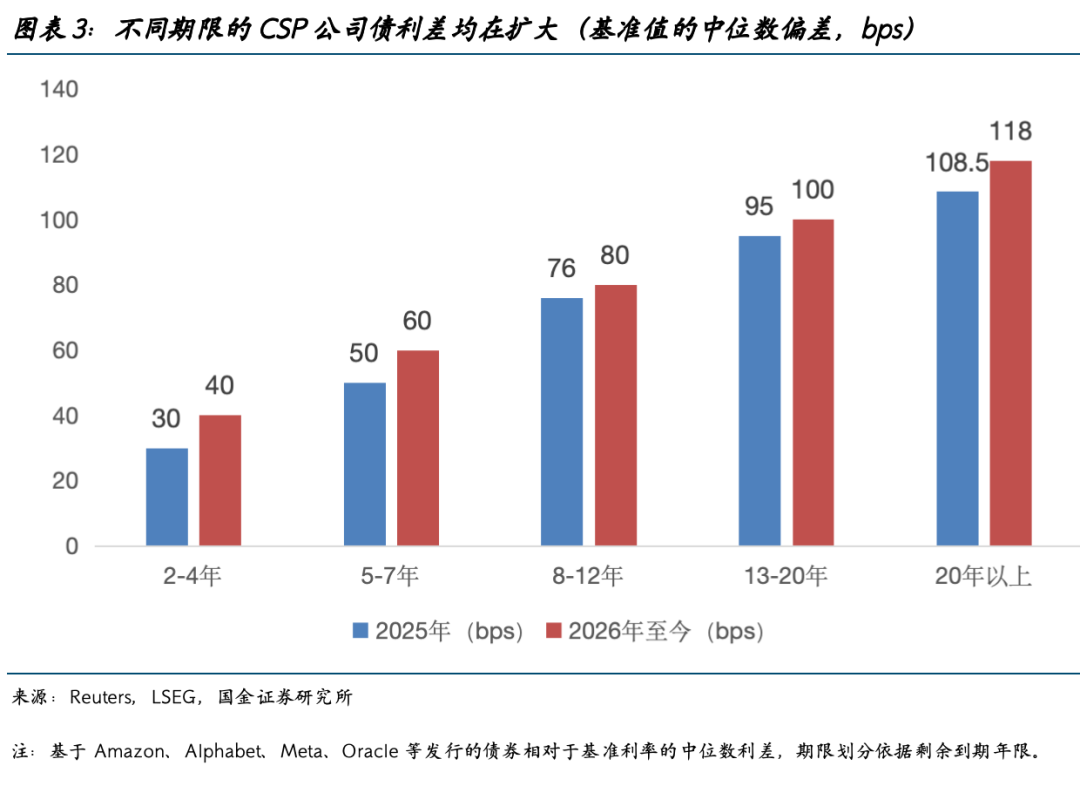
On the day Alphabet announced its $25 billion bond issuance plan on August 7, US bond yields rose 3-4 basis points across the board, rising to around 4.65% for the 10-year term and 5.21% for the 30-year term. On the same day, the g-spread of 5.65% of Alphabet's previously issued bonds and maturing 2056 increased from about 95 bp the previous day to 101 bps, all confirming the existence of a long-term asset crowding out effect.
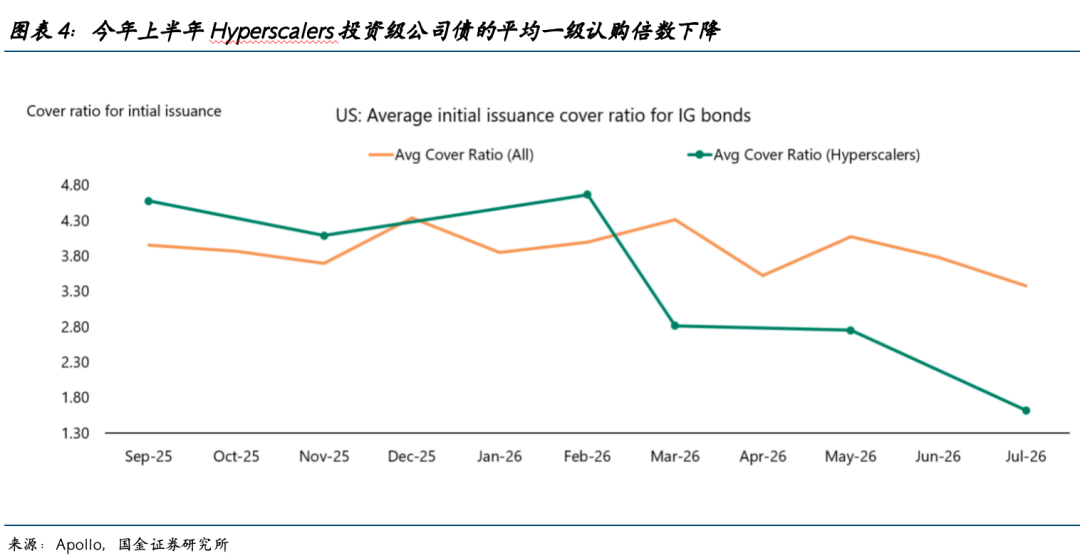
The market's ability to bear AI bonds has declined marginally. Of the 91 ultra-large-scale computing power corporate bonds issued so far in 2026, 78 had a higher yield to maturity at the end of July than at the time of issuance. Judging from the subscription situation, the subscription coverage ratio for new Hyperscaler bonds has dropped from nearly 5 times in February to less than 2 times in July, and the new issuance premium (concession) once increased from 2-3 bp to about 12 bp. The US dollar bonds issued by Amazon in March were about 3.4 times subscribed, and the July issue was only about 1.6 times subscribed. CDS and secondary market credit spreads for technology companies have also widened again since June.
A minor contradiction is that the predictability of the Federal Reserve's response function has declined, and long-term interest rates have begun to be included in “creditworthiness discounts.”
Although the Federal Reserve FOMC meeting in July remained on hold, Warsh's continued weakening of forward-looking guidance made the market worry about the predictability of the Federal Reserve's future monetary policy. Therefore, after the meeting, interest rates on US bonds “declined in the short term and increased in the long term”: bets on short-term interest rate hikes were reduced, but risk compensation for long-term inflation uncertainty and the credibility of the Federal Reserve was increased — from “rate hikes” to “fed fed” pricing.
But this time, the extreme interest rate was an opportunity to test Walsh. When faced with an extreme situation, whether the Fed Put will arrive, and how will it arrive? The market is anxious to see Walsh's expression and attitude towards stabilizing the market. This is particularly important in the post-Powell era.
Before the “Warsh put,” the market first saw the familiar “Bessent put.” On August 19, at a sensitive point where long-term US bond yields continued to rise sharply, the US Treasury Department announced that from September 9 to November 4, it will at least double the liquidity support repurchase scale of 10-20 and 20-30 year nominal treasury bonds, and raise the maximum single repurchase limit from 2 billion US dollars to at least 4 billion US dollars. According to the previously announced schedule, there were 7 long-term repurchases during this period, corresponding to an increase in purchasing capacity of at least 14 billion US dollars.
The core of this Ministry of Finance buyback is to reduce the long-term supply that the market needs to absorb in the short term, and to improve the supply and demand structure of the long-term bond market through term swaps. The Ministry of Finance has increased the repurchase of 10-30-year treasury bonds. If the financing side is completed more through short-term bonds or new short-term securities, it is equivalent to replacing part of the long-term debt stock with short-term debt with better liquidity, which can ease the liquidity pressure and term premium on long-term bonds in the short term, and has a certain effect on stabilizing the market — after the announcement, 10-year US bonds once declined by about 7 bps, and 30-year US bond yields fell by nearly 10 bps, which also shows that the market quickly traded on the back of this policy.
However, this operation did not change the US fiscal deficit and the government's overall financing needs; it only changed the maturity structure of debt issuance. Therefore, this is more like a phased “peak cutting” of long-term supply pressure. It can ease market imbalances in the short term, but it is difficult to fundamentally reverse the upward pressure on long-term interest rates brought about by fiscal expansion and increased debt supply.
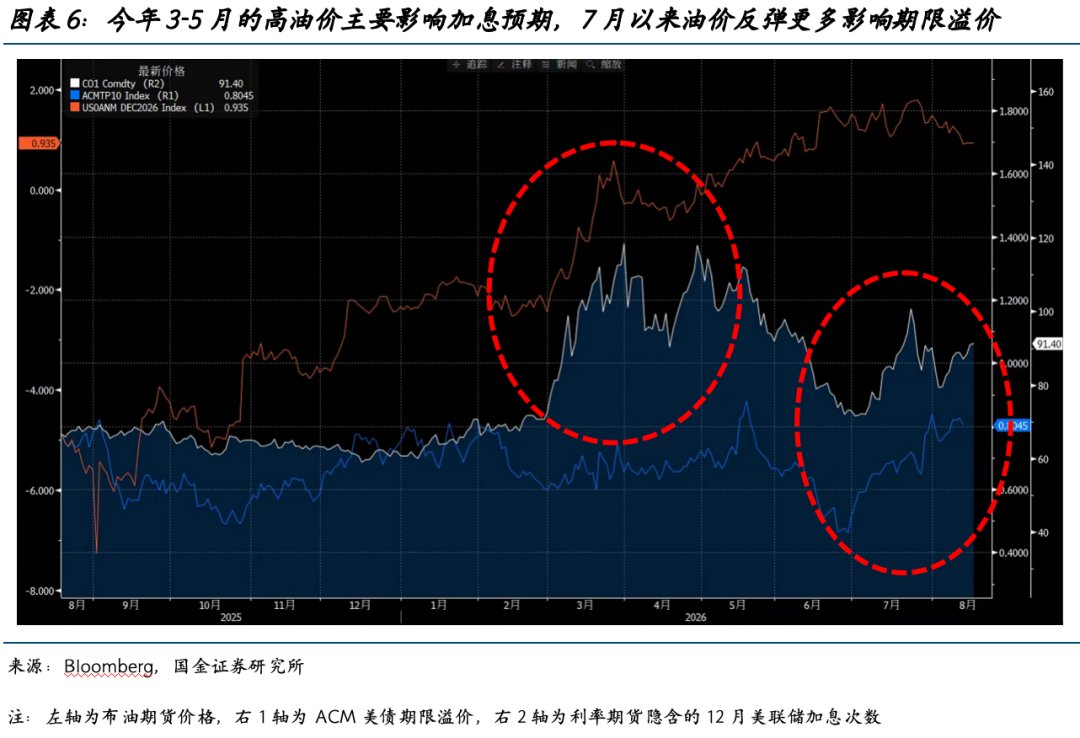
Another minor contradiction is that the risk of high oil prices reduces short-term interest rate disturbances, but concerns about long-term inflation have intensified.
On August 18, Brent crude oil rose for the third day in a row, rising to a monthly high of 92 US dollars/barrel. Unlike before, this round of the market did not drastically raise expectations for the Fed's short-term interest rate hike at the same time. Instead, the market's pricing for the September rate hike fell from the previous week, but the bigger concern became that high oil prices might make the inflation path more sticky in the next few years, causing investors to demand higher inflation risk compensation and term premiums on long-term bonds.
Finally, the gray rhino of Japanese bonds amplified risk contagion and sentiment resonance in the global long-term bond market.
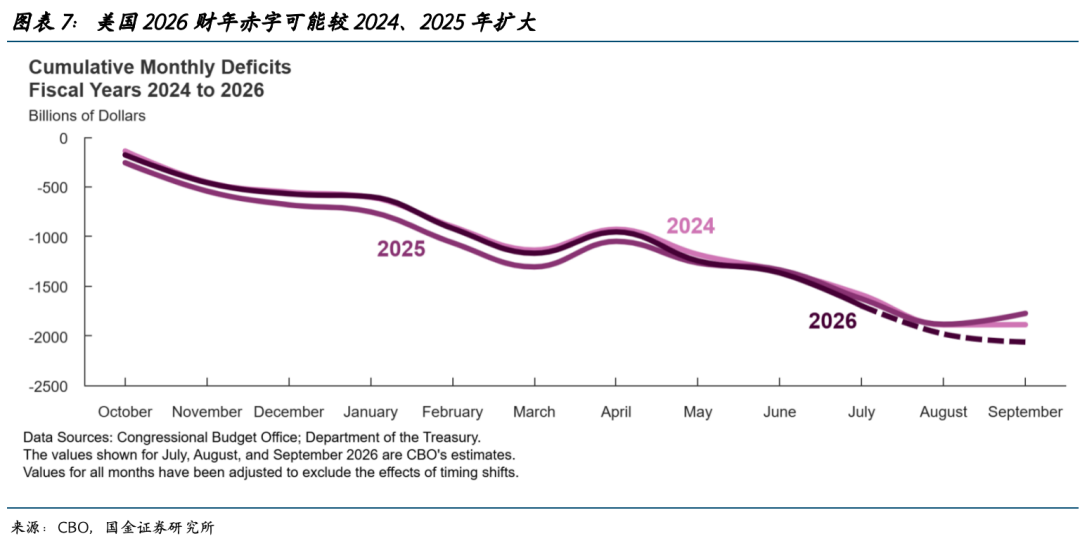
Recently, US fiscal pressure has reappeared, and it has entered the market pricing framework for long-term bonds. Last week, the US Congressional Budget Office (CBO) raised its deficit forecast for the 2026 fiscal year, from an estimated 1.9 trillion US dollars in February to 2.1 trillion US dollars. The main reason is that tariff revenue fell far short of previous estimates due to the Supreme Court ruling. Furthermore, as of the first 10 months of the 2026 fiscal year, the US fiscal deficit has reached about 1.798 trillion US dollars, surpassing the same period of the 2025 fiscal year of 1.629 trillion US dollars, and is likely to continue to rise in the next two months.
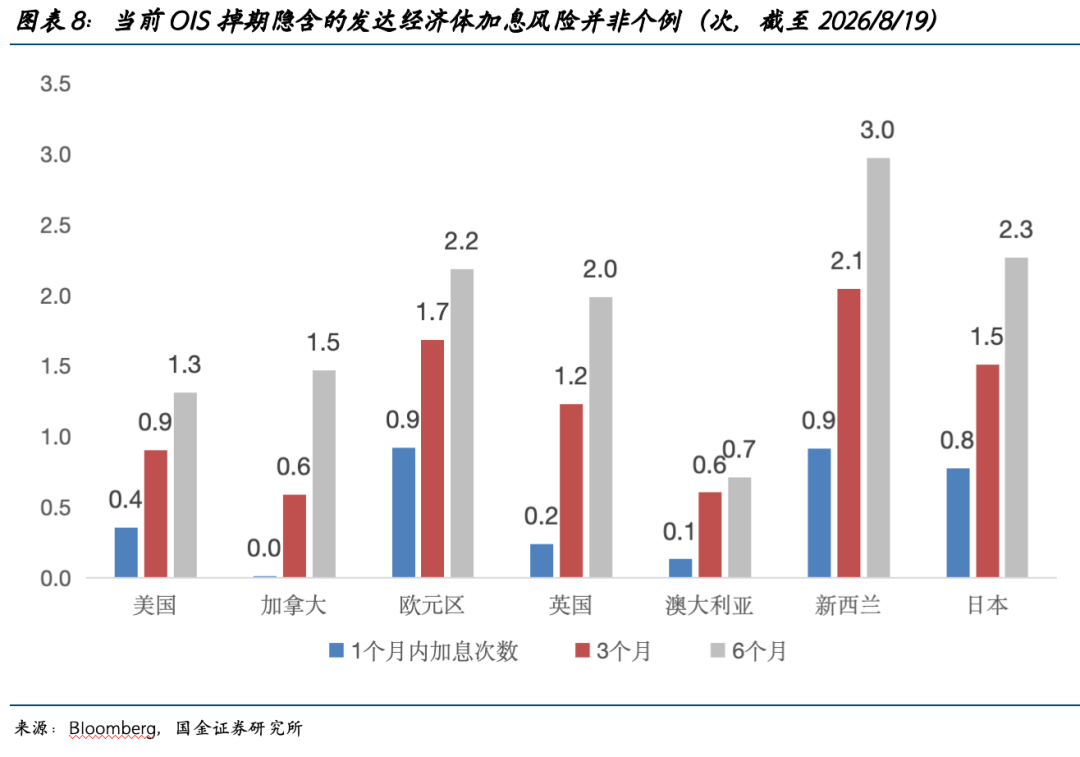
In addition to US bonds, G10 sovereign bond yields have also been rising one after another recently. On the one hand, the overall future direction of monetary policy from major economies is tight. The swap and futures market's pricing of policy interest rates for the next 6-12 months shows that South Korea, Japan, Canada, Europe, and the United Kingdom expect monetary tightening higher than the US. In addition to expectations of interest rate hikes, there are also widespread concerns about fiscal sustainability in countries. For example, the Japanese market is betting ahead on the possibility of interest rate hikes in an environment where the BOJ is weak, and the risk pricing of the expansionary finance of the high city government, while European ultra-long-term treasury bonds face the double pressure of fiscal uncertainty and inflation.
The 30-year US Treasury isn't an isolated market. The ultra-long-term treasury bonds and high-rated corporate bonds of the US, Germany, Britain, Japan, etc. are essentially long-term assets favored by long-term global funds such as insurance, pensions, and sovereign funds. Therefore, when risk spreads, the term compensation required by investors can easily rise collectively.
The depreciation of the yen is also seen as a potential “gray rhino” risk for US debt. The yen appreciated for a while after the joint intervention of the US and Japan, but soon weakened again. This shows that Japan is still facing a very difficult policy triangle — hoping to stop the yen from continuing to depreciate, but also unable to withstand the rapid rise in domestic interest rates, while maintaining financial system and fiscal stability. There is still a possibility that Japan will continue to interfere in the foreign exchange market in the future.
The return of capital from Japan may also have an impact on US debt. As Japan's risk-free interest rate continues to rise, the yield advantage of US bonds over Japanese bonds may shrink further after exchange rate hedging. This may bring about a slow structural change. The world's largest overseas US debt holder's demand for marginal allocation of US long-term bonds has declined. Japan's holdings of US Treasury bonds in June have fallen by about 2.3% month-on-month to 1.116 trillion US dollars. When the Federal Reserve's ability to control long-term interest rates declines, and overseas demand for US bonds weakens marginally, quantitative instruments (QE) may be the last resort — which explains some of the recent rise in gold.
Looking ahead to the future market, Bessent Put and the upcoming Jackson Hole meeting have given a window to repair interest rates on long-term bonds in the short term, but in the context of fiscal supply pressure and discounts on the credibility of the Federal Reserve, sustainability should not be overestimated. The point is that the scale of AI capital expenditure and the corresponding financing growth rate are likely to increase further; on this basis, the relationship between global long-term capital supply and demand may continue to deteriorate; Japanese long-term bond yields, yen, and overseas asset allocation of Japanese institutions may also form new negative feedback. All of this is forcing the US Federal Reserve to be more relaxed, and higher gold prices.