


AI trading is facing a “political backlash”! American voters' “anti-data center” sentiment spreads Wall Street pricing, risk of a pullback in US stocks
The Zhitong Finance App learned that opposition to artificial intelligence (AI) and the data centers required to run AI is gradually becoming an extremely sensitive election issue, so Wall Street has to include this factor in its stock market investment proposals. Last week, Bank of America strategists told clients that if the Republican Party performs strongly in the November midterm elections, the US stock market will “skyrocket.” The Bank of America strategist team led by Michael Hartnett is particularly concerned about the re-election of Texas Governor Greg Abbott, and warned that if the Democratic Party controls the Senate and the position of Texas governor, it could cause the stock market to fall by more than 10% next year, reaching the technical “pullback” standard. Earlier, Evercore ISI and BCA Research also warned that populist reactions surrounding AI could cause trouble for the stock market.
Henrietta Trez, co-founder of Veda Partners, investment advisors and consulting firm Veda Partners in Bethesda, Maryland, said, “There are a lot of risks looming right now for large AI superleaders.”
Polls show that in the US, opposition to building new data centers has become a cross-party issue, and voters are particularly concerned about the impact of data centers on the environment and electricity prices. Elected officials are also beginning to take notice of this issue. State governors are re-evaluating tax incentives for data centers, and many cities and counties, as well as New York State, have already imposed restrictions on data center construction.
Trez said that AI policies at the state level will serve as a model for the federal government to formulate policies. She pointed out that it is unlikely that the next National Assembly will take comprehensive legislative action, but after the midterm elections, lawmakers will be able to free up their hands to deal with this issue, which in turn will influence investors' judgment on future policy trends.
This also explains why Bank of America is so concerned about the election between Texas Governor Abbott and Democratic Representative Gina Hinojosa. The strategist said the election was actually a referendum on the conflict between tech companies' need to build AI infrastructure and voters' concerns about affordability, inflation, and the impact of new data centers on local communities.
According to reports, Texas is one of the states with the largest number of data centers in operation and planning in the US, and is also the traditional base of the Republican Party. Therefore, any action against data center construction will clearly show that concerns about data centers are not limited to the Democratic Party. This month, Abbott actually suspended the approval process for data center access to the grid and asked regulators to review all similar projects applying for grid access.
Hartnett still believes that Abbott's re-election is a bullish sign in the AI field. Other analysts, however, are concerned about how this review request will affect regulated utilities, including American Electric Power and power generation companies such as NRG Energy.
Jefferies analyst Julian Dumoulin-Smith wrote in a report to clients this month that these reviews are “the latest sign of further escalation of anti-data center rhetoric in Texas and across the US, which clearly focuses on requiring new data centers to provide their own additional electricity (BYOG),” and called Abbott's move a “chilling signal” for power stocks.
New York State's policy of suspending the construction of large-scale data centers is one of the reasons investment bank Baird recently downgraded Caterpillar (CAT.US) stock rating. As companies building data centers purchase large quantities of their power generation equipment, Caterpillar is already closely linked to AI transactions.
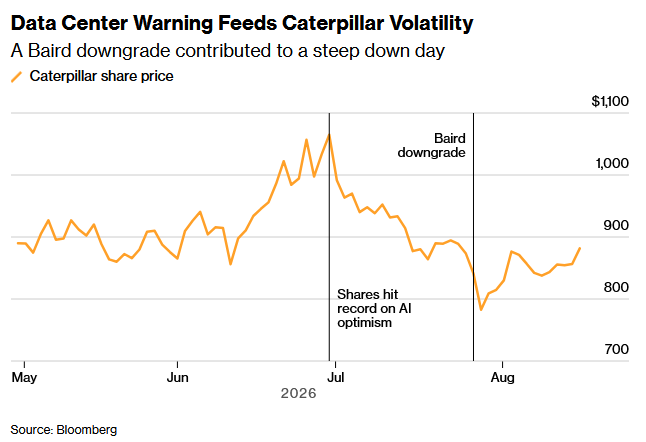
Caterpillar's stock price plummeted due to Baird's downrating
But on the other hand, Morgan Stanley believes that power equipment companies such as GE Vernova (GEV.US) and Bloom Energy (BE.US) will actually benefit as the pressure to require data centers to generate their own electricity rather than connect to the grid continues to increase. The Morgan Stanley research team, led by Michelle Weaver, wrote in a report this week: “Policy action is increasing as community opposition to data centers continues to grow. We expect discussions around this issue to expand as the issue continues to rise in importance to voters ahead of the midterm elections.”
Of course, all of this doesn't mean Wall Street is turning bearish on AI trading. The S&P 500 index is still close to its highest level in history, while beneficiary companies spawned by AI technology spending still dominate the market. The Philadelphia Stock Exchange Semiconductor Index has risen 78% since 2026. Despite experiencing a sharp correction in August, it is still expected to record its best annual performance since 1999, as capital expenditure continues to flow to chipmakers.
Anikt Shah, head of global Washington affairs, sustainability and transformation strategies at Jefferies, said that in the short term, AI infrastructure-related stocks may experience large fluctuations. However, he pointed out that if the federal government intervenes and rationalizes the fragmented technology regulation system currently regulated by various states, then in the long run, this will ultimately benefit investors.
Shah said, “It's going to be a regulated technology, just like every other normal technology. It's good for AI investments in the long run because if you want a technology to have a future, then you need regulation.”