


The UK job market continues to be sluggish! Corporate employment demand is weak, wage growth is slowing, and the central bank may face more difficult policy choices
The Zhitong Finance App learned that as uncertainty about the domestic and international situation intensifies, the performance of the British labor market continues to be sluggish — corporate employment demand is still weak, and wage growth has slowed to a new low in nearly six years. According to data released by the UK Office for National Statistics on Tuesday, the number of corporate employees fell by 13,000 in July, and there was a similar decline in the previous month; between May and July, the number of job vacancies in the UK fell further to 707,000, the lowest level since 2021. Meanwhile, private sector wage growth, which does not include bonuses, which the Bank of England is closely watching, slowed to 2.8% in the second quarter, the lowest level in nearly six years. In the three months to June, the UK unemployment rate remained unchanged at 4.9%, higher than economists' expectations of 4.8%.
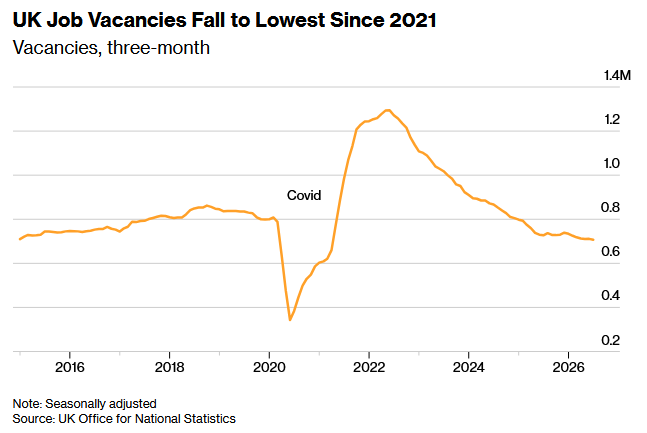
UK job vacancies fall to lowest level since 2021
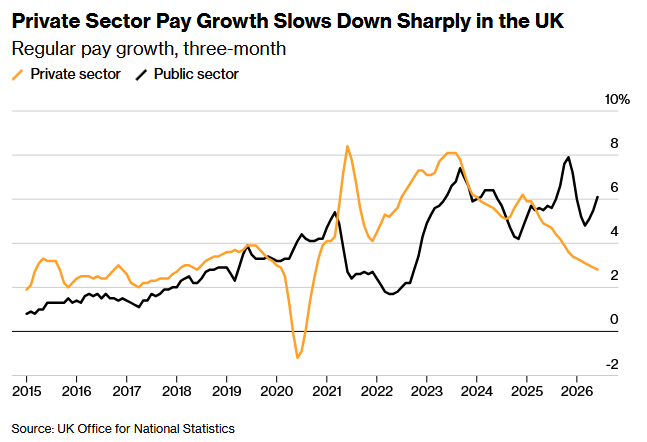
Wage growth in the UK private sector has slowed sharply
Liz McKeown, head of the economic statistics department at the UK Office for National Statistics, said that the labor market “still clearly shows some signs of weakening.” She said the decline in job vacancies was “mainly driven by smaller companies, which say labor costs and operating costs are the reason they are not hiring new employees or replacing departing employees.” However, it is worth noting that the UK Office for National Statistics previously warned that the quality of these data has declined due to errors in the data collection process.
Despite previous data showing signs of stabilization in the UK job market, companies still seem unwilling to hire amid the high level of uncertainty brought about by the Middle East war and the first budget that new Prime Minister Andy Burnham will launch later this year.
Ashley Webb, chief British economist at KITU Macro, said, “These data support our view that the UK labor market will not contribute to a second round of inflation, and the Bank of England will not raise interest rates further from 3.75%. All of these factors together paint a picture of a weak labor market, and this cooling trend continues.”
Over the past two years, the number of employed people in the UK has continued to decline. This is mainly due to the weak economic environment and the Labour government's increase in wage tax and minimum wage levels. Bank of England Governor Andrew Bailey once described the UK as an “economy with low recruitment and low layoffs.”
Economists Anna Andrade and Matt Benny said, “The latest batch of employment data continues to paint a picture of the labor market cooling down, which may be affected by rising energy costs and tighter financing conditions. We believe this trend will continue for some time, and we expect the unemployment rate to continue to rise for the rest of the year. In this context, the Bank of England needs to make a difficult trade-off between returning inflation to its target and limiting economic activity. This also supports the central bank's wait-and-see attitude in response to energy shocks. Our basic scenario is that interest rates will stay the same throughout 2026.”
The Bank of England kept the benchmark interest rate unchanged at 3.75% as scheduled at the end of July. Bank of England policymakers continued to reserve policy choices, maintaining the Committee's “ready to act” guidelines to prevent continued high inflation, while struggling to cope with sharp fluctuations in energy prices in recent weeks.
However, the Bank of England's Policy Committee said that the signs that domestic inflationary pressure is easing are “very clear,” and “there is little evidence” so far that energy shocks have boosted wage demands and prices in other sectors. Most policymakers who support keeping interest rates unchanged also said that if the war ends soon, their policy positions may change; two members, including Vice Governor Dave Lumsden, said they would consider cutting interest rates in this case.
Bailey said at the time: “There is currently almost no evidence that a second round of effects has occurred, but it is still too early to be relieved by this. Given that the global macroeconomic environment seems more uncertain, inflationary pressure is stronger, and the domestic environment is generally more moderate to inflation prospects, it is appropriate to keep the Bank of England's benchmark interest rate unchanged.”
The weak labour market, easing domestic price pressure, and the tightening of the financial environment gave the Bank of England monetary policy committee some time to assess the impact of the war on the British economy. However, although the current level of inflation is generally in line with the Bank of England's expectations for this spring, price increases are expected to accelerate in the next few months due to the increase in household energy bills in July and another rise in automobile fuel costs. Furthermore, the continuing tense situation in the Middle East may cause oil prices to rise. This seems to increase price pressure in the UK and make the Bank of England face a more difficult balance between containing inflation and stabilizing economic growth.