


Net profit increased 15.6%, and the main business grew almost zero. How long is the “adjustment period” of Budweiser Asia Pacific (01876)?
On July 30, Budweiser Asia Pacific (01876), the leading beer company listed on the Hong Kong stock market, released its first half results report. After the data was released, the market reaction was intriguing — the opening day surged close to 9%, and the market capitalization briefly returned to HK$100 billion, then quickly dived back down, narrowing to 1.73%. The two trading days had a cumulative decline of nearly 7%. By the close of August 4, its stock price had risen slightly by 0.08% to HK$6.57.
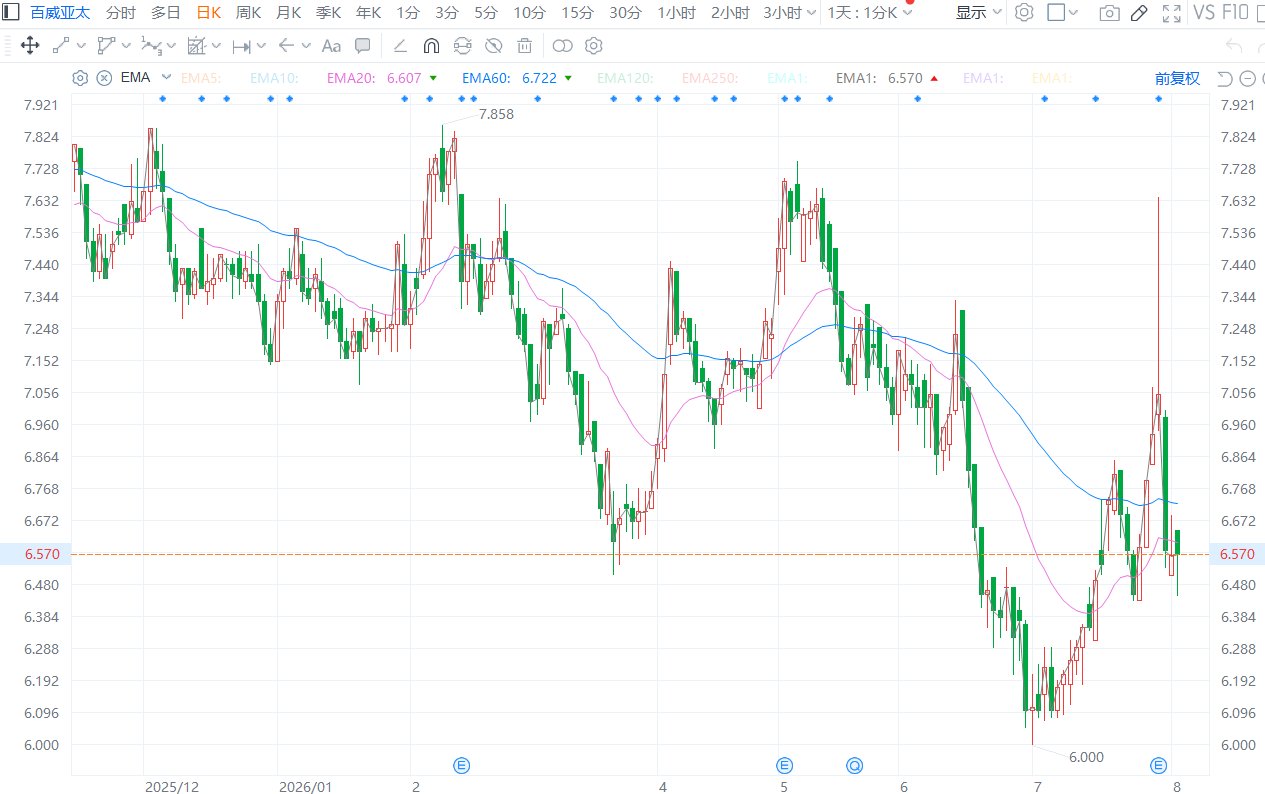
(Market source: Futu)
Behind the sharp fluctuations in the market is the core contradiction between the company's positive earnings and weakening of the main business: the profit attributable to the company's equity holders increased sharply by 15.6% over the same period last year, but after excluding one-time profit and loss, the entire core operating profit, sales, and revenue were under pressure.
And this also makes people curious. How long is the “adjustment period” for Budweiser Asia Pacific?
High-end products are no longer sheltered from the wind, and both sales and revenue are a foregone conclusion
In the first half of 2026, Budweiser Asia Pacific's overall operating data showed the characteristics of “double decline in volume revenue, slight increase in gross profit, and differentiation in net profit”. During the reporting period, the company's total sales volume was 42.624 million liters, down 2.2% year on year; achieving operating income of US$3.171 billion, a slight decrease of 1.4% year on year.
Benefiting from the optimization of the global product structure and expansion of regional high-end products, the company's revenue per 100 litre rose slightly by 0.8%, gross margin increased by 10 basis points to 51.9% year-on-year, and high-end brand barriers continued to be realized. However, pressure on the profit side completely revealed the main business's fatigue: profit before normalizing interest, tax, depreciation and amortization during the period was US$926 million, down 8.9% year on year, and profit margin fell sharply by 236 basis points to 29.2%.
The core causes of the decline in profits are clear and clear: increased investment in domestic market channels, deleveraging operations, and a decrease in overall operating income directly impeding the profitability of the main business. It is worth noting that the company's net profit to mother increased year on year, completely dependent on tax rate optimization and non-recurring profit and loss support. After excluding disturbances, the net profit due to normalization was US$482 million, an increase of only 1.5% year over year, and there was almost zero growth in the core business.
When a company's profit growth is mainly driven by tax arrangements, investors should be wary.
Judging from the performance of the single quarter, the pressure on Budweiser Asia Pacific's performance in the second quarter also further increased. Normalized EBITDA in a single quarter fell 9.7% year on year, and the downward trend in profits intensified, continuing the weak trend in the main business since 2025, proving that the weak recovery in domestic consumption was not a short-term disturbance, but rather a phased industry norm.
Through the three dimensions of channel, competition and consumption scenarios, it is easy to see that Budweiser Asia Pacific is in the midst of a “growth bottleneck” composed of channels, competition and consumption scenarios.
First, the channel structure is “lame.” In the past, Budweiser's basic foundation was firmly rooted in ready-to-drink channels such as high-end restaurants, nightclubs, and KTV, and relied on nighttime social scenes to establish a high-end brand mentality. However, resources are highly concentrated on nightclubs and high-end restaurants in Tier 1 and 2 cities, and distribution networks in prefecture-level cities, counties, and townships are almost empty. The ready-to-drink channel continues to be sluggish, directly hitting seven inches of its business. Once the core scenario cooled down, and there was no hedging market or home consumption channels to hedge against, performance immediately showed pressure.
Second, high-end local giants are fully encirclement. According to Euromonitor data, Budweiser's market share in China's high-end beer market has declined all the way from 49.1% in 2015 to around 40% in 2025. After China Resources completed the integration of Heineken's business in China, Heineken quickly conquered ground in core markets such as Fujian and Yangtze River Delta; Yanjing Brewery relied on two major single products, U8 and A10, to increase nationwide, and the growth rate exceeded 20% in many places. High-end racetracks are no longer safe havens for imported brands.
Third, there has been a permanent shift in the consumption scenario. Self-catering at home, mass catering, and ordinary business banquets have become mainstream incremental markets. This part of the track has long been an advantage for China Resources Xuehua, Tsingtao Brewery, and Carlsberg. The changing scene has directly caused the channel advantage that Budweiser was once proud of to become a “thing of the past.”
Along with the high-end brand mentality established by Budweiser through nighttime social networking scenarios, it is being swept away by the consumer wave of drinking at home and popular dining, and Budweiser Asia Pacific's once unbreakable high-end mentality is rapidly disintegrating. Scenario migration is not a short-term fluctuation, but rather a deep reshaping of the consumption structure — the advantage of being supported by a single channel is difficult after all, to withstand the tide of the changing times.
China's declining sales volume vs. double-digit growth overseas, transforming into a “painful deep-water zone”
At present, the domestic beer industry has completely bid farewell to the “incremental era” and entered a competitive cycle of stable volume and price increases. The total output of the industry remains low and fluctuates, and the growth logic depends entirely on product structure upgrades and channel efficiency optimization.
Looking at the competitive landscape, Euromonitor data revealed that the four major players, China Resources, Qingdao, Budweiser, and Yanjing, occupy more than 72% of the domestic market share, and the industry pattern is highly solidified. However, in recent years, local beer brands have accelerated their high-end breakthrough, and have continued to cultivate in the 8-10 yuan middle and high-end core price band, continuously squeezing the market space of Budweiser Asia Pacific, leading to a marginal weakening of the company's traditional high-end advantage.
At the same time, there have been dramatic structural changes in the domestic consumption scene — traditional food and beverage channels continue to weaken, and home self-drinking and online instant retail have become mainstream consumers. At this time, the industry as a whole is starting a wave of channel transformation, and Budweiser Asia Pacific is no exception.
Zhitong Finance has observed that in the face of the contraction of traditional food and beverage channels, Budweiser Asia Pacific has fully initiated channel transformation, moving from relying on offline catering scenarios to household non-ready-to-drink circuits, O2O online channels, and direct retail models. In the process of channel transformation, the company continued to increase terminal promotion, dealer subsidies and brand launch efforts, directly lowering product tonnage prices and reducing profit margins, causing short-term pain of stabilizing sales and reducing profits.
Compared to the flexible channel adjustment strategies of local leaders, Budweiser Asia Pacific, as a leading foreign investor, has a slower pace of transformation and higher investment costs, so the short-term profit loss it bears far greater than that of its peers. This is also the core reason why the company's performance has continued to be under pressure in the past two years.
Take data, for example. As the company's core basic market, the Chinese market is clearly experiencing the pain of channel transformation, and profits continue to double. Domestic consumption recovery in the first half of 2026 fell short of expectations. Combined with unusually rainy weather impacting the outdoor dining scene, ready-to-drink channels continued to be sluggish, leading to a sharp decline in both sales and revenue in the Chinese market. According to the data, endogenous Q2 revenue in the western Asia-Pacific region fell 4.6% year on year. Among them, endogenous sales in China plummeted 9.7%, revenue fell 8.6%, and normalized EBITDA plummeted 15.9% year on year.
However, for Budweiser Asia Pacific, there are still positive signs. Unlike domestic stock market volumes, Asia-Pacific markets such as South Korea and India still have strong growth attributes, providing Budweiser Asia Pacific with a second growth curve away from the domestic cycle.
India is currently the most determined growth engine for Budweiser Asia Pacific, and its market performance has greatly exceeded expectations. Relying on the upgrading of national consumption and the increase in the penetration rate of high-end beer, the company continued to expand its market share in the high-end and higher categories, and achieved double-digit revenue growth in the second quarter and the first half of 2026.
Overall demand in the Korean market is weak and the total volume of the industry is stabilizing, but Budweiser Asia Pacific bucked the trend with refined operations. In the first half of the year, sales remained flat in the industry and outperformed the market, and channel share continued to increase. The company expanded its business boundaries and opened up new growth space through initiatives such as upgrading the Kaiser series and expanding the Nütrl beverage circuit. On the profit side, relying on continuous price increases, product structure optimization, and operational efficiency improvements, normalized EBITDA increased sharply by 26.3% year-on-year in the second quarter of 2026, and the profit recovery trend is clear.
But can the volume of overseas markets hedge against the decline in China? The answer is probably no.
Overall, the high growth in the South Korean and Indian markets can only slightly hedge the domestic business gap and cannot completely offset the pressure on China's basic market performance. The company's overall performance recovery pace is still highly dependent on the recovery of the domestic market. China Merchants Securities has also clearly stated that “the Chinese business is dragging down performance, and the strong performance of South Korea and India is not enough to drive revaluation.”
epilogue
In summary, it is easy to see that even as a leading company in the domestic high-end beer segment, Budweiser Asia Pacific is still undergoing a difficult strategic transformation.
Looking ahead to the second half of 2026, the company has multiple benefits to support performance recovery: on the one hand, domestic beer terminal demand is expected to be released centrally, and after continuing to be removed from storage in the early stages, channel inventory will return to a healthy level, and sales are expected to stabilize marginally; on the other hand, India's high-end process continues to advance, and Korea's new categories will be released, and overseas incremental advantages will continue to expand. Furthermore, Budweiser's brand barriers in the ultra-high-end beer market are still deep — brands such as Corona still have strong brand appeal and user loyalty, and have not lost their long-term value.
This also means that although short-term channel changes suppress profit performance, the high-end brand assets that the company has accumulated over a long period of time have not been lost, and the results of business transformation will gradually be realized. The answer to whether Budweiser Asia Pacific can re-prove its value in China, the world's most important beer profit pool, may be hidden in the next quarter's sales data.