


Is Waymo's Latest Announcement Bad News for Uber?
Key Points
Rather than investing heavily in developing its own driverless vehicles, Uber plans to partner with multiple companies.
Waymo is essentially pulling back from its partnership with Uber and is opting to compete against the company in certain markets.
This move signals that Uber's route to becoming the default robotaxi aggregator might not be as easy as envisioned.
Uber Technologies (NYSE: UBER) is an intriguing stock for a number of reasons, including strong core business and user growth, strong adjusted earnings and cash flow, and significant value returned to shareholders through share buybacks.
Perhaps most intriguing is that it plans to avoid heavy capital investment to develop and manufacture self-driving vehicles by partnering with companies such as Waymo, which is owned by Alphabet (NASDAQ: GOOG) (NASDAQ: GOOGL), as well as with Baidu and Nvidia. But if Waymo's recent announcement is any indication, Uber's future might be competing against former self-driving car partners.
Where to invest $1,000 right now? Our analyst team just revealed what they believe are the 10 best stocks to buy right now, when you join Stock Advisor. See the stocks »
What's going on?
In the latest development between Uber and Waymo, the latter is exploring options to exit its robotaxi partnership with the former. Currently, Uber offers rides in autonomous Waymo vehicles exclusively in Austin and Atlanta. Waymo gave Uber notice that it plans to launch its own service app in those two cities at the beginning of 2028.
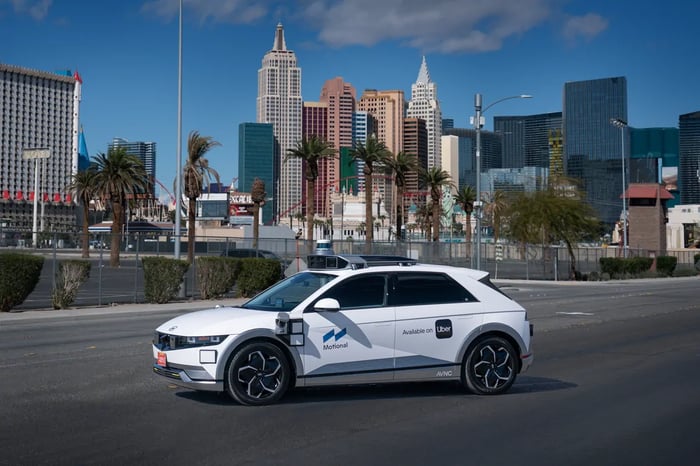
Uber and Motional launched a competing robotaxi service in Las Vegas. Image source: Uber.
Waymo will run its service alongside its existing business with Uber and will keep its fleet of vehicles on Uber's platform through May 2028, when the current contract ends. "We believe in a vibrant and collaborative AV ecosystem that champions innovation and provides riders with a choice in how they experience this technology," said a Waymo spokesperson, according to Automotive News. "This is essential to the industry's future and to our vision of making the Waymo app and the safety of our technology available to riders everywhere."
Is this bad news for Uber?
This is certainly a negative development for Uber, which has focused on developing partnerships with fleet operators and investing in robotaxi companies, hoping it would eventually become the default aggregator for driverless rides, in addition to its human-operated ride business.
Savvy investors who have followed the partnership likely anticipated Waymo looking for an exit, as the robotaxi operator hasn't announced any new cities where its vehicles will be available on the Uber app, but has launched the Waymo app in six cities outside San Francisco and Los Angeles, where it already competes with Uber.
Waymo's likely exit from its partnership with Uber affects Uber in a couple of ways. It signals that while Uber is dominant in ride-hailing and Waymo represents a fraction of a percent of its total rides per quarter, it is a viable long-term threat and competitor. Investors should also expect increased capital investment, as Uber will need to invest more in autonomous vehicle companies to offset the expected loss of Waymo.
Lastly, it's leading some analysts to reconsider the long-term impact: Morningstar analysts reduced Uber's fair value estimate from $85 per share down to $76. Ultimately, this just signals that the path to Uber becoming the default aggregator for robotaxis will be bumpy as more companies look to become independent of its network.
Daniel Miller has no position in any of the stocks mentioned. The Motley Fool has positions in and recommends Alphabet, Nvidia, and Uber Technologies. The Motley Fool has a disclosure policy.