


IPO News | Yundong Intelligence once again submitted to the Hong Kong Stock Exchange as a domestic supplier of automotive intelligent connectivity solutions
The Zhitong Finance App learned that according to the Hong Kong Stock Exchange's disclosure on August 4, Hangzhou Yundong Intelligent Vehicle Technology Co., Ltd. (abbreviation: Yundong Intelligent) submitted a listing application to the main board of the Hong Kong Stock Exchange, and CICC is the sole sponsor. The company submitted its listing to the Hong Kong Stock Exchange on January 19, 2026.
Company profile
According to the prospectus, according to the Frost & Sullivan report, Yundong Intelligence is a leading domestic supplier of automotive intelligent connectivity solutions industry in China. An intelligent connected vehicle (“intelligent connected vehicle”) refers to a vehicle equipped with technology that enables communication between the vehicle, its internal systems, and external networks, thereby supporting connected, safer, and more intelligent vehicle functions. The company provides customized solutions for Chinese automaker customers, mainly covering in-vehicle communication, emergency calls, and sensing and domain control functions.
The company mainly serves Chinese automakers, and its business covers the midstream segment of the automotive intelligent connectivity solution value chain. In the upstream segment, the company procures chips, PCBs, communication modules and other automotive-grade components from suppliers and authorized agents. In the midstream segment, the company develops, manufactures and commercializes in-vehicle communication solutions, emergency call solutions, and sensing and domain control solutions. Downstream, the company sells products directly to automaker customers in order to integrate them into specific models. The company's role in this value chain is to transform automakers' specific technical and functional requirements into customized automotive-grade products and solutions that can be verified, mass-produced, and delivered according to vehicle projects.
The company provides integrated in-vehicle intelligent connected solutions for intelligent connected vehicles. The company integrates automotive-grade hardware, embedded software, and connectivity capabilities into solutions that can be directly applied to vehicles to suit the architecture, functionality, and compliance requirements of different automakers and models. The company's solutions are mainly divided into three categories: in-vehicle communication solutions, emergency call solutions, and sensing and domain control solutions.
The company's in-vehicle communication solutions handle the vehicle's external communication and connectivity needs. They enable vehicles to exchange information with cloud platforms and other external networks, support connected services and remote vehicle management, and allow vehicles to continue to improve through software updates and continuous data interaction after delivery. In a typical intelligent connected vehicle, such solutions also facilitate interaction with other vehicle domains by supporting connected cockpit services, information exchange in several intelligent driving scenarios (such as robotic taxis), and remote vehicle status detection, monitoring, and control functions. Driven by the industry trend of vehicle communication towards high capacity, high reliability and low deterministic latency, the company continues to optimize the company's solutions and technology to support intelligent vehicle communication infrastructure, vehicle cloud collaboration, operational data processing and regulatory compliance requirements.
The company's emergency call solution is a safety-focused automotive solution designed to enable emergency communication in the event of a serious accident and to support automakers in complying with applicable regulations and market access requirements in relevant jurisdictions. Depending on the architecture of a specific automotive project, the relevant features can be integrated with a wider range of connectivity solutions or deployed in a more dedicated form, but in either case, the purpose is to provide reliable automotive emergency communication under demanding operating conditions.
The company's sensing and domain control solutions address coordination aspects within the vehicle. They support the routing, coordination, and secure exchange of information within typical intelligent connected vehicles. As the vehicle architecture improves to a more centralized, domain control and regional architecture, this has become more important, and has been further enhanced into an integrated “perception-decision-control” intelligent system through multi-anchor layouts and multi-sensors. They also support secure access and digital key-related functions to help automakers improve in-vehicle communication efficiency, system coordination, and vehicle-level safety.
The breakdown of revenue by solution is as follows:
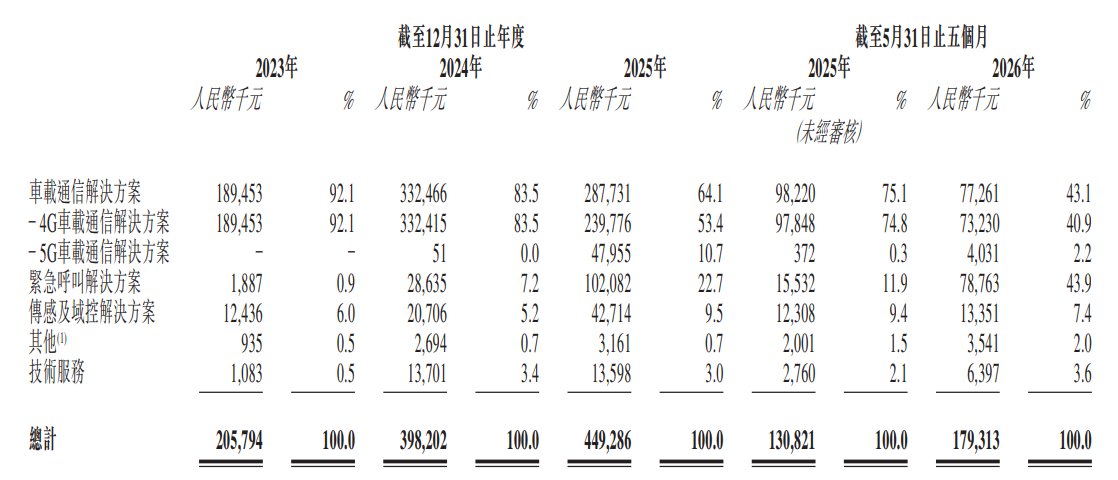
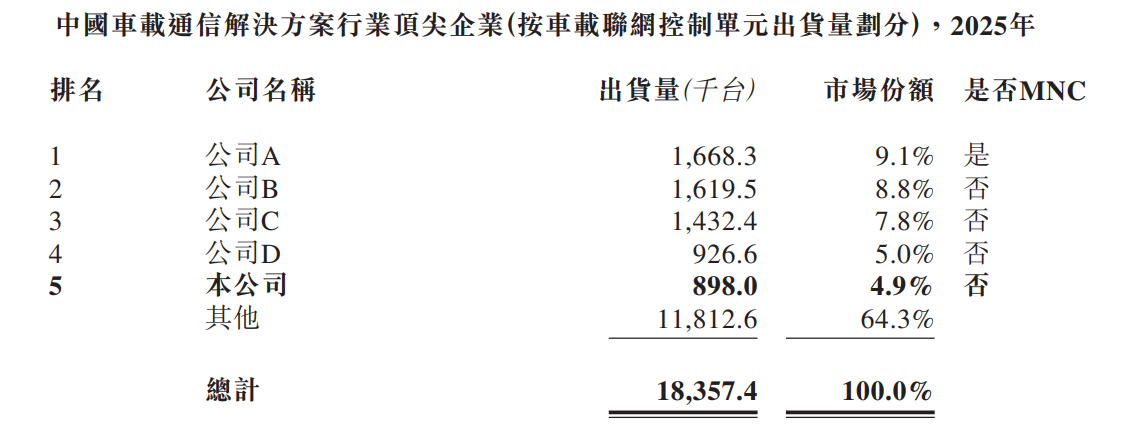
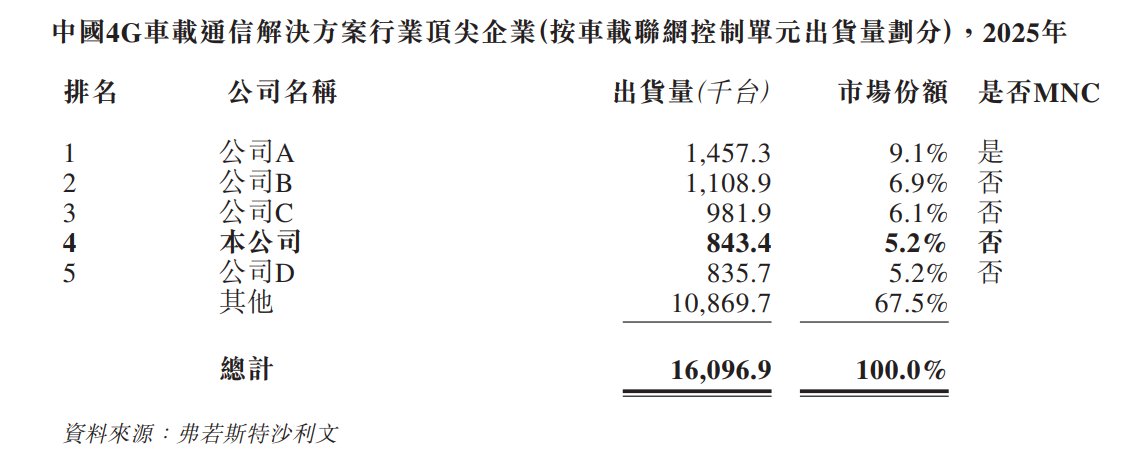
In the Chinese market, the company is the fourth largest domestic supplier of in-vehicle communication solutions (market share: 4.9%). According to the Frost & Sullivan report, for the year ended December 31, 2025, the company ranked 3rd among all domestic suppliers and 4th among all suppliers based on 4GT-box shipments of 4G in-vehicle communication solutions (market share: 5.2%). The company's competitive advantage extends to the field of emergency call solutions. In the year ended December 31, 2025, the company became the second largest domestic supplier in terms of emergency call terminal shipments (market share: 2.6%).
Furthermore, with the company's overall advantages in the field of in-vehicle communication solutions, the company has accelerated the development of 5G in-vehicle communication solutions. In the year ended December 31, 2025, the shipment volume reached about 54,600 units. According to the Frost & Sullivan report, the company has established its position as one of the largest suppliers of in-vehicle communication solutions in China. These solutions feature communication modules equipped with domestic chips.
Financial data
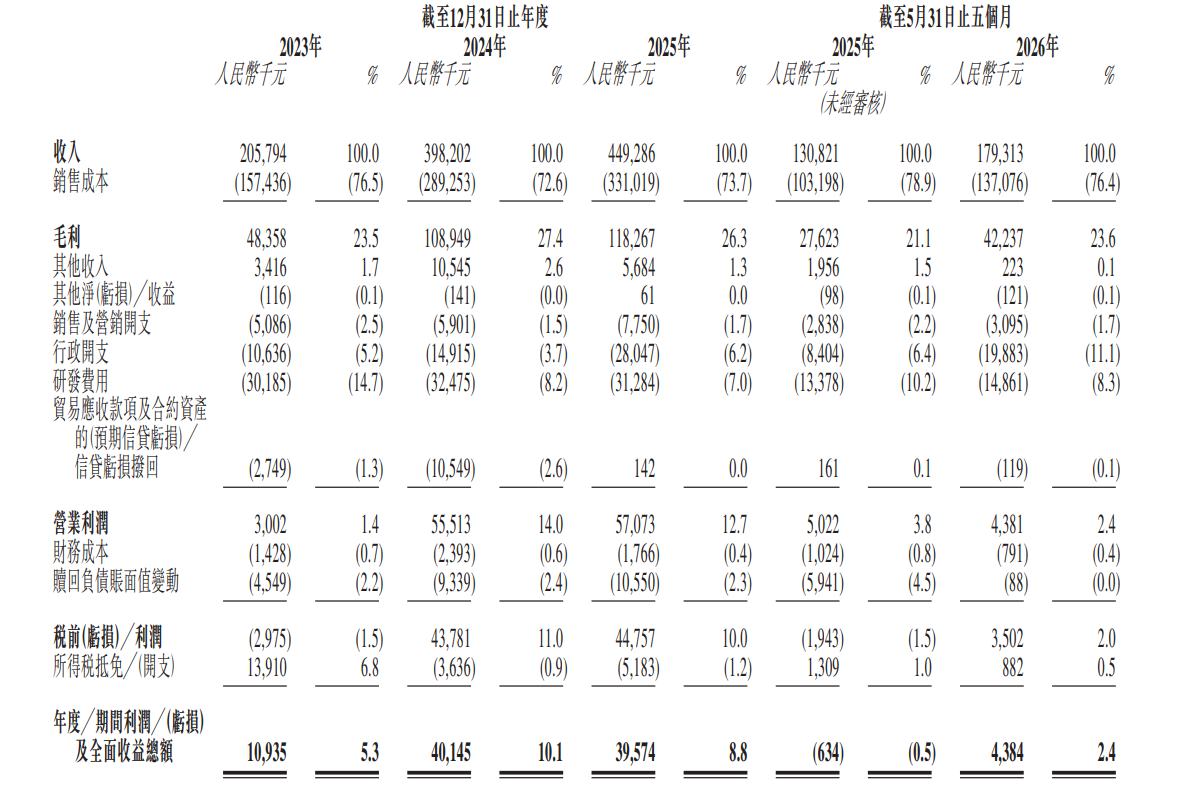
Revenue:
For the five months ending May 31 in 2023, 2024, 2025, and 2026, the company's revenue was approximately RMB 206 million, RMB 398 million, RMB 449 million, RMB 131 million, and RMB 179 million, respectively.
Net profit:
For the five months ending May 31 in 2023, 2024, 2025, and 2026, net profit was 10.935 million yuan, 40.145 million yuan, 39.574 million yuan, -634,000 yuan, and 4.384 million yuan, respectively.
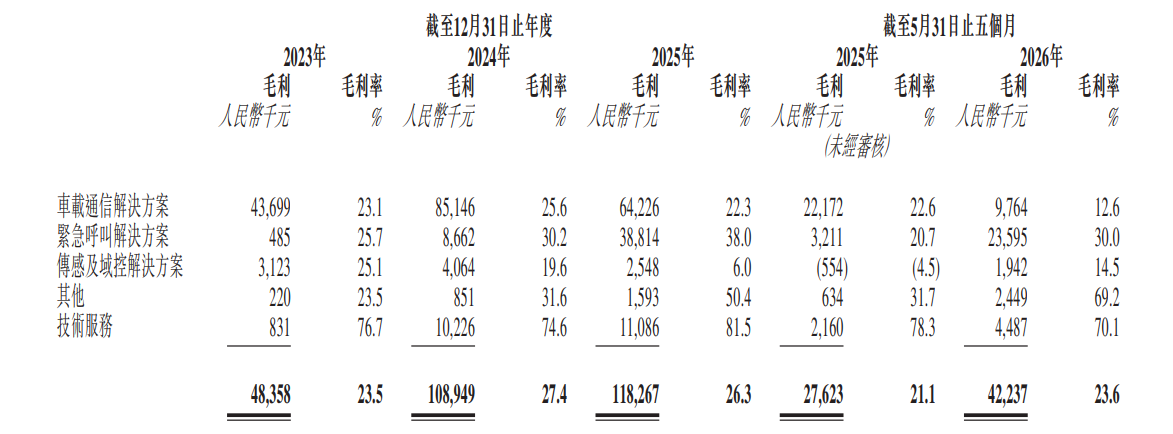
Gross profit margin:
For the five months ending May 31 in 2023, 2024, 2025, and 2026, gross margins were 23.5%, 27.4%, 26.3%, 21.1%, and 23.6%, respectively.
Industry Overview
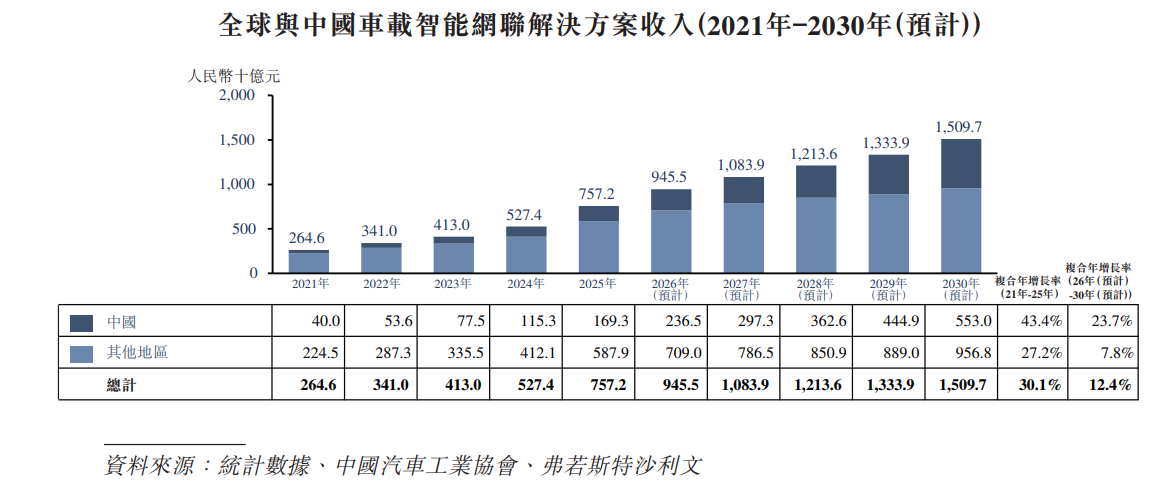
In-vehicle intelligent connectivity solutions usually consist of three parts: hardware, software, and services. The hardware level mainly includes communication modules, vehicle networking control units and other hardware devices, while the software level covers vehicle network platforms and other related services. As intelligent connected vehicle production continues to grow, the global and Chinese market for in-vehicle intelligent connectivity solutions is expanding. It is expected to grow from RMB 757.2 billion and RMB 169.3 billion in 2025 to RMB 1,509.7 billion and RMB 553 billion in 2030.
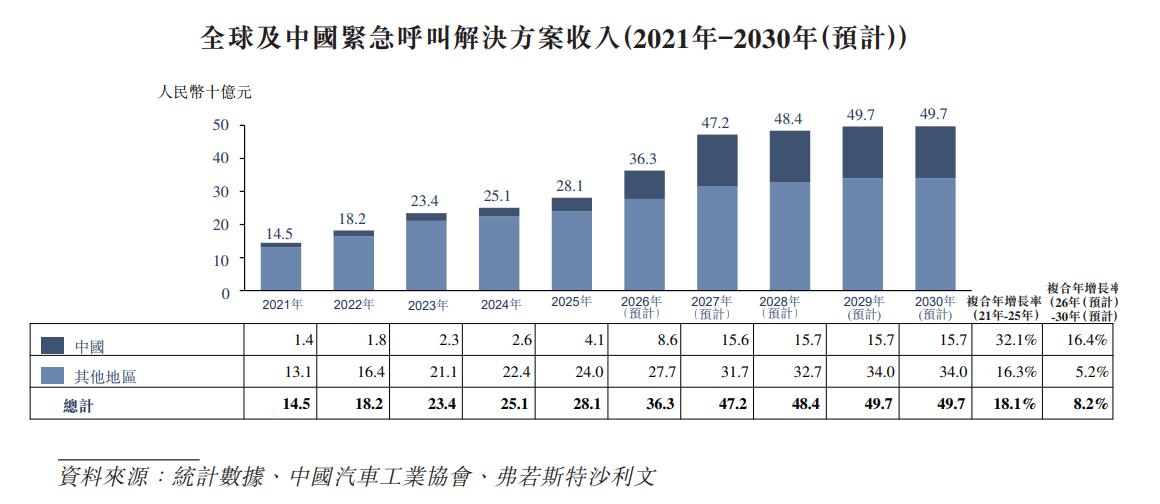
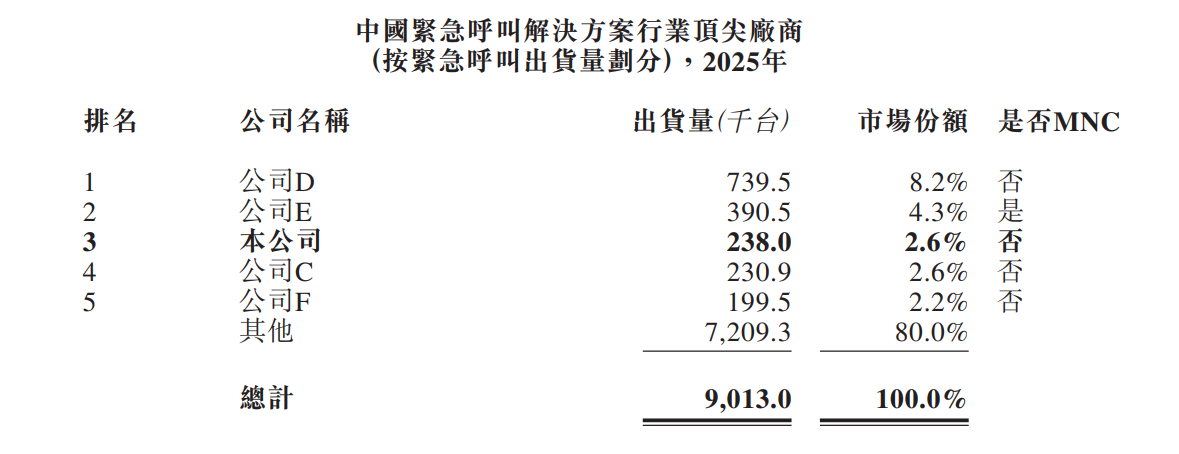
From 2021 to 2025, global and Chinese emergency call system shipments continued to grow, reaching 51,670.4 thousand units and 9,013.0 thousand units respectively by 2025. During the forecast period, the growth rate of China's emergency call system shipments is expected to exceed the global average, driven by the upcoming mandatory installation policy. Global and Chinese emergency call solutions market revenue continues to grow as shipments expand. Although the unit price of emergency call solutions is expected to decline during the forecast period due to large-scale production, increased market competition, and increased technological maturity, overall market revenue will continue to grow, driven by increased penetration rates driven by mandatory regulatory requirements and rapid growth in intelligent connected vehicle shipments. It is estimated that by 2030, the global emergency call solutions market revenue will reach RMB 49.7 billion, and the Chinese market will reach RMB 15.7 billion.
In 2025, in terms of vehicle networking control unit shipments, the top five manufacturers in the automotive communication solutions market accounted for 35.7% of the total market share. The company ranked fifth and fourth among all suppliers and domestic suppliers, with a shipment volume of 898.0 thousand units, accounting for 4.9% of the overall market share. In 2025, based on T-Box's revenue in the in-vehicle communication solutions market, the top three market participants were Company B, Company C, and Company A, with revenues of RMB 1.1 billion, RMB 1 billion, and RMB 600 million respectively.
In 2025, based on 4G T-Box shipments, the top five automotive communication solution market players will account for 32.5% of the total market share. The company ranked fourth and third among all suppliers and domestic suppliers, with a shipment volume of 843.4 thousand units, accounting for 5.2% of the overall market share. In 2025, based on 4G T-Box's revenue in the in-vehicle communication solutions market, the top three market participants were Company A, Company B, and Company C, with revenues of RMB 500 million, RMB 300 million, and RMB 300 million respectively. In 2025, in terms of 5G T-Box shipments in the in-vehicle communication solutions market, the top five market participants together accounted for 71.5% of the overall market share.
In 2025, based on emergency call system shipments, the top five manufacturers in the emergency call solution market will account for 20.0% of the market share. The company ranked second among all domestic emergency call suppliers, with a shipment volume of 238.0 thousand units, accounting for 2.6% of the overall market share. In 2025, based on emergency call revenue in the emergency call solutions market, the top three market participants were Company D, Company E, and the company, which had revenues of RMB 600 million, RMB 200 million, and RMB 100 million respectively.
Board Information
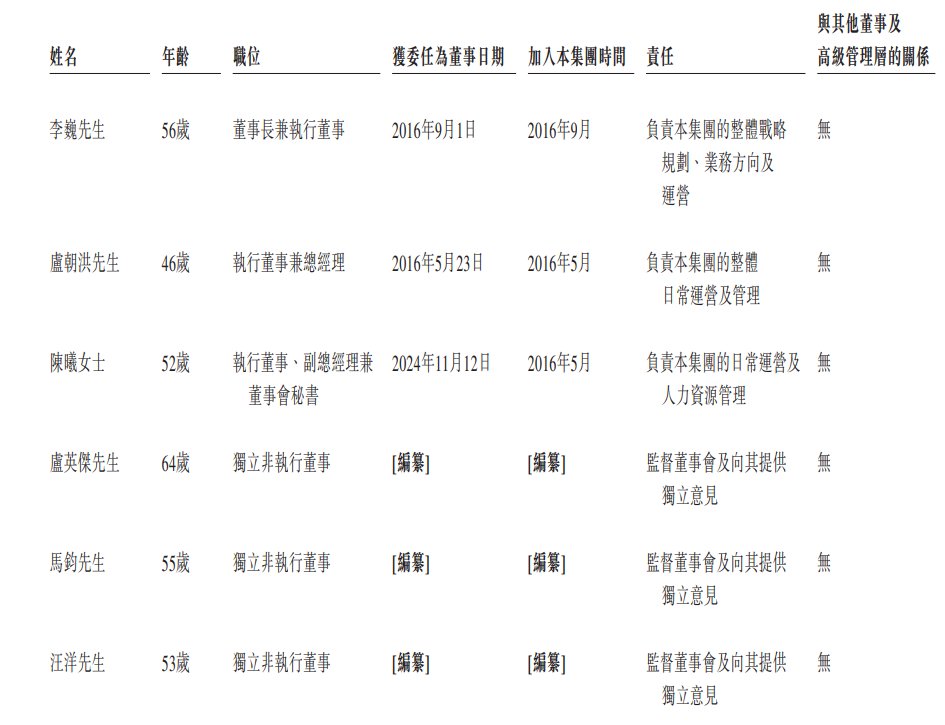
The company's board of directors will be composed of six directors, including three executive directors and three independent non-executive directors.
Shareholding structure
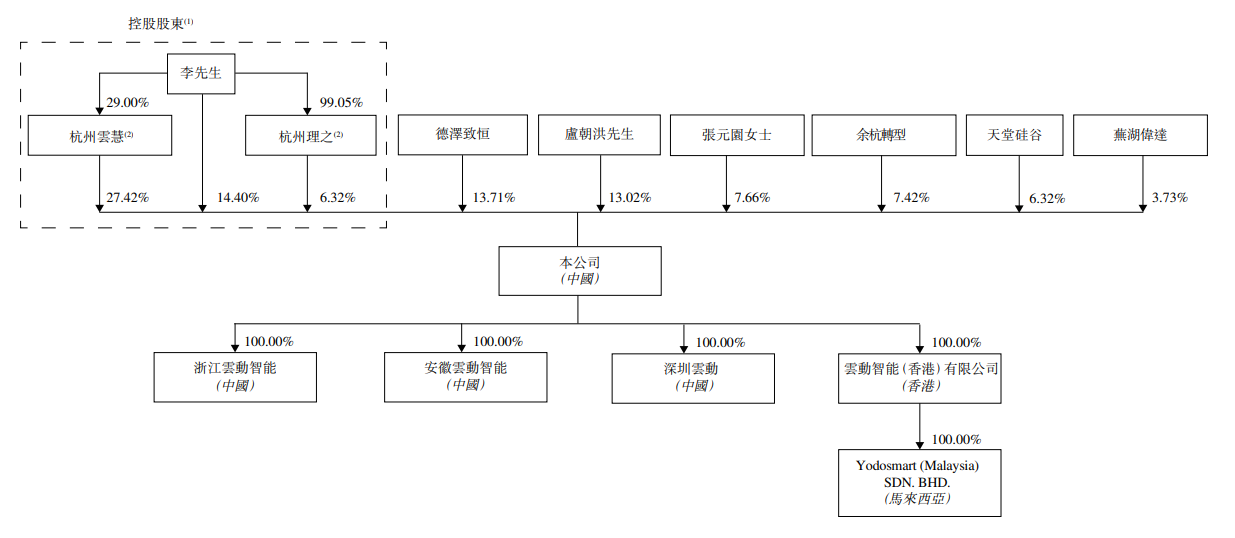
Mr. Li, Hangzhou Yunhui, and Hangzhou Lizhi, held a total of about 48.14% of our total issued share capital as of the last practical date, and are regarded as the controlling shareholder group. Since: (i) Hangzhou Yunhui is an employee shareholding platform, Mr. Li and Mr. Lu Chaohong are its general partners, and Mr. Li is its sole executive partner.
As of the last practical date, (i) Hangzhou Yunhui's remaining 71.00% partnership interests were held by Mr. Lu Chaohong (holding approximately 19.00% interest) and 30 limited partners (including one director, four senior executives and 25 employees of the Group). None of Hangzhou Yunhui's partners held 30% or more of the partnership interest in the partnership.
Intermediary team
Sole sponsor: China International Finance Hong Kong Securities Limited
Company Legal Advisors: JunHe Law Firm, Beijing JunHe Law Firm
Sole sponsor legal advisors: Ouhua Law Firm, Haiwen Law Firm
Independent Auditor and Reporting Accountant: KPMG,
Industry Advisor: Frost & Sullivan (Beijing) Consulting Co., Ltd. Shanghai Branch
Compliance Advisor: China Everbright Finance Co., Ltd.