


Leveraging weak yen and hybrid dividends! Toyota Motor Company (TM.US) spent trillions of yen to buy back shares, drastically raising profit forecast for fiscal year 2027
The Zhitong Finance App learned that on August 4, Toyota Motor Corporation (TM.US) announced a stock repurchase plan with a scale of 1 trillion yen (US$6.3 billion) and raised profit expectations. Strong demand for hybrid vehicles and a weak yen helped the company offset the impact of rising costs, tariffs, and supply chain disruptions.
As the world's largest automobile manufacturer, Toyota raised its operating profit forecast for the fiscal year ending March by more than 10% to 3.4 trillion yen. Analysts forecast an average profit of 3.9 trillion yen. Toyota's stock price recovered its early trading losses, but fell 1.4% during the Tokyo afternoon trading session.
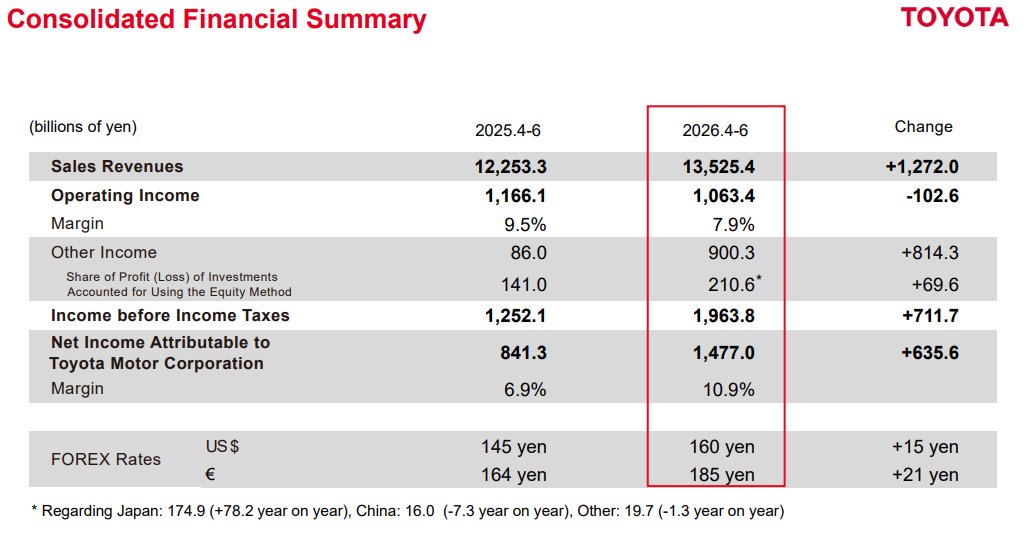
On the same day, Toyota also announced its results for the first quarter of fiscal year 2027. Financial reports showed that Toyota's sales for the first quarter were 13.5 trillion yen, up 10.4% year on year; net profit to mother was 1.48 trillion yen.
 Toyota benefits from the continued popularity of oil-electric hybrid vehicles in the US, and this technology was pioneered and promoted by Toyota. This, along with the weak yen in the first half of the fiscal year, provided a buffer against soaring raw material costs and supply chain disruptions caused by the Iran war — a war that disrupted many critical shipping routes in the region.
The sales forecast was raised to 54 trillion yen from the previous 51 trillion yen.
Chief Accounting Officer Takanori Azuma told reporters that the increase “reflects changes in the external environment, including exchange rate assumptions,” adding that sales have declined due to the impact of the Middle East conflict.
Foreign exchange is still one of Toyota's biggest variables, as the company derives most of its revenue from overseas while maintaining a huge production base in Japan. Toyota's foreign exchange expectations set the yen to 160 to 1 against the US dollar; however, after joint intervention by Japan and the US, the yen rebounded above this level in the past week, and if this reversal continues, it may affect this forecast.
Even so, the yen fell to a 40-year low earlier this year, a blessing for Japan's biggest exporter. Toyota and other Japanese car companies are preparing to enjoy this short but critical respite to deal with US tariffs, rising raw material prices, and supply chain challenges.
Toyota said that in order to improve capital efficiency, it plans to purchase up to 500 million shares, which is equivalent to 4.2% of the shares already issued after excluding treasury shares. The company said the buyback will continue until August 2027, adding that it plans to cancel 200 million treasury shares, or 1.4% of the issued shares, once the repurchase is completed.
The quarterly operating profit to the end of June was 1.1 trillion yen, marking five consecutive months of year-on-year decline.
In May, Toyota warned investors that profits would unexpectedly decline this year. The reason is that supply disruptions due to the Iran conflict are expected to impact its net profit by about 670 billion yen.
Its largest supplier is facing sharp cost increases, logistics problems, and shortages of basic materials such as aluminum and resin. Since it is almost impossible to predict when the turmoil in Iran will subside, it is difficult to predict how long its impact on production will last.
As regional conflicts and intense competition squeezed traditional brands (which are struggling to adapt to the industry's rapid transformation to software-driven, battery-powered vehicles), Toyota's global sales declined in June — the fifth consecutive month of decline.
Chairman Akio Toyoda adopted what Toyota called a “multi-path strategy” instead of betting entirely on pure electric vehicles. As consumers retreat from the price and charging demand for pure electric vehicles, Toyota's hybrid-based product lineup has given it an advantage. Dong Guiwu said that in the 2026 calendar year, hybrid vehicle sales are expected to exceed 5 million units for the first time.
The Chinese market is still a weak link, and Toyota and its Japanese counterpart are struggling to keep up with local Chinese manufacturers such as BYD — the latter is introducing cheaper, increasingly advanced pure electric and plug-in hybrid vehicles. Pressure in China is forcing Toyota to rely more on local engineers and suppliers while speeding up the development of models tailored to the world's largest automotive market.