


The momentum market is expected to bottom out and rebound! Damo Wilson: High-quality stocks took the lead, and S&P 500 hit 8,000 points at the end of the year
The Zhitong Finance App learned that Morgan Stanley strategist Michael Wilson said that as profitable sectors replace chip stocks as the main driving force for market growth, momentum stock investment is expected to rebound from a sharp pullback. He believes the S&P 500 is expected to reach 8,000 points by the end of the year, up 7% from the latest closing price.
Wilson said that after experiencing “one of the worst momentum sell-offs in history,” the market style is shifting to so-called high-quality stocks, that is, stocks with a stable profit history. He also pointed out that insurance, medical equipment, and service stocks are also becoming increasingly popular.
Goldman Sachs's momentum stock portfolio is down 35% from its peak in June. The combination has risen 9.4% so far this year, which is largely in line with the increase in the S&P 500 index.
The Goldman Sachs Momentum Stock Index and the S&P 500 Index performed the same during the year
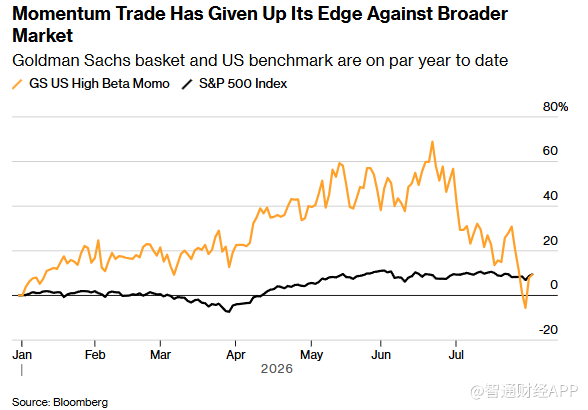
In recent weeks, investors have been selling off global chip stocks due to growing concerns about the unprecedented capital expenditure of some of the world's biggest tech companies. Nicolas Panigirzoglu, strategist at J.P. Morgan Chase, said, “We have found that investors are deleveraging faster in the technology and semiconductor sector (including storage stocks) than we previously anticipated. As a result, we now believe there is very limited room for further deleveraging.”
At the same time, the US stock company handed over a report card that can be called “one of the strongest in history.” According to the data, earnings per share of S&P 500 companies are expected to grow 29% year-on-year in the second quarter, which is one of the highest levels outside of the post-crisis recovery years. Furthermore, the percentage of S&P 500 companies whose performance exceeded expectations reached 86%, the highest level in five years.
Wilson said, “As the business cycle matures and operating leverage levels off in the post-recession period, we believe the driving force of the stock market should shift from low-quality companies to companies with more stable profits, higher profit margins, and higher operating efficiency.”
Profitability is backed by the US S&P 500 Index 8,000 points
Wilson said that the weight of high-quality stocks in the S&P 500 index is higher than that of low-quality stocks, and the expansion of the scope of profit forecast revisions should help push the index to reach 8,000 points by the end of the year. The index closed at 7489.72 points last Friday.
Other Wall Street strategists share the same view, believing that the sell-off in chip-related stocks is coming to an end, and that corporate profits will continue to support the stock market.
Goldman Sachs strategist Ben Snyder said that the current sharp shock is very similar to the historical performance after momentum factor trading was overcrowded. In those few scenarios, the market usually first experiences a period of intense deleveraging and chip clearance, then enters consolidation, and finally resumes a long-term upward trend. He also said that investor deleveraging also “indicates an improvement in future prospects,” and the final results will depend on subsequent financial statements.
Snyder stressed, “Investors should not mistake the recent turmoil in AI stocks as the beginning of a broader market failure. Unless profits themselves begin to deteriorate, this broader bull market is still based on a solid foundation of rising corporate profits, rather than simply being driven by speculation.”
Kriti Gupta, a global investment strategist at J.P. Morgan Private Bank, predicts that the S&P 500 index is still expected to rise by more than 10% in the next 12 months, and may reach 8,200 points by the middle of next year.
Although the US is entering a “recurrent cycle of inflation” similar to the 1970s, Gupta believes that the recovery in inflation will not disrupt the core support of the current US stock market — economic growth, corporate profits, and the wave of AI investment.
J.P. Morgan strategist Mislav Matejka reiterated that it will be difficult for the AI and broader technology sector to continue to lead the way in the second half of this year, and the market market is expected to continue to spread to more sectors. Although semiconductor stocks are close to or in the oversold range, and the momentum of earnings per share growth is still rising, he believes the sector will stabilize.
“Strong corporate profit performance will continue to support the stock market,” Mataika said.