The “one-sided cow” of semiconductors has collapsed! The Philadelphia Semiconductor Index plummeted 21% in a single month, and the AI spending frenzy faces a crisis of trust
The Zhitong Finance App learned that the semiconductor unilateral market, which has dominated the stock market trend since this year, has been falling apart, causing worrying sharp fluctuations — investors are increasingly worried, and the artificial intelligence (AI) spending frenzy may be unsustainable.
The Philadelphia Semiconductor Index fell 21% in July, the worst monthly performance since the worst period of the global financial crisis in October 2008. In last month's trading day, the index (which tracks the 30 largest chip makers in the world) closed with no less than 4% rise or fall for nearly half of the time. The intraday volatility reached at least 2% for all 22 trading days, a scenario that has not occurred since 2020.
Stephen Evans, chief investment officer at Pave Finance, said: “This fluctuation really reflects the uncertainty that currently prevails, and no one knows how things will evolve.” He added, “I think there is still room for the current chip cycle to continue, and investors can still hold long positions. But only if you can stand the Disneyland rollercoaster.”
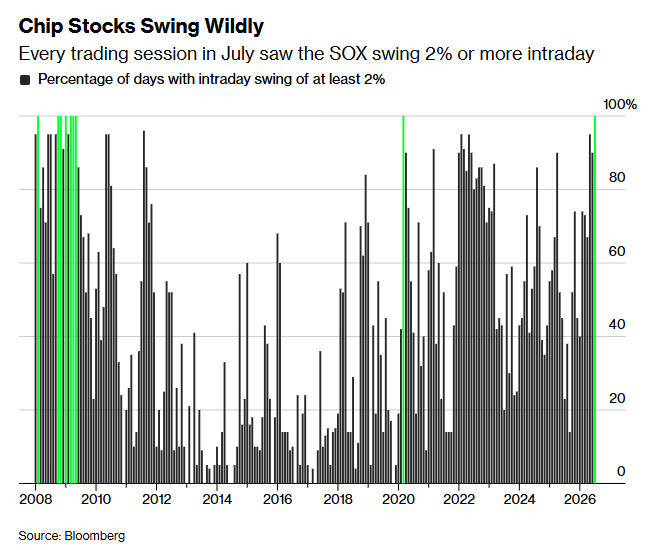
The increase in volatility is due in large part to the market's stricter scrutiny of tech giants' capital expenditure plans, and outsiders are beginning to question the sustainability of spending. Coupled with increasing competition and the growing popularity of open source AI models — models that are cheaper to run, more efficient, and require less infrastructure — investors are beginning to wonder that the bright days of chip stocks may be over.
Despite a two-day rebound of 8.3% in chip stocks at the end of July, the Philadelphia Semiconductor Index fell 23% from the all-time high set on June 22. All constituent stocks of the index recorded declines during this period, with more than half of them falling at least 25% cumulatively.
Some investors believe that this round of sell-off has been excessive; instead, it has created opportunities to buy on short-term dips. However, in the long run, the outlook for chip stocks is still full of variables.
Charles Lemonides, chief investment officer at Valueworks, said, “I wouldn't be surprised if chip stocks rebounded quite strongly after this sell-off. But I don't think they're likely to lead the next phase of the bull market. Their glory days are over.”
The shock wave of the sharp decline in the AI sector across the board in July has begun to show. Situational Awareness, a hedge fund headed by Leopold Ashenbrenner, was forced to sell off billions of dollars of technology stocks to meet additional margin requirements due to the rapid contraction of heavy stocks. The fund has invested in companies linked to the AI boom, including semiconductor manufacturer SNDK.US (SNDK.US) — the company's market value evaporated by nearly half in July after soaring 858% in the first half of the year.
Obviously, in the face of this increase, investors are cashing in on profits from stocks that have doubled, tripled, or even quadrupled this year. However, such a sharp shift in investor enthusiasm indicates that the market is increasingly skeptical about the core logic driving this round of gains.
Despite this, the industry's growth prospects for the next year are still optimistic, and analysts expect the profits of companies such as Nvidia (NVDA.US) and Broadcom (AVGO.US) to continue to expand. Last week, Amazon (AMZN.US) and Microsoft (MSFT.US) reaffirmed their commitment to invest hundreds of billions of dollars in AI over the next year, with a significant portion going to manufacturers of chips used in data centers.
The problem is that the fundamental picture since then is being questioned. Chip stocks, especially memory chip stocks, have always had strong cyclicality, rising and falling as demand fluctuates. Many people on Wall Street are still adamant that this cycle will not be an exception.
Valueworks' Lemonides said, “The explosive growth in earnings we are seeing is simply unsustainable.” He added, “The bigger question is whether profit margins can be maintained. The current profit margin has seriously deviated from the historical norm, and the pullback is a reasonable expectation. The only question is when it will happen and how the stock market will respond.”
The following three charts capture this thrilling month for chip stocks:
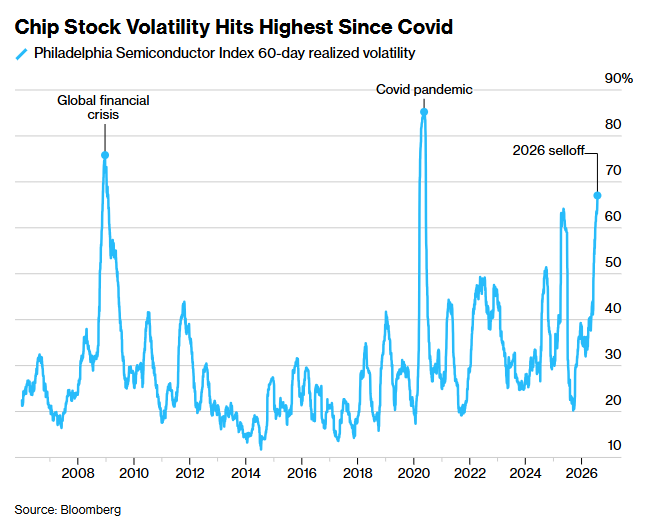
Volatility is soaring
The actual volatility index of the Philadelphia Semiconductor Index has soared to the highest level since the outbreak of COVID-19 over the past 60 days. In the past two decades, it was only during the global financial crisis that it reached similar heights.
Market capitalization evaporates
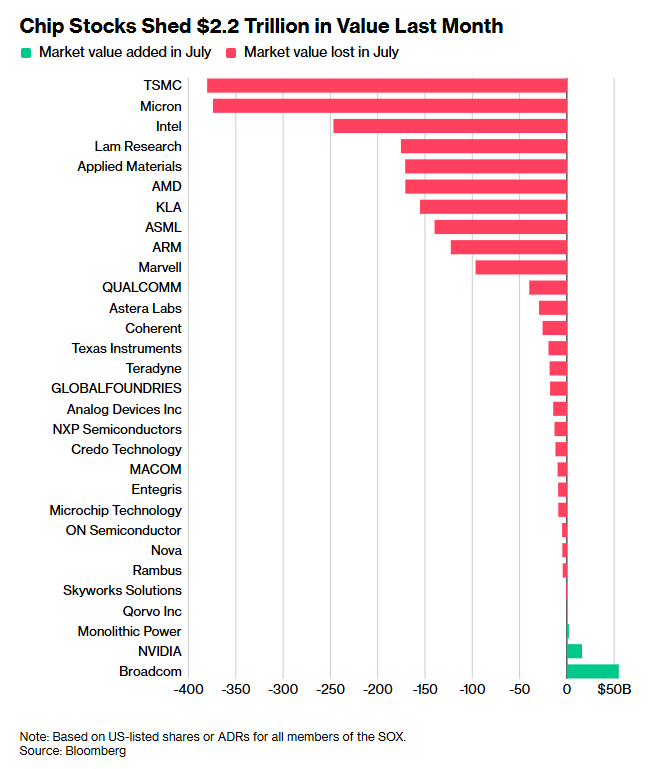
The July sell-off wave evaporated the total market value of the Philadelphia Semiconductor Index by $2.2 trillion.
The hardest hit areas include TSM.US (TSM.US) ADR, which fell 15% in July and lost more than $380 billion in market capitalization — the company also raised its spending and revenue forecasts in mid-July. Micron Technology (MU.US) followed, with a 29% decline, the biggest monthly decline in more than a decade, with a market capitalization evaporating $374 billion. Intel (INTC.US) plummeted 35% in the same month, and its market capitalization shrunk by about $247 billion, the biggest monthly decline since September 2000. It is worth mentioning that the performance of chip stocks was significantly divided, and some leading stocks such as Nvidia and Broadcom recorded increases in the same month.
Retail investors buy on dips
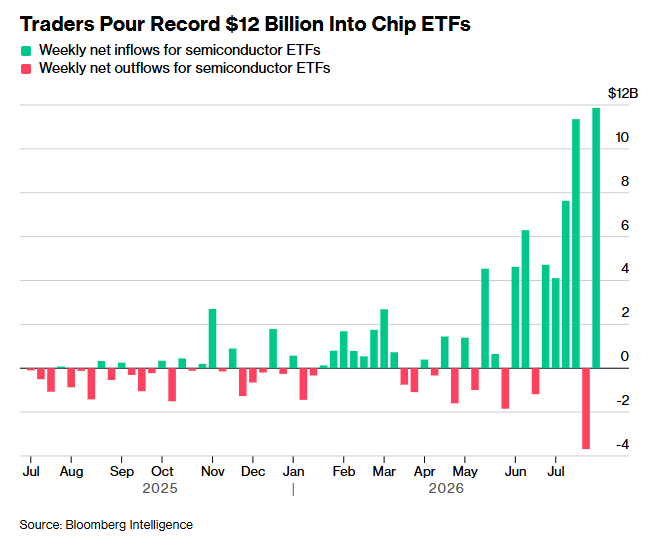
According to statistics, sharp fluctuations in chip stocks have triggered historic trading activity among retail investors. In the last week of last week alone, net inflows from individual investors to semiconductor-related exchange-traded funds (ETFs) reached a record $12 billion.
Analyst Eric Balchunas wrote, “Semiconductor ETFs have never reached this level regardless of capital flow or trading volume. The inflow of $12 billion is not only a historical record, but also accounts for 25% of all ETF net inflows over the past five days, even though semiconductor ETFs only account for 1% of ETF's total assets.”
Among them, a fund focusing on memory chip manufacturers and a triple-leveraged semiconductor fund are particularly sought after.