Societe Generale Securities: AI congestion has fallen to the bottom, and the technology and optical communication chain are suitable for long-term deployment
The Zhitong Finance App learned that Societe Generale Securities released a research report saying that the current round of sharp declines changed “differentiation” at the level of stock price positions, valuations, and chips; what did not change was “differentiation” at the business level. Therefore, for these high-quality hardware and technology assets, which have fallen out of cost effectiveness, from the perspective of long-term allocation, there is currently an agreed layout position. Furthermore, the congestion level of most AI core tracks has fallen back to the bottom, and it has dropped quite a bit over the past month compared to overseas. Internally, more attention should be paid to North American computing power chain leaders such as optical communications.
Societe Generale Securities's main views are as follows:
Over the past month, we have witnessed the most intense fluctuation in the global market since the current AI bull market. When the world is “looking for reasons” and “deleveraging,” and being held hostage by negative feedback on liquidity and panic, the market can only “trade space for time”, wait for more clear signals of sentiment to bottom out, and wait for fundamentals to give more clear guidance.
This week has certainly been an important “watershed.” Global stock markets have all launched “self-help” to curb negative feedback on liquidity. Several important domestic and foreign boots have also been launched this week, giving the market a reason to return to rational and objective analysis.
Therefore, when it comes to structural choices, and for AI and non-AI, the most important thing is to return to the essence of industry comparison: fundamentals, stock price positions, valuation, chips — what has changed after this round of sharp decline? What else hasn't changed? Once these issues are clarified, the next configuration ideas will be more clear.
1. What was changed after this round of sharp decline: In terms of stock price position, valuation, and chips, this year is no longer a “fragmented market”
Before this round of sharp decline, the biggest feeling in the market was the “differentiation” between AI and non-AI. Admittedly, the huge profits and excessive concentration of chips accumulated previously are the main reasons for this round of global AI resonance adjustments.
However, it is precisely this that changed the most after this round of sharp declines — after experiencing structural “rebalancing” and chip digestion, this year is no longer a “divided market” in terms of stock price position, valuation, and chips.
First, the stock price position level:
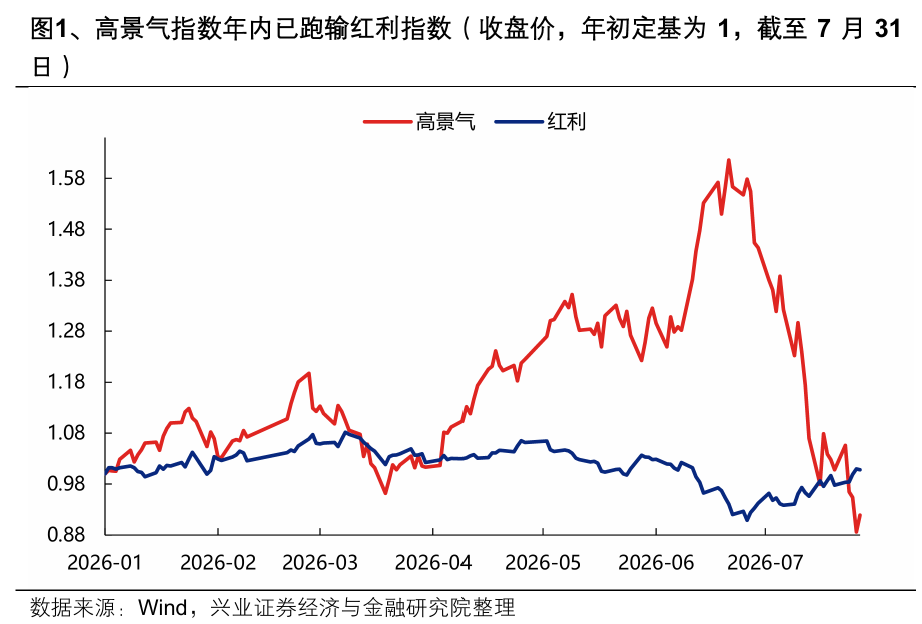
1) The earnings of the High Sentiment Index turned negative during the year and outperformed the dividend index: The high boom index, which measures the performance of leading stocks in the booming industry, turned negative from a maximum level of 60% or more during the year, and has outperformed the dividend index.
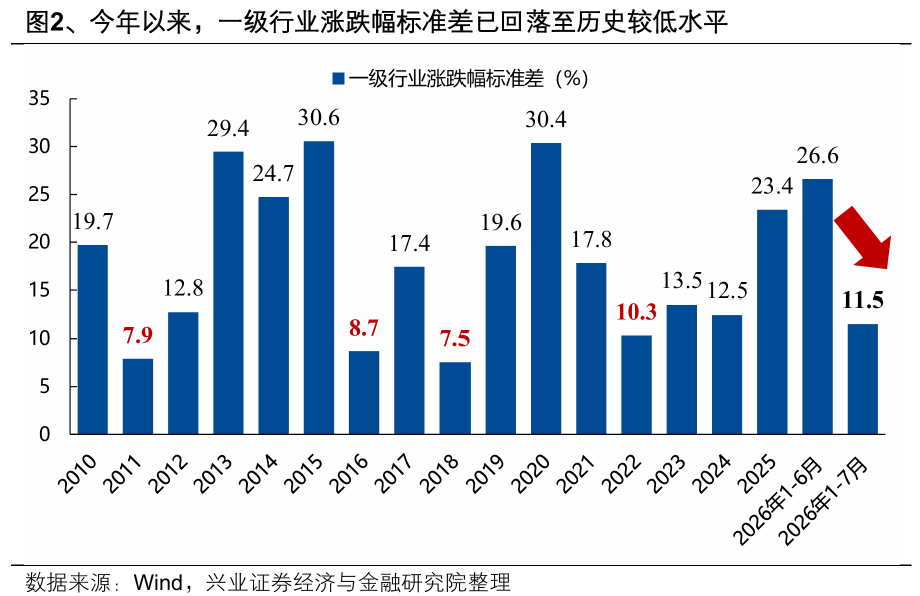
2) Since the beginning of the year, the degree of differentiation of the rise and fall of all tier 1 industries has fallen to the fifth lowest level since 2010: before the sharp decline (January-June), the standard deviation of the rise and fall rate of each tier 1 industry was 26.6%, the fourth highest since 2010 (after 2013, 2015, and 2020); after the sharp fall (January-July), this indicator fell sharply to 11.5%, the fifth lowest since 2010 (only higher than 2011, 2016, 2018, and 2022).
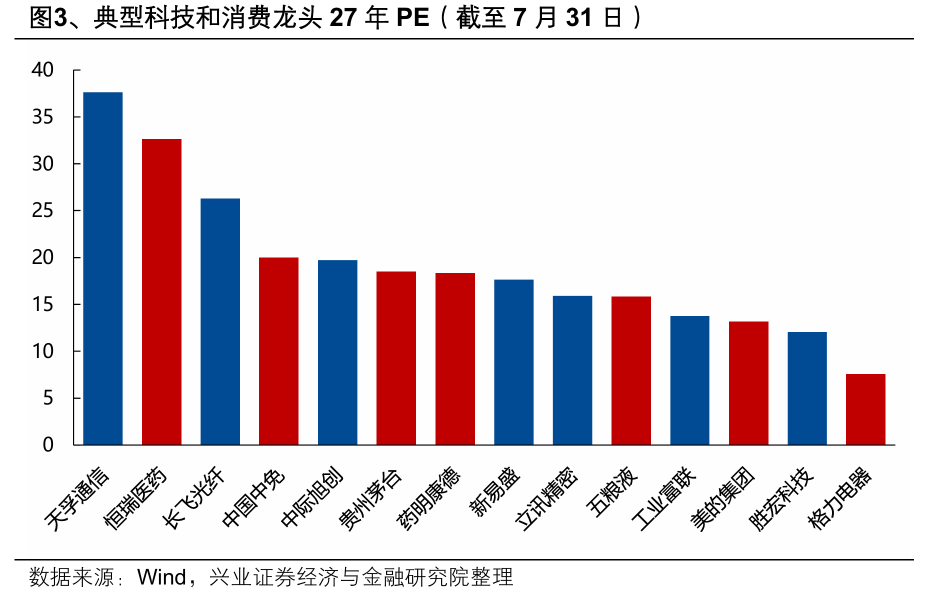
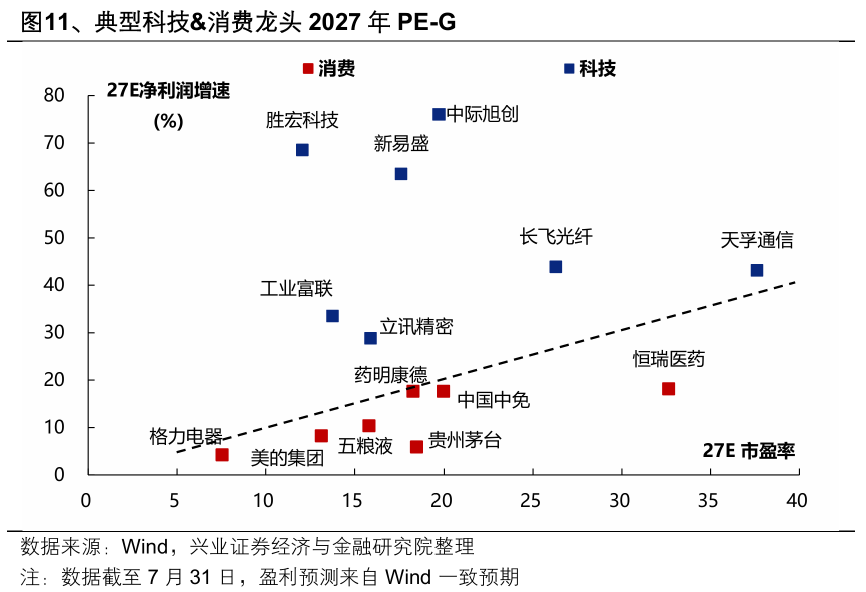
Second, at the valuation level, most of today's typical technology and consumer leaders have reached the range of 10 to 20 times. From the perspective of long-term configuration, current technology leaders are no longer “expensive.”
Finally, at the chip level:
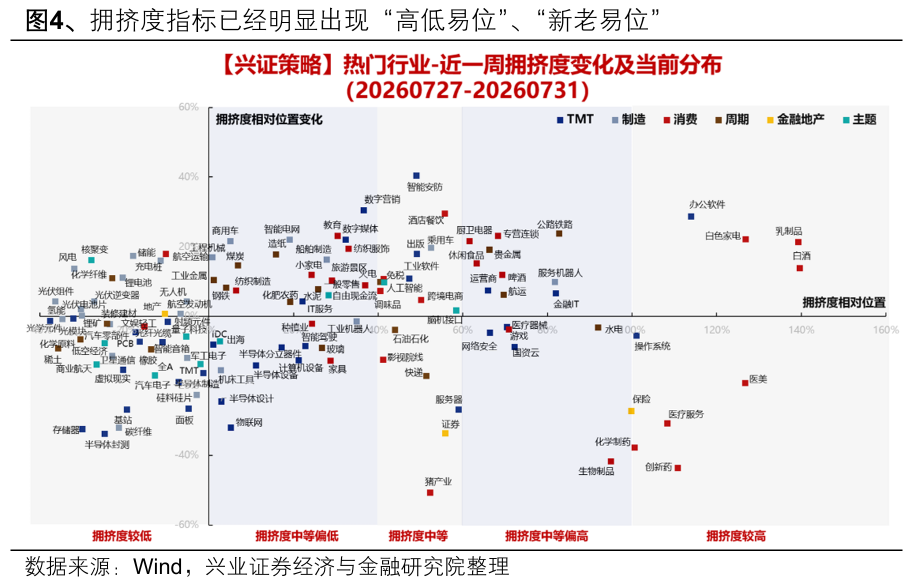
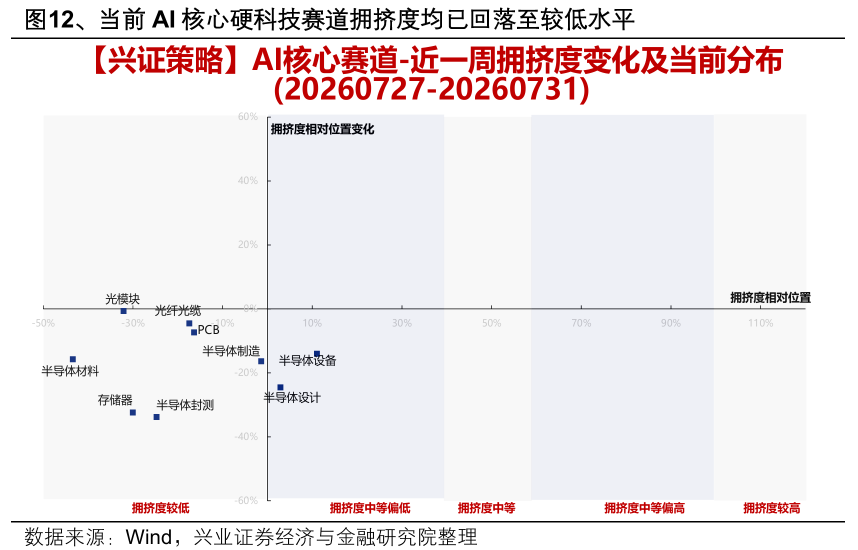
1) Our congestion index, which measures short-term market sentiment, has clearly shown “shifting positions between high and low” and “new and old”: previously low levels of consumption and dividend congestion have risen to high levels, while congestion levels in most technology growth sectors have fallen back to the bottom of history.
2) After this round of decline, the position pressure on AI-related tracks should also be digested quite a bit:
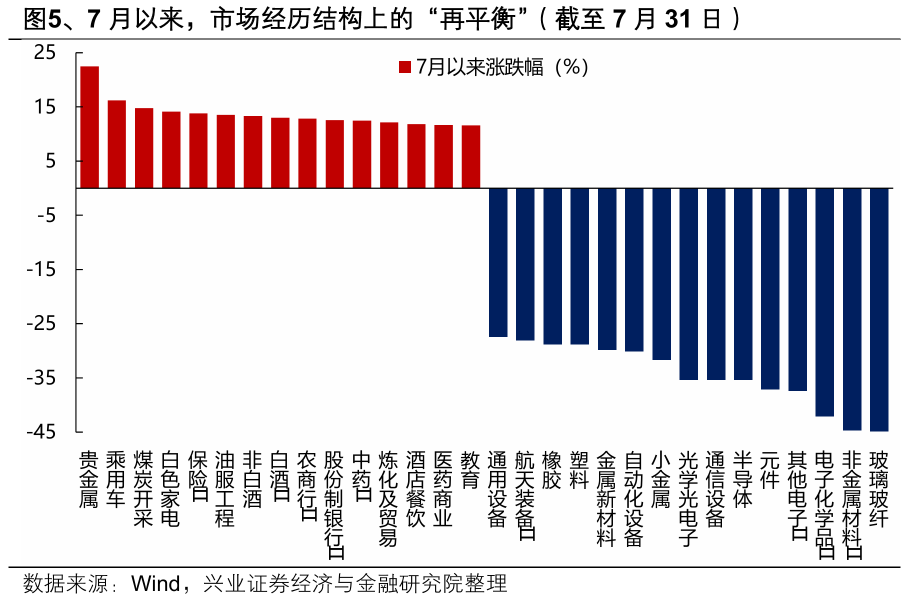
As far as active public offering is concerned, AI-related tracks (including upstream materials such as communication equipment, electronic hardware, non-ferrous & chemical & glass fiber) have generally declined by 25% to 50% since July. Whether due to the decline in the stock price itself or the fund manager's active position adjustment, the allocation ratio on AI-related tracks should have been digested to a certain extent.
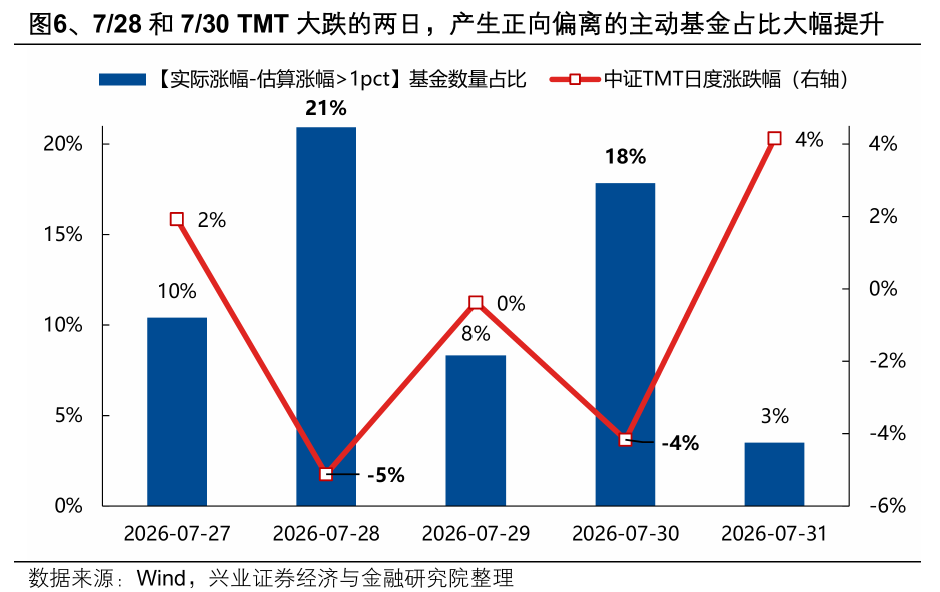
As supporting evidence, on the two days of the 7/28 and 7/30 TMT sharp declines, there was a sharp rise in the share of active funds with a positive deviation (the actual decline was smaller than the decline based on the fund's second-quarter report position estimates), indicating that in the process, active funds have adjusted their positions to a significant extent compared to the second quarterly report.
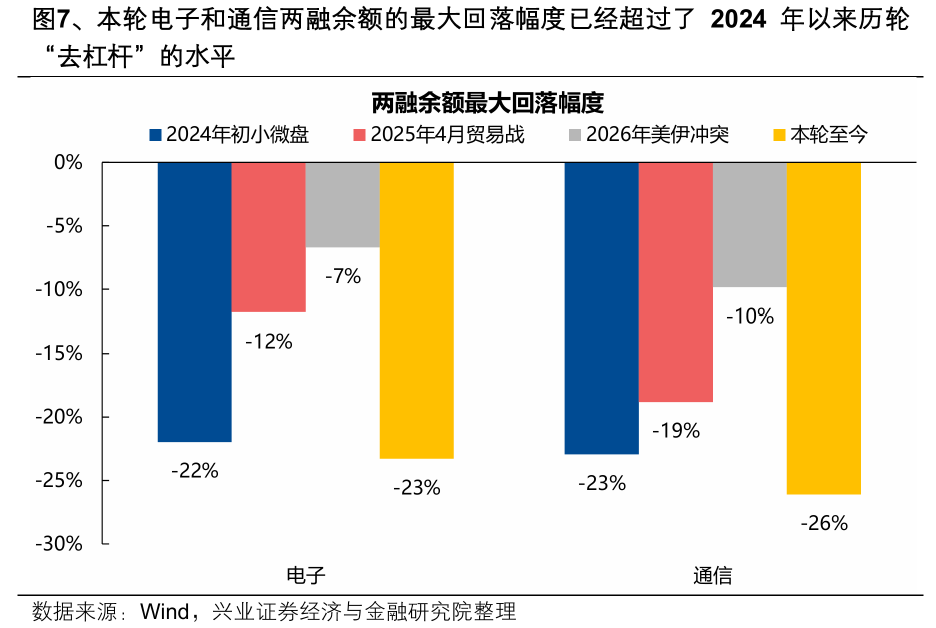
As far as Liangfinance is concerned, the current balance of the two finance balances of electronics and telecommunications has declined by 23%/26%, respectively, exceeding the magnitude of “deleveraging” since 2024, and the absolute values have all roughly fallen back to the position in early May, and the chip pressure on high-wave capital has also been greatly digested.
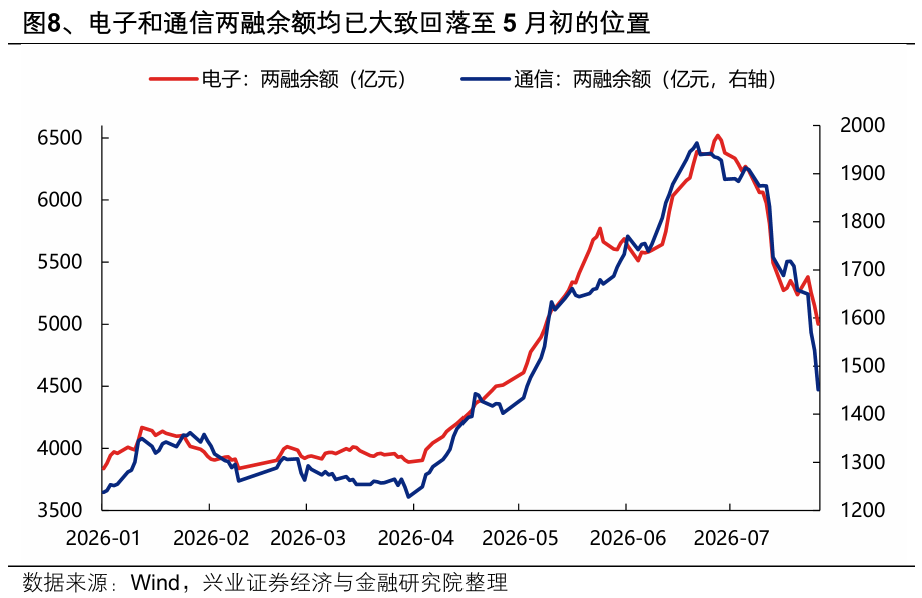
Therefore, after this round of adjustments, the “differentiation” between AI and non-AI in terms of stock price position, valuation, and chips has been reduced to a large extent. When the differentiation in these dimensions is “leveled out,” the core should return to judging the economic advantage of the two with regard to the cost performance ratio of the two.
2. Unchanged in this round of sharp decline: fragmentation at the economic level
However, what has not changed in this round of sharp decline is precisely the differentiation between AI and non-AI at the economic level.
Regarding this round of AI adjustments, we have repeatedly emphasized that the essence is that negative feedback on liquidity has amplified fluctuations and fears. There have not been many substantial changes in fundamentals; more, more clear information is needed to once again forge market consensus.
And with the results of cloud companies in North America and the launch of domestic political bureau meetings this week, the market should have a more clear judgment on AI and non-AI trends.
First, with regard to AI, the market's previous concerns about performance falling short of expectations, and the pessimistic situation where AI Capex is slowing down has not occurred. The industry picture described in the latest financial report of the North American cloud factory: AI returns have greatly exceeded expectations, the backlog of orders continues to increase rapidly, supply is in short supply, and forward capital expenditure is still certain.
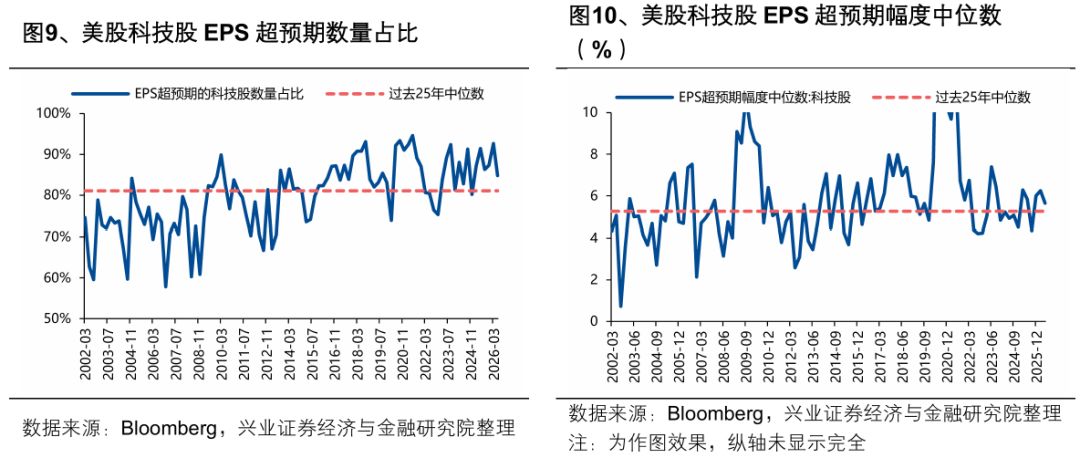
First, even after experiencing a sharp improvement since the second quarter, the proportion and magnitude of the 26Q2 US technology stock performance exceeding expectations is still at a high level in history: the 26Q2 US technology stock EPS exceeded expectations by 85%, and the median EPS exceeded expectations by 5.6%, all at historically high levels.
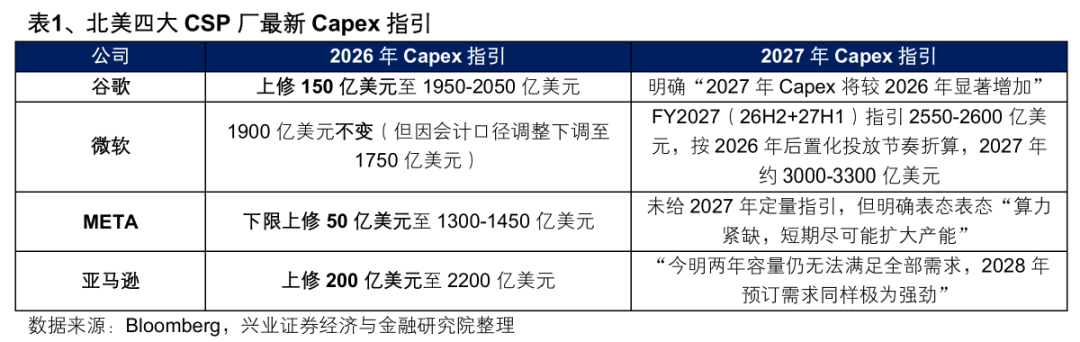
Second, Hyperscalers' 26-year Capex guidelines continue to be improved, and there is still certainty about Capex expansion in '27: Google, META, and Amazon's 26-year Capex guidelines continued to be upgraded. The four major CSP companies totaled about US$720-745 billion, and Capex's growth rate increased to about +80% in '26 under the central caliber. Although no quantitative guidelines were given for '27, none gave a “reduction” signal.
Third, cloud factories' AI returns have all exceeded market expectations, and the backlog of orders in the cloud business continues to increase dramatically, and supply is in short supply, continuing to guarantee the sustainability of AI capital expenses: Google, Microsoft, and Amazon Cloud revenue are all significantly higher than market expectations, and the capital expenses invested earlier are being transformed into real AI returns. More importantly, the backlog of orders (RPO/backlog) for the three cloud businesses continues to increase, and the growth rate greatly exceeds the growth rate of cloud revenue. The conflict between supply and demand has intensified, increasing visibility for subsequent growth, and also ensuring the sustainability of subsequent AI capital expenditure.

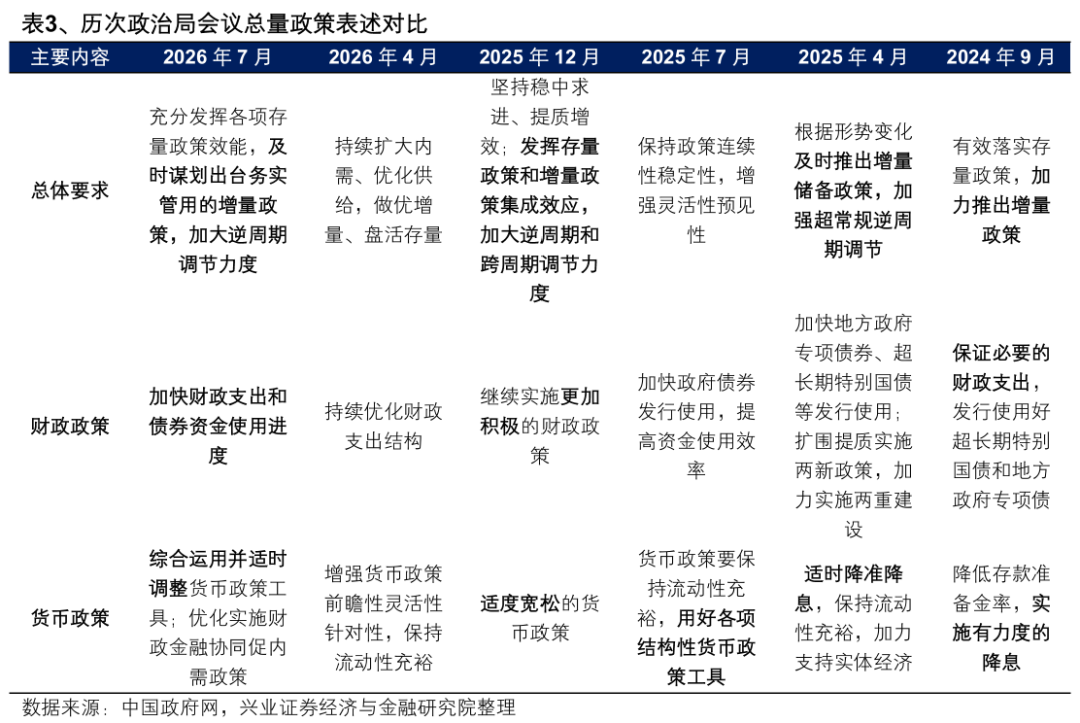
Second, for non-AI, the core depends on how strong domestic policies are in the second half of the year. The policy ideas for the second half of the year conveyed at the latest Politburo meeting: marginally more positive, but implementation and good use of stocks are still priority options. “Countercyclical adjustments” and “timely planning and introduction of incremental policies” were more active than in April. If the downward pressure on fundamentals increases in the third and fourth quarters, the incremental policy may underpin it. However, implementing and making good use of stocks is still a priority option. Whether it is monetary policy or fiscal policy, a drastic increase is not necessary or strong.
As a result, the differentiation between AI and non-AI fundamentals may continue in the second half of the year, but this round of decline has brought the valuations of the two back to the same level. If you make a simple comparison from the perspective of PE-G: Currently, most typical technology and consumer companies have reached the range of 10 to 20 times PE, but the corresponding growth rates are above 30% and 10%, respectively. Once the market calms down, the allocation value of technology leaders will be re-examined based on this.
III. Configuration ideas at the current time
What has changed in this round of sharp declines is the “differentiation” at the level of stock price positions, valuations, and chips; what has not changed is the “differentiation” at the boom level. Therefore, for these high-quality hardware and technology assets, which have fallen out of cost effectiveness, from the perspective of long-term allocation, there is currently an agreed layout position.
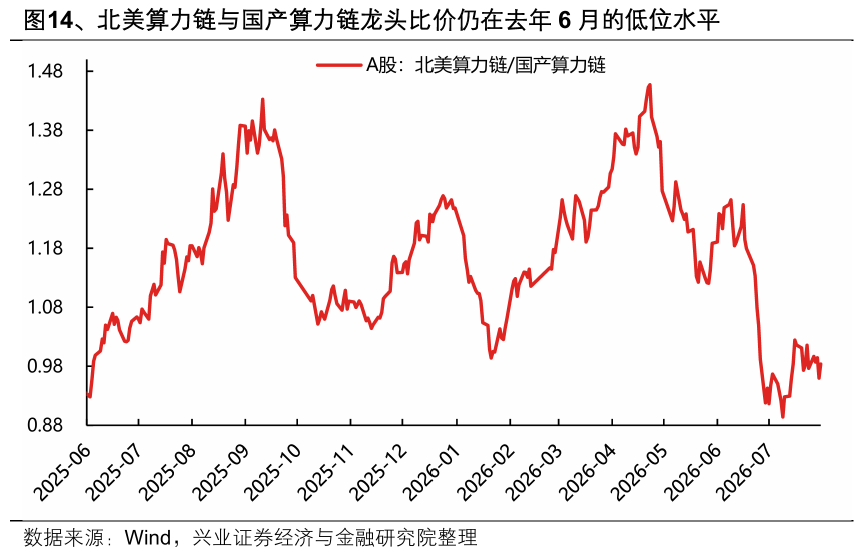
Furthermore, the congestion level of most AI core tracks has fallen back to the bottom, and it has dropped quite a bit over the past month compared to overseas. Internally, more attention should be paid to North American computing power chain leaders such as optical communications.
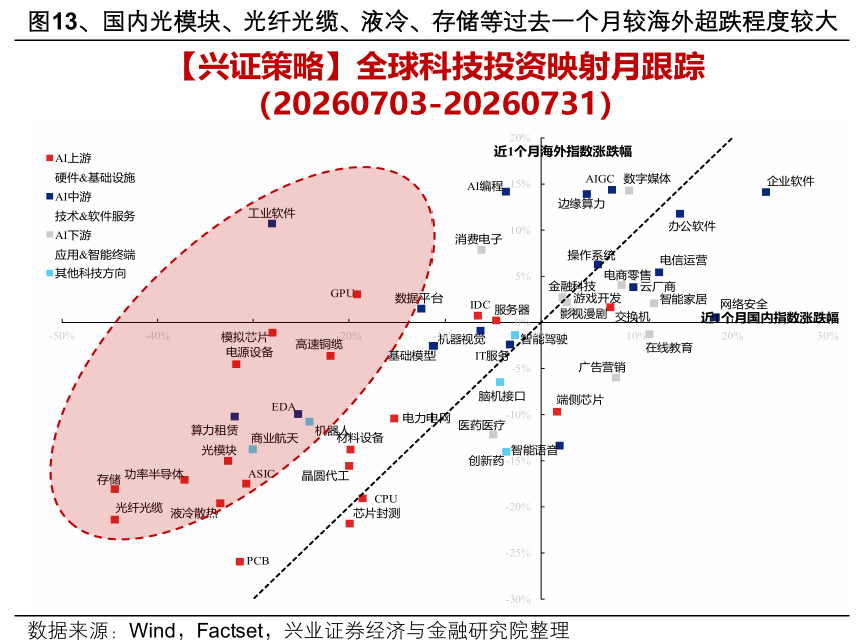
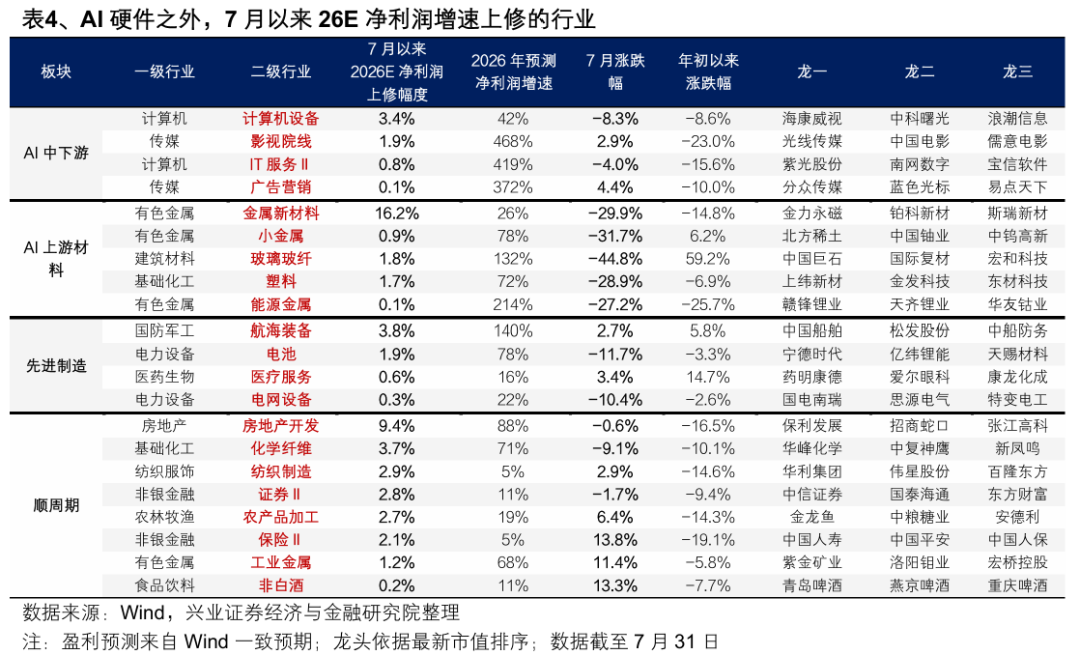
Furthermore, from the perspective of marginal changes in the economy and recent catalytic effects, the current recommendations focus on:
AI midstream and downstream: Focus on changes in the AI main line to overseas narratives, and recently catalyze the spread of AI midstream and downstream (software, applications) more;
AI upstream materials: Focus on the restoration of surplus AI upstream materials (new materials, small metals & energy metals, glass fiber, plastics);
Advanced manufacturing: ships, battery energy storage, innovative drugs, power grids;
Procyclical α: Profit expectations for chemicals, textile manufacturing, non-silver, industrial metals, and beer have improved since July.