


IPO outlook | Standard Robotics: High revenue growth but successive losses, only 54 million yuan in cash on hand
Standing on the cusp of the robotics industry, it has accumulated losses of 409 million yuan in less than four years, and only 54 million yuan in cash on its account. Can Standard Robotics, the fourth largest industrial intelligent mobile robot solution provider in China, land on the Hong Kong Stock Exchange as it wishes after submitting the statement three times?
The Zhitong Finance App learned that recently Standard Robotics submitted a listing application to the main board of the Hong Kong Stock Exchange for the third time, with CITIC Securities and Cathay Pacific Haitong as co-sponsors. The company is a leader in industrial intelligent mobile robot solutions. According to Insight Consulting, based on sales volume in 2025, the company is the fourth largest industrial intelligent mobile robot solution provider in China with a market share of 4%.
Standard Robotics' revenue growth is impressive. In 2023-2025, revenue was 162 million yuan, 250 million yuan and 301 million yuan respectively, with a compound growth rate of 36.3%. Revenue in the first 4 months of 2026 was 107 million yuan, an increase of 139.4% over the previous year. However, the company lost money year after year. Net losses for the above cycle were 100 million yuan, 45 million yuan, 202 million yuan and 62 million yuan respectively, with a total net loss of 409 million yuan, compared with a net asset value of 265 million yuan as of April 2026.
The company's growth was driven by a profit-sacrificing model. As of May 2026, its cash equivalent was only 54 million yuan. The cash level was clearly stretched according to the rate at which money was burned in previous years. This also explains why the company still has to go public in Hong Kong after submitting three statements. Furthermore, as one of the leading echelons in the segment, the company has attracted a lot of capital to enter the market, so what are the company's fundamentals, and are they worth paying attention to?
Sales of the three major robot products have increased steadily, with functional robots as the core driver
The Zhitong Finance App learned that Standard Robotics was founded in 2016 and is a pioneer in providing industrial embodied intelligent robot solutions. It can tailor a one-stop robot solution integrating technology platforms, intelligent robots and intelligent collaborative systems. The company's service concept is “1+N+S = ∞”, 1 is the core robotics platform, N is an industrial intelligent multi-function robot product, S is a one-stop collaborative system, and ∞ provides unlimited possibilities for intelligent manufacturing.
The company has two major businesses: robotics solutions and robotics and others. Multi-purpose robot products include standard robots, functional robots, and embodied robots.
Looking at the revenue structure, the revenue contribution of the former fell from 87.5% to 38.2% in the first four months of 2023 to 2026, based on the division of the three major businesses, robotics solutions and robotics and other businesses, while the latter increased from 12.5% to 61.8%. Among them, functional robots had a significant impact on performance. The revenue contribution of the solution business fell from 70.5% to 27%, and the contribution of product sales increased from 10.2% to 55.1%.
Specifically, Standard Robotics' standard robots provide mobility for various complex scenarios, can move in all directions, and are priced at 60,000 to 350,000 yuan each; additional modules for functional robots are integrated into the core robot technology platform, which can also be sold at 100,000 to 550,000 yuan per unit according to customized functional requirements; while physical robots achieve more general functions through AGI, and can perform complex tasks in various industrial scenarios. The price is 450,000 to 1,111,000 yuan per unit.
In terms of sales volume, sales of the three major robots have maintained an upward trend. From 2023 to the first 4 months of 2026, the sales volume was 1,212 units, 1932 units, 2,284 units, and 556 units, respectively. In previous years, functional robots accounted for the majority of sales. In the first 4 months of 2026, 410 units were sold, accounting for 73.74%. Furthermore, the sales volume of self-made robots increased 2.6 times to 68 units in 2025, and further increased by 50% to 27 units in the first 4 months of 2026.
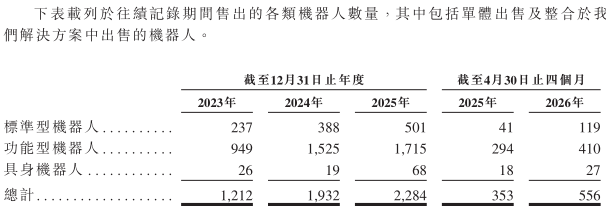
Photo source: Company hearing materials
It is worth noting that Standard Robotics settled revenue through contract value settlement of orders. From 2023 to the first 4 months of 2026, the new contract values were 188 million yuan, 208 million yuan, 348 million yuan, and 124 million yuan respectively. Except for 2024, they are all higher than confirmed revenue. If the order amount continues to increase, the revenue increase is certain. However, this also made inventory and receivables account for a relatively high share. From 2023 to the first 4 months of 2026, the company's total inventory and receivables were $162 million, $153 million, $226 million and $303 million respectively, accounting for 100%, 61%, 75% and 283% of total revenue, respectively.
The company has diverse customers, including high-tech industries such as 3C, automotive and semiconductor, as well as system integrators integrating robotic products into a wider range of automation solutions.
From 2023 to the first 4 months of 2026, the number of customers was 171, 208, 242 and 123, respectively, with 87, 83, 112 and 25 new customers, respectively. However, the customer retention rate was low, at 42.2%, 52.6%, 55.3% and 35.9%, respectively. Customer acquisition costs continued to rise, amounting to $6593 million, $778,300, $1.06 million and $1,369,800, respectively. In addition, the top five customers contributed 68% in the first 4 months of 2026. One of the customers had a transaction volume in the first 4 months of last year, and the contribution increased from the number of units to 32.1%.
Standard Robotics faces significant operating pressure. Inventory and receivables account for a high share of revenue. Although new customers have been added, the retention rate is low and customer acquisition costs continue to rise. Customers are also showing a concentrated trend. On the one hand, there is repayment pressure, and on the other hand, growth pressure, which will cause the market to worry about its growth expectations. However, robots are currently a popular circuit. The industry is developing rapidly, and with policy support, this is a good development ground for the company.
The industry maintains high growth, and the company's market segments are competitive
From an industry perspective, the industrial intelligent robot industry chain covers a complete closed loop from component manufacturing to system integration and terminal application deployment. It is characterized by highly technology-intensive and complex systems. The downstream demand is mainly 3C electronics, automobiles and semiconductors. According to Insight Consulting, the global market size of industrial intelligent mobile robot solutions will be 21.1 billion yuan in 2025, with a compound growth rate of 33.8% in the past five years. It is expected to reach 80.8 billion yuan by 2030, a compound growth rate of 29.6%.
In terms of sales volume, global industrial intelligent mobile robot solutions sold 87,000 units in 2025, while China sold 50,700 units, accounting for 58.3%, the main demand market for the industry. The industry has high growth prospects. According to Insight Consulting, the global sales scale of the industry is expected to reach 372,600 units by 2030 and 178,200 units in China, with compound growth rates of 32.2% and 28.3%, respectively. In addition, the industrial embedded intelligent robot solutions market is one of the industry segments, with global sales volume of 0.63 million units in 2025, but is expected to reach 54,700 units by 2030, accounting for an increase of 7.24% to 14.68%.
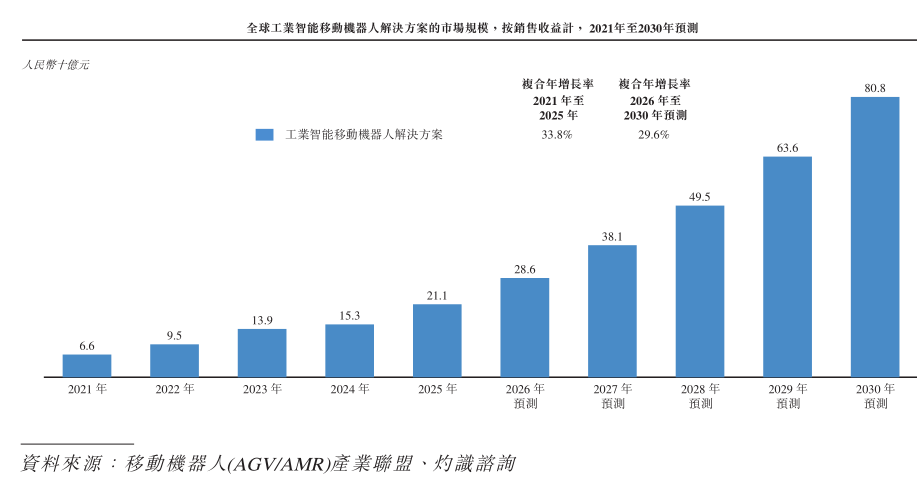
The industry is small, but it is in a stage of rapid growth, and the industry concentration is low. In terms of sales, the total market share of the top five participating systems in 2025 was 35.6%, while Standard Robotics ranked fifth with a 2.6% market share. It should be noted that the first place had a market share of 17.3%, the second place was 8.5%. The gap between the top five is large, and the overall competitiveness of the company is weak.
However, in specific customer markets, it still has some strength, such as in the 3C field, which ranks second in the industry with a market share of 4.1%. Furthermore, the company has achieved many leading advantages in terms of technology. According to insight and consultation, the company is one of the few companies in the industry to independently develop full-stack technology. It is a pioneer in industrial intelligent robot system engineering and proprietary robot operating systems in China. At the same time, it has become one of the first companies to release SLAM technology, and one of the first companies in China to achieve a world model and group intelligence for industrial robot systems.
Standard Robotics's core robotics platform includes a core controller, operating system SROS and algorithms. Its RoboVerse system is based on a self-developed industrial scene-oriented world model and large-scale multi-robot coordination technology. As of April 2026, the company's R&D team has 141 members and has 155 issued patents (including 29 invention patents) and 57 pending patent applications in China.
High cost rates lead to losses. Although popular, there are many risk points to be wary of
Standard Robotics has a production facility in Kunshan, Jiangsu Province. The Kunshan robot production base is equipped with production lines tailored to the characteristics of various products, including semi-automatic production lines and flexible customized product production lines. In 2025 and the first 4 months of 2026, capacity utilization rates reached 120.9% and 152.5%, respectively. As can be seen, the company's product technology is still approved by customers, and it plans to build new production lines to expand.
It is worth noting that the company is currently in a state of loss, but gross margin is showing an upward trend. From 2023 to 2026, gross margins were 31.6%, 38.8%, 40.5%, and 44.5%, respectively. The core reason for the loss was that the three major expenses of sales, administration, and R&D were too high, and the total share of revenue in the first 4 months of 2026 was as high as 92.6%. Due to the high cost ratio, the cash flow situation was not optimistic. The net operating cash flow for the above cycle was -120 million yuan, -027 million yuan, -87 million yuan, and -65 million yuan, respectively. Continued net outflows continued to weaken cash reserves.
However, as a popular racetrack, from 2016 to 2025, Standard Robotics experienced Pre-A round investment to Series D financing, and introduced a number of institutional investors such as Zhangjiagang Bohua Venture Capital. Old shareholders promised to lift the ban for 12 months after listing, while leading investors such as Bohua Investment lifted the ban for 6 months.
Overall, the robotics industry is on the cusp of policy, market, and technology, and Standard Robotics is leading the market segment. Among its three major robots, functional robots are currently the core driver of performance, but the continuous expansion of embedded intelligent robot products is expected to become a new driving force for growth. The company adds new customers every year, and the capacity utilization rate exceeds 100%. This listing may speed up the construction of a new production capacity base.
However, the company has risks such as a high share of inventory and receivables, low customer retention rates, and rising customer acquisition costs. Furthermore, the company's expense ratio is high, making short-term profits difficult. If the company successfully listed three times, it can greatly mitigate the development capital problem, but if it wants to be recognized by investors, it is not enough to just look at the popularity; it still needs strong performance support.