


The “big empty head” spreads big on your face! The sharp rise in semiconductors pulls the trigger for “shorting” and increases the leading power of shorting AI computing power
The Zhitong Finance App learned that Michael Berry, who has the title of “Big Short,” has been posting pessimistic remarks about “the end is coming” on his Substack subscription platform, and is shorting popular AI technology stocks at a time when global capital continues to flock to the theme of AI computing power infrastructure. The prototype character in the movie “The Big Short” recently focused more on crowded transactions related to AI computing power infrastructure and AI semiconductor capital expenditure cycles. For example, Burry expressed bearish positions on Nvidia, Tesla, Micron, Applied Materials, and iShares semiconductor ETFs through put options or bears.
Michael Berry revealed his latest portfolio adjustments on Thursday EST. While increasing many of his existing holdings, he further expanded his bearish bets on semiconductor stocks related to the topic of artificial intelligence computing power and software companies focusing on AI application platforms.
Bury increased short positions on the main AI investment line, reminding investors not to misjudge a sharp decline and rebound as a complete trend reversal in the AI computing power chain. Wall Street billionaire Ken Griffin is at the helm of hedge fund Citadel reached a deal with Situational Awareness, an up-and-coming hedge fund that is in deep trouble, to help trigger a global AI-themed stock market, particularly semiconductor stocks closely linked to AI computing power, to move towards a long-lost “irrational catharsis of bullish sentiment.”
The Korea Composite Stock Price Index (KOSPI Composite Stock Index), which owns SK Hynix and Samsung Electronics, the two largest global supermemory chip giants, soared by a record 18% on Friday after experiencing a sharp sell-off in a fusing situation for three consecutive trading days. The benchmark stock index of TSMC, the “king of chip foundries” that controls nearly all of the world's AI chip production capacity, rose 8% in the Taiwanese stock market, and Japan's Nikkei 225 Index, which hosts leaders in the AI computing power industry chain such as Kioxia, Tokyo Electronics, and Edwin Test, also rose 4%. On Thursday, a much-publicized US semiconductor giant index (the Philadelphia Semiconductor Index, which can be called the “global semiconductor weather vane”) recorded its biggest increase since April 2025.
The “big bears” hunt for AI while scavenging spending and gambling
Stocktwits quoted a paid subscription article published by Bury on Substack as reporting that he increased his holdings of gaming giants DraftKings (DKNG.US), Flutter Entertainment (FLUT.US), and also increased his holdings of Zoetis (ZTS.US) and Lululemon Athletica (LULU.US), while also increasing his put position on NVDA.US (NVDA.US), the “superhero of AI chips,” and Short positions on DRAM/NAND memory chip giant Micron Technology (MU.US) and iShares Semiconductor ETF (SOXX.US). He himself maintained his short positions with Tesla (TSLA.US) and Palantir Technologies (PLTR.US).
“All of them were buying and adding positions, and no sales were carried out.” Burry said on Substack.
According to information, he increased his DraftKings holdings at a price of about 23.40 US dollars, and indicated that both the stock and Flutter are “large positions.” Bury also significantly increased its Zoetis holdings at about $76, calling it a “complete position.” He also significantly increased his holdings of Canada-based sports consumer leader Lululemon Athletica for about $118, describing this as a complete position.
“Like the two stocks mentioned above, this is a major opportunity to bottom/consolidate after a long period of decline.” Barry wrote.
Explaining the logic of increasing positions, Barry said that these recent trading methods reflect “the transfer of chips to more powerful holders,” and that he believes that these three purchases “have released a considerable amount of risk” at current prices, especially for investors who focus on long-term principles.
In terms of options derivatives operations for bearish trading, Burry added QQQ put options (that is, NASDAQ 100 ETF put options) that expire on January 15, 2027 and the execution price is in the high range of $500. He also increased his holdings of Nvidia put options due on December 18, 2026 and the execution price was in the historically low range of $100 to $125.
Furthermore, Bury expanded its short position with the US memory chip leader Micron Technology (MU.US) at a price of about $880, and increased its short position on the Philadelphia Semiconductor Index ETF (SOXX) by about $506. The latest July 30 disclosure specifically describes “QQQ puts,” “Nvidia puts,” “Micron short position,” and “SOXX short position,” which can be described as indicating that Bury did not place all bets through options, but instead used long-term put options on the Nvidia and NASDAQ indices, while directly shorting Micron and some semiconductor targets.
Bury “threw cold water” on the day US semiconductor stocks soared
The title of the original Substack post published by Bury on July 30 was “Trading Post July 30, 2026.” The text not only stated “all were bought and increased positions, no sales,” but also clearly stated, “To save time, let's sort out today's latest transactions.” Therefore, this is not just about disclosing positions accumulated over the previous few days on Thursday, but Burry himself described the following actions as transactions completed or added on July 30.
These same-day operations include:
Add QQQ put options that expire on January 15, 2027 and have an execution price in the high range of $500;
Add Nvidia's put options that expire on December 18, 2026 and have an execution price in the low range of $100;
Expanding direct short positions around $880 for Micron;
Expanding short positions around $506 on SOXX.
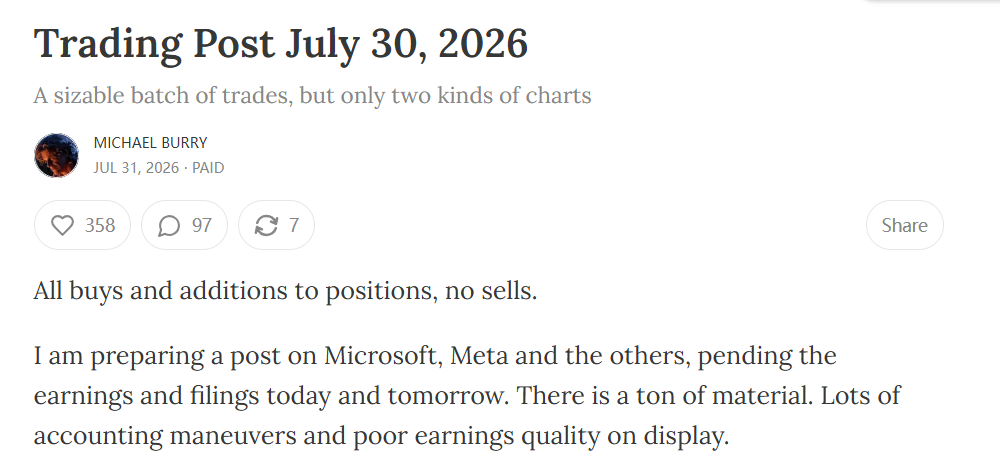
According to the clear wording of Bury's own July 30 Substack post, this batch of Nvidia, QQQ, Micron, and SOXX bears were traded on Thursday, US time, and were not simply an old operation announced on Thursday; however, they were disclosed by investors themselves. The public information can only confirm the date, direction, and approximate price of the transaction, and cannot independently verify the specific transaction time, scale, and full net short exposure.
Barry chose to continue to increase his short exposure on the day of the rebound, indicating that his deal was not a bet that “AI orders will disappear immediately next quarter,” but rather that the market overestimates the full-cycle profit, free cash flow, and residual asset value that this round of capital expenditure can eventually be converted into. The core logic of Bury's bearish AI investment theme since the fall of 2025 has basically focused on “the technical life span is shorter than the accounting life,” “the growth rate of capital expenditure is ahead of verifiable AI monetization,” and “a real technological revolution may also create a supply bubble.”
Bury's open AI shorts began in the fall of 2025. Scion's 13F for the third quarter of 2025 shows that the company holds put options corresponding to 1 million Nvidia shares and 5 million Palantir shares; however, the US$187 million and US$912 million listed in 13F are the nominal values of the target stocks and are not actual investment. Berry later clarified that the Palantir deal actually bought 50,000 put options at $1.84 per share, and the premium cost was about $9.2 million. In November 2025, he further proposed that large cloud vendors extend the depreciation period for servers and network equipment, and may accumulate depreciation expenses by about 176 billion US dollars from 2026 to 2028, thereby overestimating profits related to AI investments.
After entering 2026, he gradually upgraded single-point shorting to the industry chain and exponential bears: adding Nvidia, QQQ, SOXX, and putting up Palantir direct short positions from April to May; rolling out QQQ and SOXX options and increasing risk capital at the end of May; establishing Nvidia Direct Short at about $198.09 on June 30, while shorting applied materials, SOXX, and included Tesla and Caterpillar in the cyclical short portfolio; on July 2, he spent about $105.87 on US shorting US and Caterpillar on July 2; July On the 17th, Nvidia's put options were increased again, and the holdings were reduced by half due to Oracle's excessive profit position; on July 30, Nvidia, Micron, SOXX, and QQQ bears were increased when the semiconductor sector rebounded strongly.
For the AI computing power industry chain, Burry's latest addition is more like a mid-term end-of-life risk warning rather than a short-term order that must be sold on Friday. His low execution price and long maturity options indicate that he is betting on a nonlinear reduction in valuation and profit expectations in the coming months, and does not require Nvidia, Micron, or SOXX to continue falling every day. At the same time, put options outside the far price are extremely sensitive to time, volatility, and entry points; even if the final direction is right, a premature layout may lose all of the premium.