


Wheat Futures Rally on Black Sea Escalation as Market Tests Key Resistance
War Premium Returns: What Is Fueling Wheat's Breakout
Wheat sentiment has turned decisively bullish this month, and the move has been driven by a combination of geopolitical escalation and a genuinely tight fundamental picture rather than speculative positioning alone. Chicago wheat gained roughly 16% in July and reached its highest print since 2024 on July 22, before easing modestly as traders booked profits. The primary catalyst has been the intensifying conflict between Russia and Ukraine, which has increasingly spilled into Black Sea shipping lanes that both countries depend on for grain exports. Consultancy SovEcon trimmed its Russian wheat export forecast for the current marketing season by about 4%, citing navigation closures in the Sea of Azov. Russian officials have reportedly discussed arming grain vessels with machine guns and mobile missile launchers to defend against Ukrainian drone strikes, while Ukrainian farm groups have warned of widespread bankruptcies if maritime exports remain disrupted through what is normally peak shipping season. A missile strike on a Russian port added to the sense that logistics along the Black Sea corridor remain fragile.
On the domestic side, the US crop story has reinforced the bullish tone. USDA is projecting the smallest winter wheat crop in sixty-one years, with a hard red winter production forecast at its lowest level since the late 1950s, largely a result of severe drought across the Southern Great Plains. Winter wheat condition ratings stood at only 26% good to excellent in early July, more than twenty points below year ago levels, though harvest itself has moved along at a pace ahead of the five-year average. At the same time, export demand has been soft, with 2026/27 sales commitments running about 26% behind last year's pace and USDA projecting full year exports of 775 million bushels, a three-year low. That tension between a shrinking supply base and cooling export demand is what markets are currently trying to price, and it explains why rallies have been sharp but have also met selling once they approach prior resistance.
What the Market Has Done
- The market has held above the yearly VWAP since the start of the year, reflecting a persistent bid underneath price throughout 2026.
- From March until now, buyers have been progressively making higher highs, building a steady uptrend structure.
- Each down rotation during that advance has made it back to the 580 level (Daily level 4), showing that buyers are not yet stepping up bids at higher levels.
- Most recently, the market managed to extend up into the 720 area (Daily level 2), a resistance level carried over from 2024.
- Since testing that resistance, price has rotated back down to the 660 area (Daily level 3), where buyers appear to have held bids.
What to Expect in the Coming Weeks
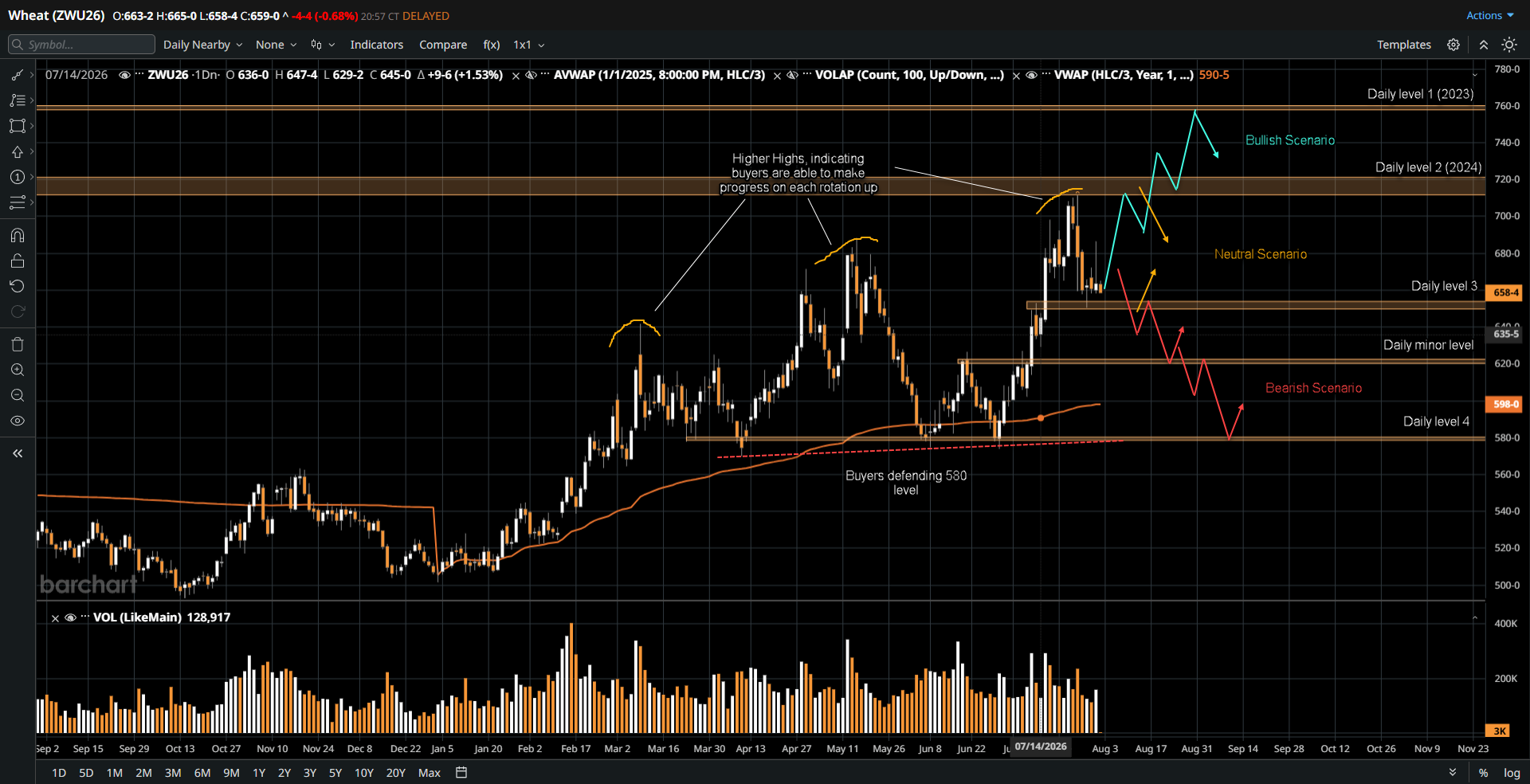
The key level to watch is 660 (Daily level 3).
Bullish Scenario
- If buyers are able to hold bids at 660, expect a move back up toward the 720 area (Daily level 2).
- Expect sellers to respond at 720 given its history as 2024 resistance; if buyers instead break above it, look for a move toward the 760 area (Daily level 1), a resistance level dating back to 2023.
- A possible trigger for this would be a further escalation in Black Sea attacks, such as additional strikes on Russian or Ukrainian port infrastructure that force new export suspensions.
Bearish Scenario
- If buyers are not able to defend 660, expect a move down to the 620 area (daily minor level).
- If buyers do not respond at 620, expect a move back down to the 580 level (Daily level 4).
- A possible trigger for this would be a ceasefire or negotiated safe corridor agreement that restores Black Sea shipping, or a string of stronger than expected US export sales that ease concerns over demand.
Neutral Scenario
- If the market is unable to break either edge after testing the 720 area at the top and the 660 area at the bottom, expect a two-way auction to develop between these levels as the market works to build value higher.
- A possible condition to support this would be a period of conflicting headlines, where geopolitical risk remains elevated but without fresh escalation, leaving traders to digest existing news without a new catalyst.
Conclusion
Wheat futures enter the coming weeks caught between two powerful forces. On the fundamental side, a historically small US winter wheat crop and an increasingly disrupted Black Sea export corridor are providing genuine support, even as softer US export sales cap how far that support can carry price on its own. Technically, the market's structure since March, with higher highs and a defended VWAP, still favors buyers, but the rejection from the 720 resistance area shows that sellers have not yet been overwhelmed, and the 660 level now stands as the line that will likely decide whether this rally has more room to run toward 760 or needs to digest gains back toward 580. Given how quickly Black Sea headlines have been moving this market in either direction, that news flow deserves as much attention as the charts in the weeks ahead. Where do you see wheat heading from here, toward a retest of 720 or back down to build value near 660?
We provide the infrastructure you need to quantify your discipline and ensure every decision is backed by the confidence of seeing exactly what drives your performance. Start trading with the clarity you deserve. Open an Account today.
Disclaimer:
This article is provided for informational and educational purposes only and does not constitute financial, investment, or trading advice. The analysis presented reflects the author’s market observations and opinions at the time of writing and is not a recommendation to buy or sell any futures contract, security, or financial instrument. Futures trading involves significant risk and is not suitable for all market participants. Losses may exceed initial margin deposits, and market conditions can change rapidly.
Any scenarios, levels, or market expectations discussed are hypothetical in nature and are intended solely to illustrate potential market behavior. They do not represent actual trading results and should not be interpreted as guarantees of future performance. Past performance, market behavior, or historical price action are not indicative of future outcomes.
Readers are solely responsible for their own trading decisions and risk management. Always conduct independent research, consider your financial situation and risk tolerance, and consult with a qualified financial professional, if necessary, before engaging in futures or derivatives trading.