


IDC: In 2025, the market size of China's industrial embodied intelligent robot market will be about 5.74 billion yuan, and the commercialization process will accelerate across the board
The Zhitong Finance App learned that according to data from the International Data Corporation (IDC), China's industrial embedded intelligent robot market size in 2025 is about 5.74 billion yuan, of which the market for physical intelligent applications using industrial robots as carriers is about 3.62 billion yuan, which is currently the main direction of industrial commercialization. As industrial competition gradually shifts from robot performance to comprehensive competition for models, data, engineering, and scene implementation capabilities, industrial embodied intelligent robots are becoming an important direction for the development of intelligent manufacturing.
IDC pointed out that as physical AI (Physical AI) becomes the focus of industry attention on WAIC 2026, industry, as an application field with intensive data, complex tasks, and clear commercial value in the physical world, is becoming an important scenario where Physical AI is pioneering implementation. Industrial physical intelligent robots are an important application form of physical AI in the manufacturing field.
The market has entered the stage of large-scale introduction, and industrial robots are the main landing carriers
According to IDC data, in 2025, China's industrial embedded intelligent robot market will enter a stage of accelerated commercialization, with an overall market size of about 5.74 billion yuan. Currently, the market mainly uses multi-form robots as carriers. Through intelligent upgrading of industrial production lines and manufacturing stations, the integration of sensing, learning, decision-making and execution capabilities is achieved, and manufacturing scenarios are promoted in the direction of more flexibility and autonomy. According to IDC data, the market size of embodied intelligent applications using industrial robots as carriers in 2025 is about 3.62 billion yuan, occupying the current dominant position in the market. It mainly includes collaborative robots, composite (mobile operation) robots, multi-joint robots, etc. Relying on a mature industrial foundation, this type of robot realizes integrated delivery of “robot hardware+intelligent software+industry service” by integrating visual perception, force control technology, environmental understanding, and intelligent model capabilities. It has been used in industrial scenarios such as loading and unloading, quality inspection, polishing and repair, flexible assembly, and material handling.
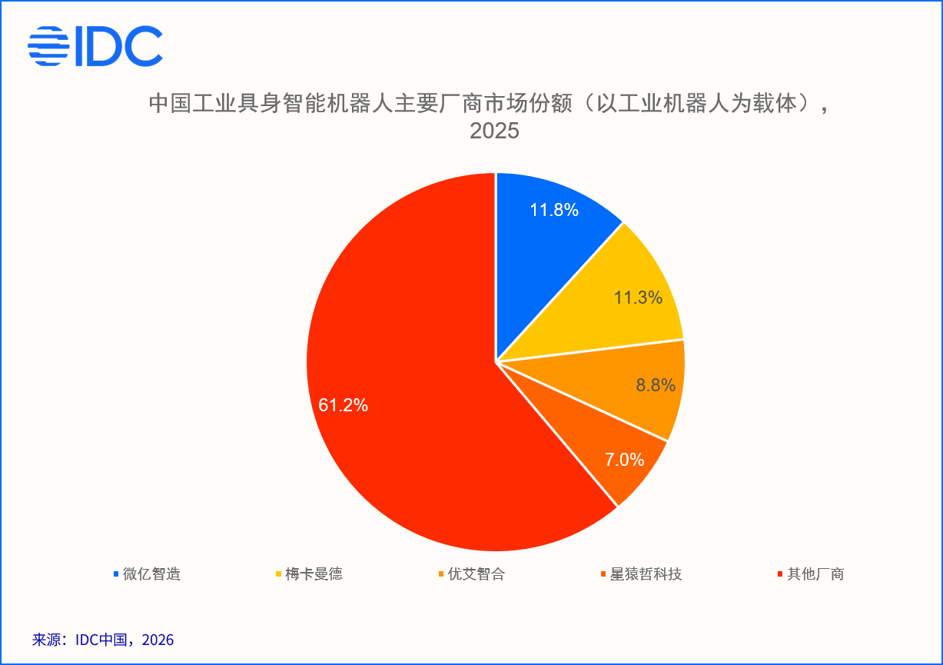
The above market structure clearly shows that at present, the main commercialization of industrial embodied intelligent robots still relies on mature industrial robot categories, and they quickly penetrate various manufacturing sites using the “hardware+software+service” turnkey model. However, the market pattern is not static — as AI model capabilities jump and hardware costs drop, players with different backgrounds are moving from their respective fields of advantage, and the competitive focus is also shifting from single product performance to system-level comprehensive capabilities.
Industrial AI vendors are taking the lead in establishing competitive advantages. The current competitive advantage in the market mainly comes from industrial vision, perceptual decision-making, and the ability to accumulate scene data. Companies such as Weiyi Intelligent Manufacturing and Mecamand rely on industrial AI technology and closed-loop data capabilities to apply physical intelligence capabilities to standardized industrial scenarios such as quality inspection, polishing, repair, and loading and unloading, and promote cross-industry replication.
At the same time, a large number of robot manufacturers, industrial automation, and AI are speeding up the layout of industrial embodied smart circuits, and market competition continues to intensify, relying on their respective accumulation in hardware, algorithms, software platforms and industry resources to explore differentiated product positioning and commercialization paths.
Chinese manufacturers are speeding up their global deployment. In 2025, the overseas model for industrial embedded intelligent robot manufacturers gradually changed from stand-alone product output to software and hardware integrated solution export, and products began to enter overseas markets such as European automobiles, Southeast Asian electronics, and North American manufacturing. Localized deployment, model optimization, and operation and maintenance service capabilities have become important supports for enterprises to expand overseas markets.
In 2025, new embodied intelligent carriers represented by humanoid robots are entering the industrial scenario exploration stage, with a market size of about 2.11 billion yuan. Current applications mainly focus on demonstration production line deployment, scenario verification and POC testing. Humanoid robots have greater morphological versatility and potential to adapt to complex environments, but they are currently in the stage of improving technical capabilities and exploring commercial models, and factors such as product cost, reliability, engineering maturity, and actual production efficiency are being further verified. For data on the industrial application of humanoid robots, please refer to IDC's “Worldwide Annual Humanoid Robotics Tracker”.
From technical ability to commercial value: the competition for industrial embodied intelligent robots has entered the stage of comprehensive competency
As industrial embodied intelligent robots gradually move from technical verification to commercial application, industrial users' evaluation standards for robots are changing. IDC user research shows that manufacturing enterprise users pay attention to the comprehensive performance of the manufacturer's “technical capability+engineering capability+commercial value”.
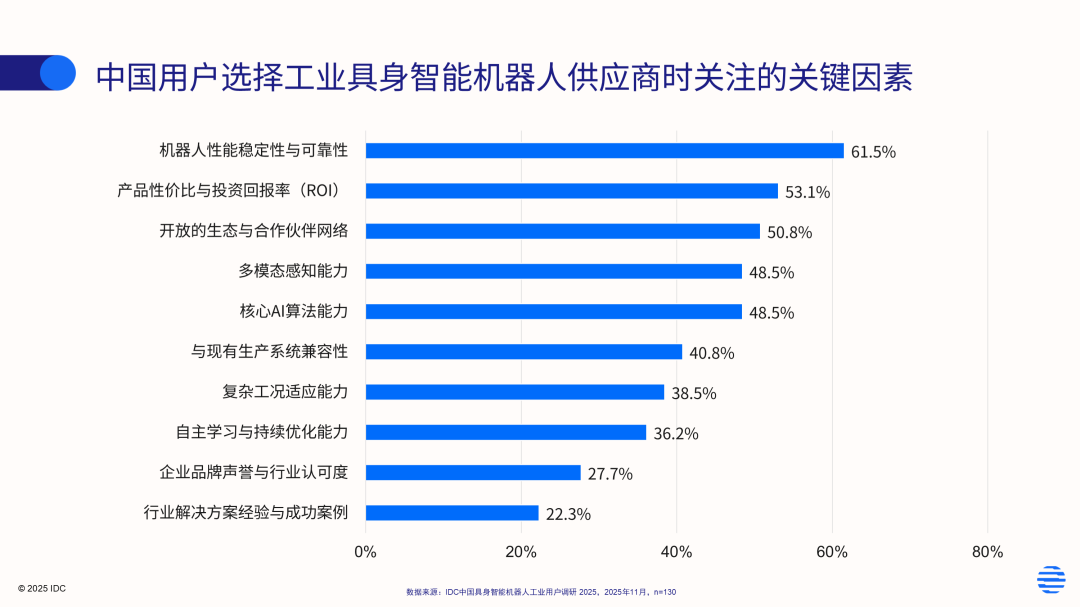
Based on changes in industrial user needs, IDC has constructed a technical evaluation framework covering eight dimensions, including industrial intelligent decision-making, multi-modal perception and understanding, autonomous operation and task execution, complex scenario adaptation and continuous optimization, industrial system integration and ecology, industry practice and large-scale implementation, commercial value and ROI verification, and conducted a comprehensive evaluation of typical Chinese suppliers that have product capabilities and have carried out commercial exploration in automotive manufacturing, new energy, semiconductors, and 3C electronics. The competitive advantage of enterprises in the future will come from the deep integration of industrial knowledge, data, models and manufacturing systems.
Anchored for the next three years: a critical transition from scenario pilots to system restructuring
In the next three to five years, China's industrial embedded intelligent robot market will enter an important stage of expansion from single-point scenario verification to production process-level applications. IDC believes the industry will show the following trends:
From single-station intelligence to production process intelligence. Robots will break through the limitations of a single task, be deeply integrated with MES, WMS, ERP, PLC, and industrial Internet platforms, and gradually evolve from devices that perform a single task to intelligent nodes in production systems.
Industrial knowledge became an important component of model competency. Industrial embodied intelligent models require further integration of process rules, equipment mechanisms, and production experience to evolve from “completing tasks” to “understanding the production process”. Future model competition will depend not only on the scale of data, but also on the ability to integrate industrial knowledge.
Multi-morphic robots coexist for a long time. Future industrial scenarios will form a multi-robot collaborative pattern: humanoid robots are suitable for highly flexible, unstructured tasks; mobile operating robots are suitable for cross-space tasks; collaborative robots are suitable for human-robot collaboration scenarios; and special industrial robots are suitable for high-precision, high-stability tasks. The focus of future competition is not on the form of robots, but on who can actually solve industrial problems.
Closed data loops and engineering capabilities determine large-scale implementation. As the market enters the mass deployment stage, real industrial data accumulation, model iteration efficiency, and large-scale delivery capabilities will become key competitive factors. Companies that can establish a closed loop system: data collection → model training → industrial deployment → feedback optimization will gain a long-term competitive advantage.
ROI has become the core indicator of commercial implementation. According to IDC user research, more than 80% of manufacturing companies expect industrial embodied intelligent robot projects to achieve a return on investment within two years. In the future, solutions that can achieve rapid deployment, stable operation, and generate clear economic value will receive priority market recognition.
Li Junlan, research manager in the field of robotics and embodied intelligence at IDC China, said that competition for industrial embodied intelligent robots is shifting from single-point AI capabilities to comprehensive competition for software-hardware collaboration, industry know-how, and closed-loop data capabilities. Leading manufacturers continue to increase investment in R&D to promote the deep integration of artificial intelligent models, industrial AI, and robotics; under the joint drive of policy support, intelligent upgrading of the manufacturing industry, and overseas market expansion, Chinese manufacturers are expected to further enhance their global competitiveness.