


The Indian stock market, which was “shorted” by AI, ushered in a recovery situation: IT stocks rebounded strongly, and the banking, electricity, and pharmaceutical sectors were favored
The Zhitong Finance App learned that against the backdrop of severe shocks in global AI trading, the Indian stock market rebounded, and the Nifty IT Index rose strongly by nearly 19% in July. ICICI Prudential Asset Management, India's second-largest asset management company, is betting on the banking, refining, electricity, and pharmaceutical sectors, and is optimistic about investment opportunities brought by the demand side.
Sankaran Narun, chief investment officer of ICICI Prudential Asset Management, said that banking sector valuations are attractive, and in addition, rising demand in the electricity infrastructure and medical fields has also brought very attractive investment opportunities. The company manages assets of about 11.8 trillion rupees (equivalent to US$123 billion), and stock assets account for more than two-thirds of the total.
“The banking industry remains one of the most attractive industries in India,” he said in an interview on Wednesday.
Bank of India stock valuation nears 5-year low
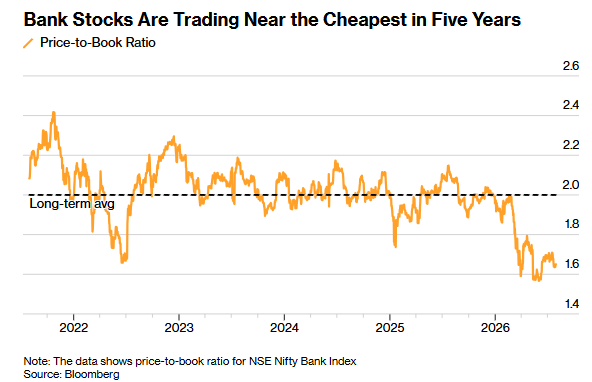
When India's senior fund manager Narun made the above remarks, Indian corporate profits showed signs of recovery. Narun is a promoter of the concept of reverse investment and value investing in India. The data showed that the raw materials, utilities, and financial services sectors took the lead in recovering. Among the constituent stocks of India's Nifty 50 Index, 34 have disclosed their June quarterly earnings reports, and more than half of the companies have exceeded market expectations.
Improved earnings prospects drove India's benchmark stock index Nifty up for the second month in a row. Furthermore, a rebound in foreign capital inflows and a rebound in Indian software stocks also boosted the market. However, Naren said that the price of Brent crude oil soared above 90 US dollars per barrel, posing a risk to this wave of recovery.
He said, “If profit growth improves, but macroeconomic risks rise — such as the price of crude oil rises to $100 — the market will give a lower valuation. The ideal situation is for profits to improve, while oil prices are stable and monsoon weather conditions are suitable.”
The $9 billion ICICI Prudential multi-asset fund managed by Narun has outperformed 95% of similar funds in the past five years, and its holdings confirm the above view: the fund continues to overallocate bank stocks and has increased its holdings in Kotak Mahinda Bank, HDFC Bank, and Union Bank of India in recent months.
“Foreign investors continue to sell off, making the valuations of many large stocks very attractive,” he said.
In March of this year, foreign investors left the Indian stock market and sold off a total of 6.5 billion US dollars of financial stocks, causing India's Nifty Bank Index to approach the bear market range for a while. The index has since rebounded more than 13%, but the current net market ratio is still discounted by nearly 20% from the long-term average.
In addition to the financial sector, Narun is also optimistic about the electricity and medicine circuit. He believes that the continued rise in electricity demand will drive investment expansion in power generation and transmission grids. Pharmaceutical companies, on the other hand, benefit from globally competitive export business and growing local healthcare demand. He reiterated his long-term optimism about the pharmaceutical industry.
He said, “The pharmaceutical industry has always brought us great rewards. We still think this industry is very attractive.”
The rotation of funds has spawned the restoration of the market! The Nifty IT Index rebounded sharply in July
Notably, after experiencing the worst first-half performance in 18 years, India's Nifty IT Index rebounded strongly in July, rising nearly 19%, the biggest monthly gain in six years as investors switched from crowded artificial intelligence (AI) deals to relatively cheap tech stocks.
Previously, the market feared that AI technology would disrupt the business model of India's IT outsourcing industry, and India's technology sector underwent deep adjustments. In the first half of 2026, the Nifty IT Index, known as the benchmark for Indian technology stocks, fell by about 30%, making it the worst performing sector in the Indian market. The Nifty 50 Index fell about 9% during the same period.
At the capital level, in the first half of 2026, there was a net withdrawal of more than 23 billion US dollars of foreign capital from the Indian stock market. There are even arguments in the market that India is the first country to be “shorted” by AI, and pessimism has spread to the capital market and long-term economic prospects.
However, with the recent pullback in AI chip stocks, capital has begun to rotate the Indian IT service sector, treating it as a relatively low-risk technology circuit. Jefferies raised the Indian IT industry's rating from “reduced holdings” to “neutral” and boosted market sentiment.
The corporate earnings report also sent a positive signal. The annual revenue of Tata Consulting's AI business reached 2.6 billion US dollars; Infosys said AI-driven services contributed 8.2% of total revenue.
However, market sentiment did not completely shift to optimism. Sonam Srivastava, founder of Wright Research, warned that this round of growth is more of a repair market after an early deep evaluation, and not a new demand-driven upward cycle. Medium- to long-term issues such as the impact of AI technology on traditional outsourcing models and weak non-essential corporate spending remain unresolved.
Independent market expert Ajay Baga pointed out that the July rebound may only be a short-term phenomenon. The real test is the new order data for the September quarter to verify whether this round of market was a structural reversal or a technical rebound after a sharp decline.