


The stock price rose as high as more than 30% within 20 days. Is the capital setting the price for Hygea Healthcare (06078) in advance?
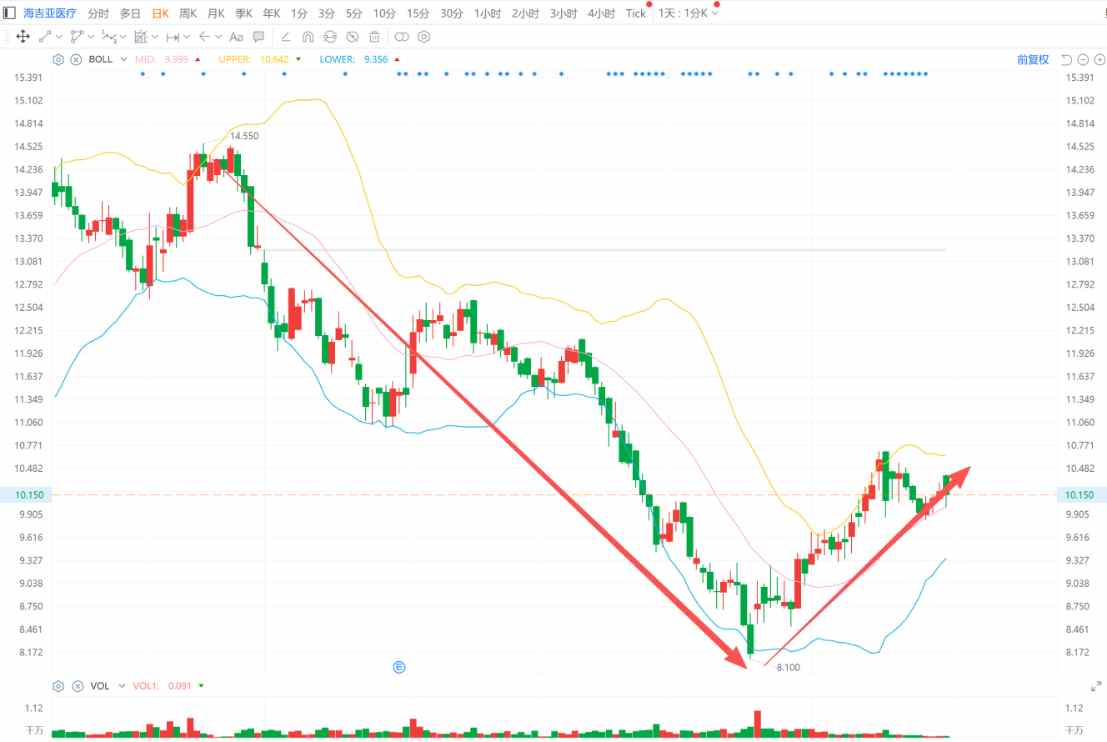
Stimulated by a $1.5 billion shareholder return plan, the stock price of Hygea Healthcare (06078) bottomed out and rebounded. Recently, it returned to HK$10, and the high price range returned to HK$10.69. If the year-long low of HK$8.10 ends on June 17, the biggest increase in Hygea Healthcare's stock price in the 20-trading day range reached 31.98%.
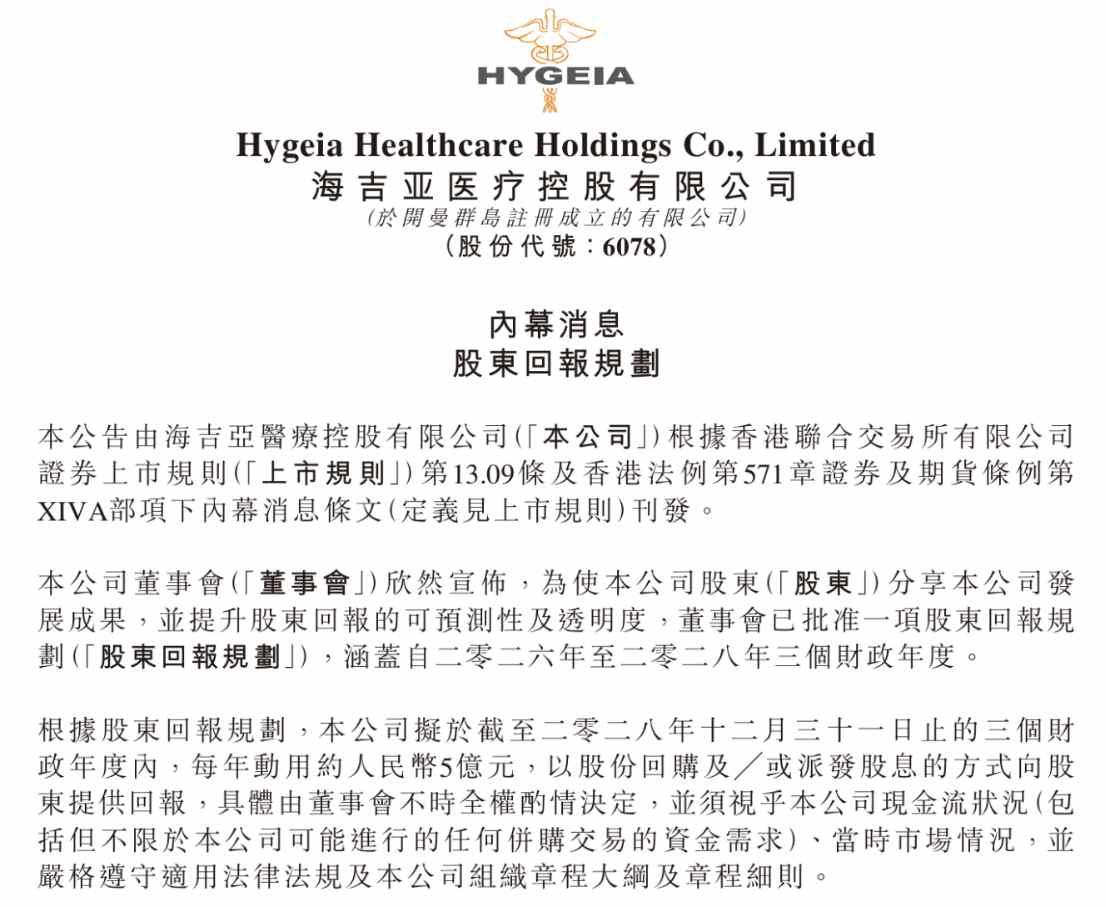
The Zhitong Finance App learned that Hygea's large repurchase plan directly sent a signal to the market that management believed that the company's value was undervalued, strengthened investors' confidence in the company's fundamentals and future development, and was clearly the most direct driving force for the rise in stock prices.
Perhaps the deeper driving force is that the 2026H1 earnings report is approaching, and some market investors are betting that Hygea will continue to maintain steady performance and strong cash flow performance under the health insurance DRG/DIP policy.
After the stock price fell by more than 40%, how did you drive the rebound?
Judging from market performance, from February to June of this year, Hygea Healthcare's stock price experienced a round of deep correction. The range stock price fell sharply from a high of HK$14.55 to a low of HK$8.1, and the range decline reached 44.33%.
And this is mainly due to multi-factor resonance.
In the period of decline from February to March of this year, the “uncertainty factor” brought about by the health insurance DRG/DIP 3.0 package plan, which was about to be implemented, was also a major factor affecting Hygea's stock price.
Judging from all kinds of market information, although some investors at the time thought that the new regulations were beneficial to oncology specialists in special groups (such as expanding the scope of individual special cases), many investors seemed even more concerned that health insurance fee controls continued to suppress the profit margins of private hospitals. The uncertain dispute from the policy side turned into a change in market sentiment, which is illustrated by the 14.08% drop in Hygea's stock price in March this year. Since then, the company's stock price has gradually stabilized because the health insurance DRG/DIP 3.0 subgroup plan was officially released on March 20 this year, bringing a lot of uncertainty to the market.
In the period from May 12 to June 17, the most important factor was the change in market conditions. Among them, the continued tightening of liquidity in the Hong Kong stock market became the biggest drag factor.
According to the data, the Hang Seng Healthcare Index fell by about 21% in the current period, and the net outflow of capital to the south exceeded HK$30 billion in a single month, indicating a systematic decline in the valuation center of the healthcare sector. Moreover, this period was still the last 2 months of the current Hong Kong Stock Connect review period. The continued decline in stock prices exposed the company's Hong Kong Stock Exchange status to the risk of potential adjustments, further exacerbating the withdrawal of institutional investors.
In this period of market, Hygea Healthcare has basically broken out of a one-sided downward trend. After the stock price hit the middle line of the BOLL line on May 12, it quickly fell to the bottom, and then continued to decline along the lower line of the BOLL line.
In terms of quantitative energy, although Haijia Healthcare's single-day stock trading volume during the period was significantly lower than the previous rise/rebound phase, there was a phased increase in price decline within the range. This phenomenon usually indicates a steady release of sell-off pressure in the market under clear bearish signals.
However, after June 17, the recovery in the Hong Kong pharmaceutical sector provided key beta support for the rebound in Hygea Healthcare's stock price.
First, there are marginal changes in capital. That is, although the overall net outflow of capital from Hong Kong stocks has continued, the information technology and healthcare industries have maintained net inflows, and due to the high level of turbulence in the AI sector at this time, some capital has begun to seek valuation depressions to rebalance assets. The pharmaceutical sector has become an important direction for undertaking spillover capital due to its defensive and growth attributes.
The Zhitong Finance App learned that since June of this year, many public funding institutions, including E-Fangda Fund, Huaxia Fund, Wells Fargo Fund, and Huitianfu Fund, have intensively increased their holdings of Hong Kong stocks and pharmaceutical stocks. After 4 individual pharmaceutical stocks were increased, the shareholding ratio of public equity institutions hit or exceeded the statutory listing line of 5%, and the shareholding ratio of some target public institutions reached about 7%.
Under the influence of the weather vane, the Hong Kong stock innovative drug sector has rebounded markedly since late June, and the Hong Kong Stock Innovative Drug Index has increased by more than 20% in the range. Driven by this, the Hang Seng Healthcare Index has rebounded 7.92% since bottoming out on June 22. Driven by the recovery in the sector, Hygea Healthcare benefits, which had seriously surpassed the previous period, rebounded at an accelerated pace. Over the same period, the increase reached 15.93%, significantly exceeding the index.
Are funds being priced in advance for the interim report?
Since this year, the siphon effect brought about by the concentration of market memory capital in the AI industry chain (computing power, chips, etc.) has led to a clear correction in high-beta growth sectors such as Hong Kong stocks and pharmaceuticals, which are sensitive to overseas liquidity. In this process, Hong Kong Stock Connect funds seem to have become one of the main forces in the net outflow of capital from Hygea Medical Center.
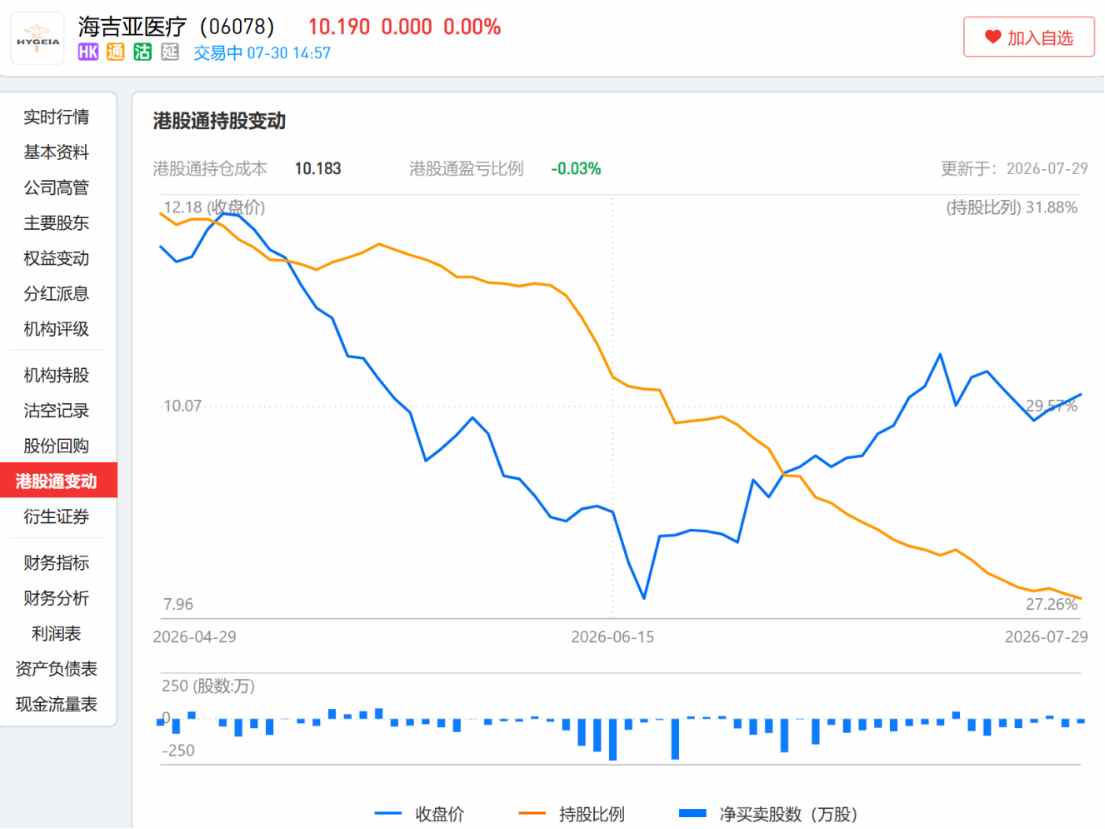
The Zhitong Finance App observed that especially after Hygea's second round of decline began in May, Hong Kong Stock Connect's trading strategy reduced its holdings all the way, and even accelerated the “bloody chips” after Hygea's stock price fell below the average holding cost of HK$10.18. Even after the company's stock price began to rebound on June 18, there was no significant change in the trading strategy of continuing to reduce holdings.
Judging from brokerage transaction data for the past 60 days, the top five sellers in Hygea are Hong Kong Stock Connect (Shenzhen), Citibank (Shanghai), Citibank, BNP Paribas, and Futu Securities, which sold 16.1236 million shares, 9.970,900 shares, 2.789,400 shares, and 1.32 million shares respectively. From the buyer's perspective, Hong Kong and Shanghai HSBC were the biggest buyers, with a total of 24.1077 million shares purchased by CITIC Securities, Morgan Stanley, DBS Bank and Washington, respectively. 11.1226 million shares, 854,200 thousand Shares, 40700,000 shares, and 201,800 shares.
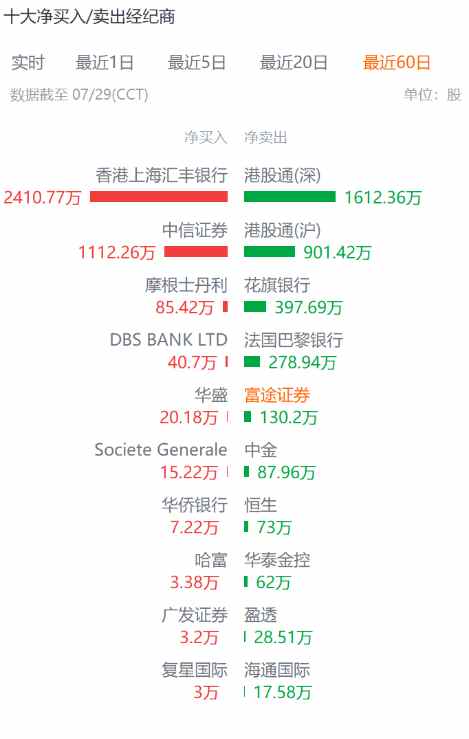
At the time point where Hygea's stock price has continued to rebound recently, the top two brokers in the market have bottomed out and increased, probably due to the gaming company's upcoming 26H1 performance.
Currently, the key point of Hygea's investment logic is to verify its transformation from “scale expansion” to “value medicine.” First, the company needs to continue to prove to investors that it is gradually establishing an effective coping strategy and adapting to the new regulations to prove that the negative impact of DRG/DIP on hospitals is beginning to ease.
In the 25H2 financial report, the company's 25H2 achieved revenue of 2.02 billion yuan, an increase of 1.5% over the previous month. Also, looking at medical services, the company's current number of patients was 2.4 million, an increase of 9.1% over the previous year; at the same time, the number of patients treated at the company's hospitals was 4.6 million throughout the year, an increase of 1.5% over the same period last year, showing that the number of visits to Haijia hospitals is still stable.
The key reason for this data is that it shows that the demand for medical treatment at Hygea Hospital was not affected, and the actual impact of the DRG payment reform on the company only led to a decline in the unit revenue of its hospitals. This was not a “fatal injury” for a company focusing on network expansion, cost control, and supply chain integration of the sinking hospital. In the 26H1 financial report, the above data will also continue to be a key factor supporting Hygea's core values.
In addition to this, cash flow advantage is also an element that investors focus on. In 2025, the company achieved net operating cash flow of 950 million yuan (a record high), capital expenditure of 480 million yuan, a year-on-year decrease of 21.4%, and achieved free cash flow of 470 million yuan, a sharp increase of 407.0% year over year, achieving a significant improvement in the cash revenue port. Meanwhile, by the end of 2025, the company's stock of interest-bearing liabilities was 2.44 billion yuan, down 12.3% year on year, further reducing the company's debt-side financial costs, and is expected to reduce the marginal downward pressure on subsequent companies.
However, Hygea also made a clear statement before that it would stop “building a new hospital from scratch”. In the future, it will only carry out expansion+mergers and acquisitions, and will no longer build new asset-heavy self-built hospitals. This optimized capital allocation is expected to allow it to officially enter a full operating period. If the financial report continues to consolidate the certainty brought about by cash flow in the future, the “safe haven effect” brought about by it is expected to become an important force driving back in Hygea Healthcare's subsequent stock price.