


Bank of England and America “tacitly agree with three votes against”! War clouds loom over inflation prospects, the Bank of England “stands still” at a ratio of 6 to 3
The Zhitong Finance App learned that after the Federal Reserve kept the benchmark interest rate unchanged, the Bank of England also kept the interest rate unchanged at 3.75%. British monetary policy makers are trying to strike a positive balance between the threat posed by the resurgence of tension between the US and Iran and signs that domestic price pressure is easing faster than expected.
The minutes released on Thursday showed that the Bank of England's Monetary Policy Committee (MPC) decided to keep interest rates unchanged with 6 votes in favor and 3 against; chief economist Hugh Peel and outside councilors Megan Greene and Kathryn Mann advocated a 25 basis point increase in interest rates. In June, only Peel and Greene supported immediate action.
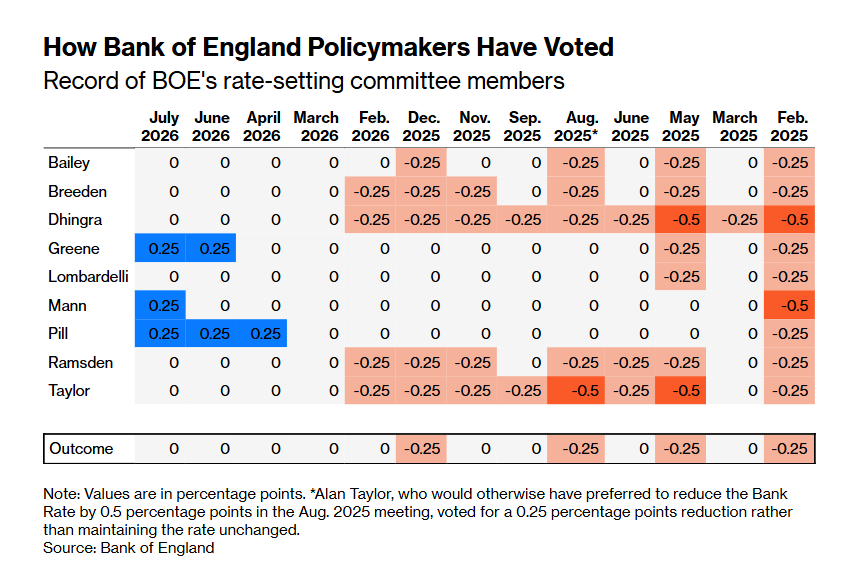
The picture above shows the Bank of England policymakers' previous votes — voting records of the members of the Bank of England's Interest Rate Setting Committee.
After the Bank of England's monetary policy decision and voting ratio were announced, the British pound rose and British treasury bonds rose, and traders now expect a cumulative 35 basis point increase in interest rates by December.
The pound rose to a one-week high against the US dollar; the two-year British Treasury yield, which is most sensitive to changes in monetary policy, fell 8 basis points to 4.37%. The yield on the benchmark 10-year UK Treasury fell 3 basis points to 5.01%.
The Bank of England and the US had three votes against interest rate hikes at the same time. The core message was not that the next meeting would inevitably raise interest rates, but that the policy response function had already changed from “waiting for inflation to fall” to “preventing the energy shock from solidifying.” The Federal Reserve maintained the federal funds rate at 3.50% to 3.75% at 9-3, and the Bank of England kept the bank interest rate at 3.75% at 6-3. Both groups of opponents demanded an immediate 25 basis point increase; the Bank of England's interest rate hike camp also expanded from 2 to 3 in June.
Pressure on the UK's domestic wage and labor market is easing, but repeated conflicts between the US and Iran, declining refining capacity, and low European gas inventories have led to a marked increase in energy price risks; the Bank of England's benchmark scenario expects inflation to rise to 3.2% by the end of the year, while the unfavorable scenario is likely to rise above 4% in 2027. As a result, both central banks are currently “hawkish suspensions”: interest rates are temporarily unchanged, yet they clearly place the next step of raising interest rates rather than cutting interest rates among the closer policy options.
Hold on to six to three! Three Bank of England policy councilors called for interest rate hikes
Bank of England policymakers continued to reserve policy choices, maintaining the Committee's “ready to act” guidelines to prevent continued high inflation, while struggling to cope with sharp fluctuations in energy prices in recent weeks. The environment is highly unpredictable, which means that just a few days before the Commission announced its decision, oil and gas prices were already significantly higher than the average forecast level used by the Bank of England in its benchmark forecast just 10 days ago.
However, the Bank of England's Policy Committee said that the signs that domestic inflationary pressure is easing are “very clear,” and “there is little evidence” so far that energy shocks have boosted wage demands and prices in other sectors. Most policymakers who support keeping interest rates unchanged also said that if the war ends soon, their policy positions may change; two members, including Vice Governor Dave Lumsden, said they would consider cutting interest rates in this case.
Bank of England Governor Andrew Bailey said, “There is currently little evidence of a second round of effects, but it is still too early to be relieved by this. Given that the global macroeconomic environment seems more uncertain, inflationary pressure is stronger, and the domestic environment is generally more moderate to inflation prospects, it is appropriate to keep the Bank of England's benchmark interest rate unchanged.”
The geopolitical conflict in the Middle East region has entered its sixth month, and there is little sign that intermittent negotiations will lead to lasting peace. Although the current level of inflation is generally in line with the Bank of England's expectations for this spring, price increases are expected to accelerate in the next few months due to the increase in household energy bills in July and another rise in automobile fuel costs.
The Bank of England has resumed its central inflation forecast, which it cancelled in April, while also announcing “moderate” and “unfavorable” scenarios to show the different paths that oil and gas costs may take.
The central bank's macro forecast released on Thursday — based on a 15-day energy price snapshot ending July 20, shows that the UK inflation rate will peak at 3.2% by the end of this year, higher than the current 2.6% inflation point level, and then fall back close to the Bank of England's 2% target next year.
In a more pessimistic forecast scenario, the price of crude oil will rise above $100 per barrel and remain high, and the price of natural gas will rise 60%; the Bank of England expects the inflation rate to rise to a high of 4.5% in the second quarter of 2027. If the Middle East conflict is resolved more quickly, more optimistic forecasts suggest that the price increase will peak at 3%, and there will be even fewer second-round effects.
Under all three scenarios, the UK GDP growth rate hovered around 1% in 2026 and 2027, then rebounded in 2028.
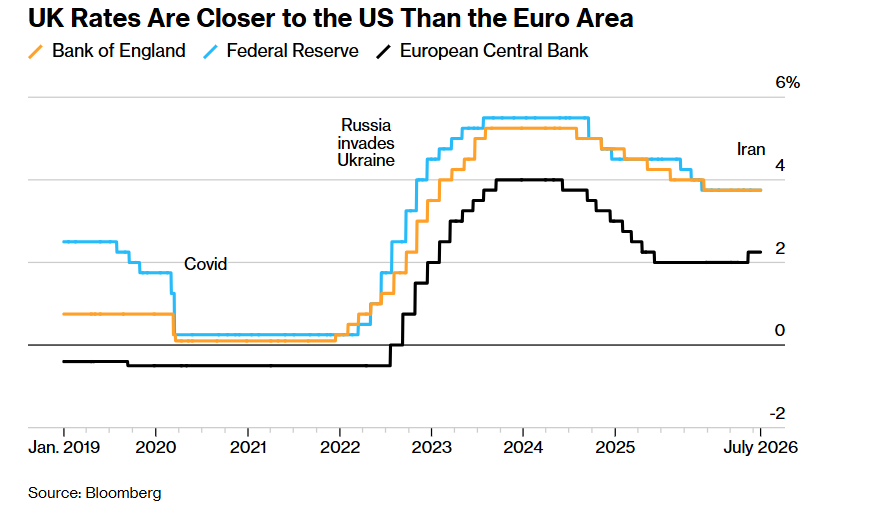
As shown in the chart above, the UK interest rate level is closer to the US Central Bank than to the Eurozone.
Weak economic growth, easing domestic price pressure, and a tightening financial environment have saved some time for the Bank of England's Monetary Policy Committee to assess the impact of the war on the British economy. Job vacancies and private sector wage growth are at their lowest levels since the COVID-19 pandemic. Job market conditions may help curb the energy shock from triggering a second round of effects, thereby increasing the possibility of inflation.
Although the Bank of England remains on hold until now, before the announcement of the decision on Thursday, traders in the interest rate futures market expected the probability of raising interest rates by 25 basis points at the September meeting to be slightly higher than 50%; at the time, the market expected the cumulative rate hike to be slightly less than 40 basis points by the end of the year.
Oil and gas prices have experienced a turbulent month, overshadowing the Bank of England's prospects, and these prices are critical to the UK's inflation outlook. The price of Brent crude oil rose from a low of slightly above $70 per barrel in early July to over $100 a barrel last week, then fell back to around $90 per barrel on Wednesday.
The Federal Reserve also decided to keep interest rates unchanged at 3.5% to 3.75% on Wednesday, but three policymakers voted to raise interest rates; Federal Reserve Chairman Kevin Walsh insisted that once there are signs that inflation will remain high for a longer period of time, the central bank will act. Despite this, long-term US Treasury bonds have fallen sharply due to market concerns that the Federal Reserve is acting too slowly to contain inflation, and inflation has been above its target for 5 consecutive years.
The Bank of England also revealed for the first time a clue about the future direction of quantitative austerity. In September, it will decide on plans for the next year. The Bank of England said that the impact of the balance sheet reduction was moderate, but its estimated increase in 10-year British Treasury yields was 20 to 30 basis points, 5 basis points higher than last year's estimate.
The Bank of England and the US “tacitly agree with three votes against”: it is not dovish; global interest rates have entered the war inflationary stress test
The Federal Reserve maintained the federal funds rate at 3.50% to 3.75% at 9-3, and the Bank of England kept the bank interest rate at 3.75% at 6-3. Both groups of opponents demanded an immediate 25 basis point increase in interest rates, highlighting that the monetary policy response function of central banks around the world has shifted from “waiting for inflation to fall” to “preventing energy shocks from solidifying.”
In contrast, the Bank of England's position is closer to two-way conditional options: if the energy shock continues and triggers a second round of effects on wages, inflation expectations, and corporate pricing, the policy will raise interest rates; if the war ends quickly, energy prices fall, and the domestic deflation process continues, some members have made it clear that interest rate cuts can resume.
The restrictions faced by the Federal Reserve are more biased towards creditworthiness risk: on the one hand, Walsh emphasizes “never wavering” on inflation and will not hesitate to act when necessary; on the other hand, he refused to give a clear interest rate path, and indicated that rising bond yields have tightened some financial conditions for the central bank. As a result, the market did not understand the suspension as safe patience, but rather worried that the Fed would act too late and eventually require a more drastic rate hike; the probability of interest rate hikes in September after the meeting was about 57%, and the cumulative rate hike before the end of the year was expected to be about 35 basis points. The 30-year US bond yield exceeded 5.20%, rising to near the highest level since 2007, creating a sharp bearish market in the US bond market where short-term US bond yields continue to decline and rise in the long run.
In terms of financial market investment strategies, the Bank of England and America's latest policy developments mean that the traditional “central bank suspends interest rate policy = full benefit from long-term assets” logic has temporarily failed. As long as oil prices fluctuate high and the risk of a second round of inflation does not disappear, long-term nominal treasury bonds, highly valued growth stocks, and highly leveraged companies still face the double pressure of rising actual discount rates and term premiums; in contrast, short-term treasury bonds, cash assets, value stocks with pricing power and stable cash flow, and inflation-hedging assets such as energy and inflation-protected bonds have a comparative advantage.