


The new coach's debut showed an increase in performance, and the stock price fell back down. Sanofi (SNY.US)'s “new drug shortage” became a fatal weakness
The Zhitong Finance App learned that French pharmaceutical giant Sanofi (SNY.US) released its first financial report since new CEO Belén Garijo (Belén Garijo) took office on Thursday. Although the company raised its full-year sales growth forecast due to the impressive performance of the blockbuster drug Dupixent, the market was disappointed by the contraction of R&D pipelines and the lack of strategic updates. The stock once fell more than 3% intraday in the Paris stock market.
According to financial reports, Sanofi performed strongly in the second quarter, achieving revenue of 11.6 billion euros, which is significantly higher than analysts' previous estimate of 10.85 billion euros; core operating profit reached 3.29 billion euros, which also far exceeded the market consensus of 2.96 billion euros. Adjusted earnings per share climbed to €2.09.
The core driver of the performance remains Dupixent, a super-blockbuster drug developed in collaboration with REGN.US (REGN.US). Sales of this drug, which is used to treat diseases such as asthma and atopic dermatitis, soared 38% at a fixed exchange rate in the second quarter to reach 5.15 billion euros, significantly exceeding market estimates of 4.48 billion euros. As a result, Sanofi raised Dupixent's annual sales forecast to €25 billion in 2030, compared to analysts' current estimate of €24.2 billion.
In view of strong demand from Dupixent, Sanofi raised its sales growth forecast for the full year of 2026 from the previous “high single digit” to an increase of about 10% under the fixed exchange rate, and it is expected that the growth rate of core operating profit will continue to be slightly higher than the revenue growth rate.
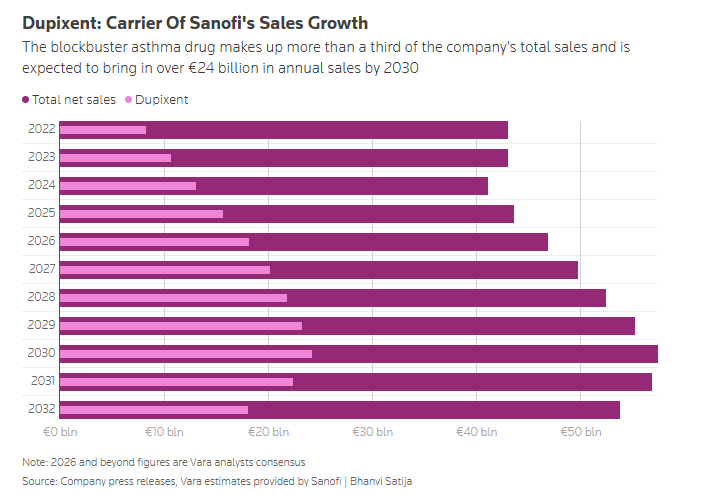
Despite Dupixent's bright light, the earnings report revealed the chill in other business segments. The newly launched product portfolio represented by Altuviiio for hemophilia and Sarclisa, a treatment for multiple myeloma, grew 48.3% during the quarter to 1.3 billion euros, but the vaccine business and the performance of Altuviiio itself fell short of market expectations, casting a shadow over this report card.
What made investors even more uneasy was the failure of the successor product. Just last week, Sanofi announced that it was abandoning plans to seek the marketing application for its new eczema drug amlitelimab, which was once seen as Dupixent's potential future successor. The company disclosed that it had accrued asset impairment losses of up to 952 million euros (about 1.09 billion US dollars) in the first half of the year.
Pipeline cleaning: terminated multiple projects and established a new R&D manager
In his first formal communication since taking up his job, Gariho did not shy away from the challenges faced by the R&D system. “Achieving our full potential will require greater scientific rigor,” she said bluntly. Under her leadership, Sanofi is carrying out a drastic overhaul of the R&D pipeline.
In addition to amlitelimab, the company confirmed on Thursday that it has also decided to discontinue development of two other drugs under development, namely itepekimab for lung diseases and balinatunfib for psoriasis. Throughout the second quarter, Sanofi cut out more than 8 R&D projects. R&D spending for the quarter increased 18% year-on-year to 2.23 billion euros, including costs associated with project termination of more than 200 million euros.
To reshape R&D productivity, Garrijo has appointed former Roche (RHHBY.US) executive Paulo “> 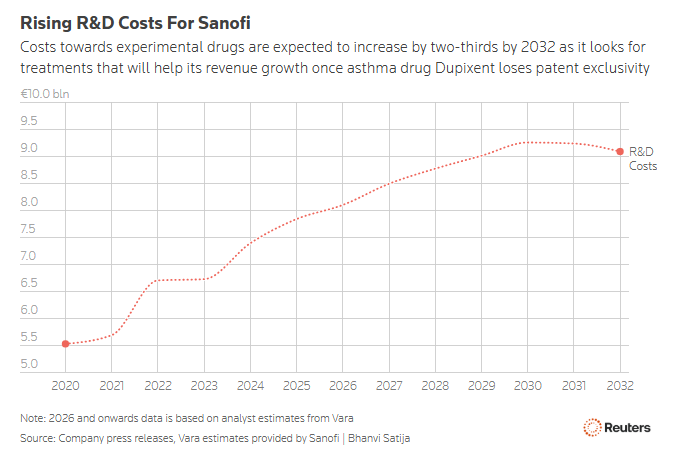
However, under the pressure of the weak patent cliff, mergers and acquisitions have become a key path to reinforce the pipeline. Dupixent's key patents are expected to expire in the early 1930s, when it will face the impact of cheap generic drugs. Former CEO Paul Hudson (Paul Hudson) left his job precisely because he failed to show an effective strategy to make up for this portion of lost revenue.
Garijo said the company is looking for opportunities to achieve growth through acquisitions. The key areas will still focus on immunization, rare diseases and vaccines, but it will remain “highly cautious” in executing the deal. Chief Financial Officer François-Xavier Roger (François-Xavier Roger), who is in charge of finance and also takes over business development functions, revealed that compared to focusing on targets of 2 billion to 5 billion euros in the past, the company's vision is “broadened”, but he emphasized that the scale of the transaction is not a core consideration; strategic significance at the scientific level is the key.
Faced with this mixed financial report, the market directly chose to sell off. Despite the increase in performance guidelines, Sanofi's stock price fell on Thursday. The cumulative decline this year was about 3%, clearly outperforming peers such as Novartis Pharmaceuticals (NVS.US), GlaxoSmithKline (GSK.US), Roche, and Gariho's former owner, Merck (MRK.US).
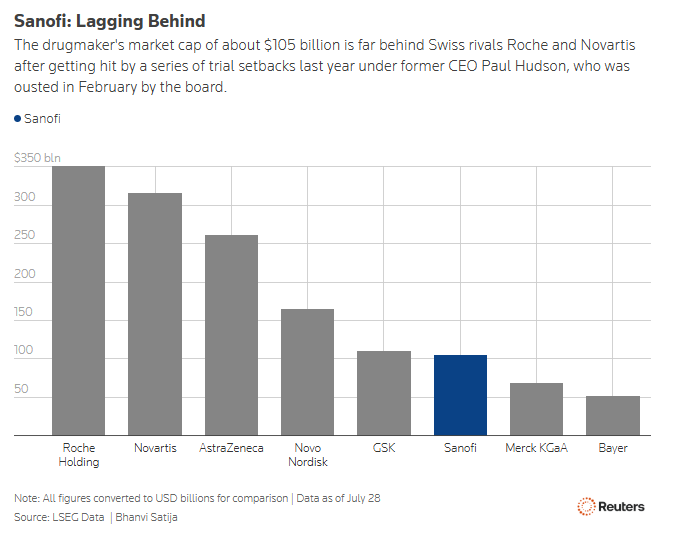
Barclays analysts pointed out in a report that some investors had expected the new CEO to bring more significant strategic updates, but due to the lack of “amazing moves” and cuts in R&D pipelines, this is enough to offset the boost in stock prices due to improved sales prospects.