


UnitedHealth Stock Has Rallied Big Since Berkshire Bailed. Did Warren Buffett and Greg Abel Blink Too Soon?
Key Points
Berkshire bought UnitedHealth stock a year ago and sold it at a loss in the first quarter.
The company is beginning to see a recovery in its profit margins, which is driving the stock higher.
Shares still look like a good value when evaluating UnitedHealth's long-term earnings growth.
Missed Nvidia in 2009? This Rare Signal Is Flashing Again. In 2009, a "Double Down" signal flashed for a little-known chipmaker called Nvidia. For the first time in years, that same "Total Conviction" signal is flashing for a company 1/100th the size of Nvidia. Continue »
Berkshire Hathaway is known for its astute investing acumen. The conglomerate built by Warren Buffett, now transitioning under Greg Abel, has made some fantastic investing decisions over the last few decades. Its purchase and then recent sell of UnitedHealth Group (NYSE: UNH) stock was not one of them.
While we do not know the exact price Berkshire paid for its investment, UnitedHealth Group averaged around $380 in the second quarter of 2025, when shares were bought, and less than $300 in Q1 of this year, when the trade was exited. Today, the stock has rebounded significantly amid improving profitability in the health insurance sector and the government's unexpected adjustment to Medicare Advantage funding, hitting $420 recently. Part of Buffett and Abel's whiff on UnitedHealth Group may simply have been bad timing ahead of this unexpected funding increase.
Is UnitedHealth Group stock a buy after rallying back to over $400 in the second quarter?
Insurance cost control
To understand why UnitedHealth stock is rallying, we need to first look at why it collapsed in 2025. In 2024 and 2025, health insurers in the United States experienced unexpected increases in medical costs, which drove up the all-important medical care ratio for UnitedHealth Group.
This ratio measures the percentage of insurance premiums spent on claims in a period. For a health insurance provider like UnitedHealth, the lower this figure, the better. In 2025, UnitedHealth's medical loss ratio was 88.9%, up from 85.5% in 2024, leading to a collapse in operating earnings from $32 billion to $19 billion.
Now, in 2026, UnitedHealth has shored up its insurance pricing through price increases and the exiting of unprofitable sectors. Its medical care ratio is beginning to recover, hitting 86.7% in the second quarter. For all of 2026, it is guiding to a medical care ratio of 88%, aiming to beat this figure. As this figure normalizes, UnitedHealth Group's profitability should start to recover.

Image source: Getty Images.
Inflation-driven revenue growth
Optimally balancing costs is the one key input for health insurers to ride the wave of healthcare cost inflation in the U.S. Spending on healthcare has grown faster than the country's overall economy for decades, driven by an aging population and a greater focus on health outcomes.
For insurers that want to put an umbrella over the entire sector and earn a small profit margin on total healthcare spending, this healthcare inflation is a secular tailwind for overall premium revenue. This is why UnitedHealth Group's revenue has increased by 150% over the last 10 years. As long as these healthcare spending trends continue, I would expect a similar rate of growth in the years ahead.
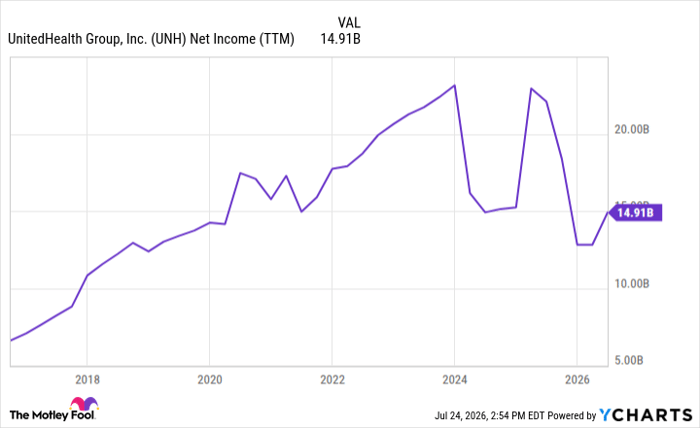
UNH Net Income (TTM) data by YCharts. TTM = trailing 12 months.
Is UnitedHealth stock a buy?
After rebounding in the last few months, UnitedHealth Group stock now trades at a market cap of $380 billion. This does not look overly cheap compared to its trailing net income of $14.9 billion, which gives it a trailing price-to-earnings (P/E) ratio of 25.5.
However, this understates UnitedHealth Group's future earnings power if it can keep riding the healthcare inflation tailwind (driving consistent revenue growth) and continue its recovery in the medical care ratio. At its peak, UnitedHealth Group generated net income well above $20 billion. At a higher revenue level, the company should be able to achieve a net income of $25 billion to $30 billion within the next few years.
Compared to the current market cap, the net income of $25 billion is a cheap-looking forward P/E ratio of 15. Plus, management is now repurchasing stock using excess cash flow, with guidance to return at least $5 billion to shareholders this fiscal year.
Implementing a reduction in shares outstanding alongside a profit recovery should lead to meaningful earnings-per-share (EPS) gains over the next five years, making UnitedHealth Group a cheap insurance stock for investors today.
Brett Schafer has no position in any of the stocks mentioned. The Motley Fool has positions in and recommends Berkshire Hathaway. The Motley Fool recommends UnitedHealth Group. The Motley Fool has a disclosure policy.