


Insurance Dividend Stocks for Fed Uncertainty and Lower Volatility
With the Federal Reserve reassessing how precisely it guides the market, interest rate expectations can swing more sharply, and that can ripple through bond portfolios, equity prices and household balance sheets. In this kind of stop start communication cycle, many investors look to low volatility dividend stocks that aim to combine steadier price moves with regular income. This article focuses on three stocks from a Low Volatility Dividend Stocks screener that appear closely exposed to these Fed communication trends, and explains how this backdrop may matter for your long term portfolio decisions.
Old Republic International (ORI)
Overview: Old Republic International is an insurance group that focuses on specialty commercial insurance for industries like transportation, construction and healthcare, alongside a large title insurance business that supports real estate and mortgage transactions in the US and Canada. Through these two segments it sells policies, warranties and related services that help businesses and property owners manage a wide range of financial and legal risks.
Operations: Old Republic International generates most of its revenue from Specialty Insurance at about US$6.1b, with around US$3.1b from Title Insurance and smaller contributions from Corporate and Other activities and unallocated investment gains and losses.
Market Cap: US$10.1b
Old Republic International stands out in a market where Fed communication can jolt bond prices and income portfolios because it combines a value style price, high quality earnings and a long record of paying dividends, even if that dividend history is not perfectly smooth. The stock trades well below one internal estimate of fair value. Recent results show higher net profit margins and growing book value per share, supported by rising investment income and ongoing buybacks. At the same time, you need to weigh the forecast decline in earnings, slower revenue growth and higher funding risk, as well as recent reserve strengthening in parts of Specialty Insurance. For investors hunting for steadier income stocks that may benefit if volatility flares around Fed signals, this mix of strengths and trade offs deserves a closer look.
Old Republic International’s mix of value-style pricing, steady dividends and rising book value may be masking the real trade off between its earnings outlook and reserve risks. Get the fuller story in the 1 key reward and 2 important warning signs (1 is major!)
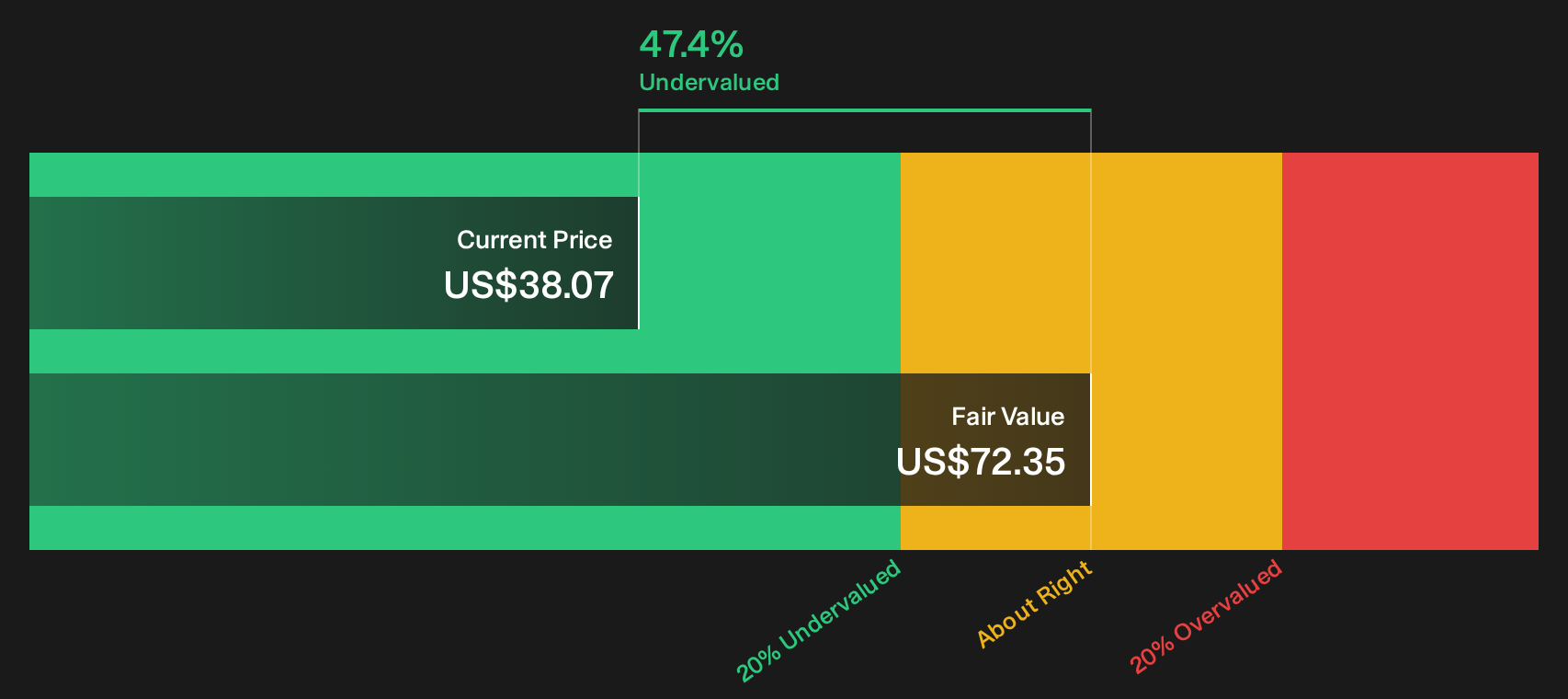
Cincinnati Financial (CINF)
Overview: Cincinnati Financial is a US based insurer that offers a wide range of property, casualty and life policies for both businesses and households, alongside an investment portfolio that supports its insurance operations and long running dividend record.
Operations: Cincinnati Financial generates most of its roughly US$12.9b in revenue from Commercial Lines Insurance at US$4.9b and Personal Lines Insurance at US$3.4b, with the remainder coming from Excess and Surplus Lines, Life Insurance, Investments and Other activities.
Market Cap: US$28.3b
Cincinnati Financial can appeal if you are looking for a low volatility dividend stock that may hold up when Fed communication causes sudden swings in bond markets and rate expectations. The company combines a relatively low P/E compared with both the US market and insurance peers with high recent net margins and a long running dividend record. Analysts currently see only modest upside from current prices. At the same time, forecasts point to a sharp earnings decline and pressure on return on equity, alongside higher risk funding and rising catastrophe and competitive pressures. How those pieces fit together, especially with analysts debating fair value, is where the real insight lies for long term investors weighing quality against future earnings risk.
Cincinnati Financial’s mix of a relatively low P/E and high recent net margins suggests the market may be missing something in the story. See how the 3 key rewards and 1 important major warning sign could change when the next inflection occurs.

W. R. Berkley (WRB)
Overview: W. R. Berkley is an insurance holding company that focuses on commercial insurance and reinsurance, offering tailored coverage for businesses across areas such as liability, property, cyber risk, professional lines and specialty personal lines worldwide.
Operations: W. R. Berkley generates most of its revenue from Insurance at about US$12.3b, with around US$1.8b from Reinsurance & Monoline Excess and smaller contributions from segment adjustments and corporate and eliminations.
Market Cap: US$29.3b
W. R. Berkley is attracting attention as a low volatility dividend stock because it blends a specialty insurance focus, high quality earnings and active capital returns at a time when Fed communication is keeping rate and bond volatility in the spotlight. Recent quarters show higher operating income, record investment income and solid premium growth, which complement a long history of disciplined underwriting and a strong, experienced board. At the same time, forecasts point to flat to slightly declining earnings and revenue, an unstable dividend profile and higher risk funding, while the stock trades on a richer P/E than many peers. To understand how these cross currents, plus fresh management changes and ongoing buybacks, really shape the risk reward equation for W. R. Berkley, you need to look under the surface of the headline metrics.
W. R. Berkley’s mix of specialty focus, premium growth and record investment income could be masking a more interesting earnings path. See how the analyst forecasts for W. R. Berkley reframes the risk reward story before the next shift hits.

The three low volatility dividend stocks in this article are just a starting point, since the full Low-Volatility Dividend Stocks screener has identified 29 more companies with equally compelling income and risk stories through the Low-Volatility Dividend Stocks screener. Use Simply Wall St to identify, analyze and filter for the specific catalysts, balance sheet strength and dividend narratives that matter most so you can focus on your highest conviction ideas.
Take Control of Your Investment Journey
If Cincinnati Financial or any of these companies sound like a great opportunity, register for FREE with Simply Wall St and add your companies to a Watchlist to monitor the share price against the fair value the ideal entry point. Once you've made your move, manage your holdings with our Portfolio Command Center that filters out the noise to deliver only the most critical, actionable updates. Throughout your journey, our Community allows you to filter the best ideas from thousands of investor perspectives. By uncovering hidden catalysts and risks early, you'll accelerate your decision-making and stay one step ahead of the market.
Seeking Alternatives Beyond Dividend Calm?
Fresh ideas move fast. The best entry points often appear just as momentum builds, before the crowd catches on and prices start flying. Scan these under the radar themes and get in early.
- Spot potential breakouts in companies with strong cash generation and robust balance sheets by running the 51 high quality undervalued stocks while the market is still caught looking elsewhere.
- Ride accelerating demand for AI infrastructure by reviewing the curated 56 AI infrastructure stocks before capital flows crowd into the same narrow group of stocks.
- Lock onto resilient income ideas by scanning the hand picked 8 dividend fortresses before yields start dropping as investors chase the same dependable payouts.
This article by Simply Wall St is general in nature. We provide commentary based on historical data and analyst forecasts only using an unbiased methodology and our articles are not intended to be financial advice. It does not constitute a recommendation to buy or sell any stock, and does not take account of your objectives, or your financial situation. We aim to bring you long-term focused analysis driven by fundamental data. Note that our analysis may not factor in the latest price-sensitive company announcements or qualitative material. Simply Wall St has no position in any stocks mentioned.
Have feedback on this article? Concerned about the content? Get in touch with us directly. Alternatively, email editorial-team@simplywallst.com